
When I received my first recording offer ten years ago, I thought a six-figure advance meant instant wealth. It took an entertainment attorney five minutes to show me I was essentially taking out a high-interest mortgage on my own creative voice. Weighing a major record deal vs independent music contract pros and cons comes down to one fundamental trade-off: trading equity and creative control for institutional leverage, or keeping your masters and building long-term enterprise value.
Both paths build viable careers. However, signing the wrong agreement without understanding how royalties, master ownership, and marketing budgets function will derail your momentum for years.
The Core Trade-Off: Global Clout vs. Master Ownership
The three major record conglomerates—Universal Music Group, Sony Music Entertainment, and Warner Music Group—control roughly 70% of the global recorded music market. They operate massive marketing machines capable of commanding commercial radio, securing billboard campaigns, and pitching worldwide DSP (Digital Service Provider) playlists.
Independent music companies, ranging from boutique imprints to powerhouse operations like Beggars Group or EMPIRE, operate on artist-first revenue splits. Knowing how do independent record labels sign artists reveals their emphasis on data, organic audience engagement, and sustainable catalog growth over mass-market churn.
Side-by-Side Comparison
| Contract Feature | Major Record Deal | Independent Contract | DIY / Distribution Deal |
| Typical Advance | $100,000 to $2,000,000+ | $5,000 to $100,000 | $0 (Self-funded) |
| Royalty Share | 14% to 20% (Standard) | 50% profit-share (Common) | 85% to 100% net receipts |
| Master Ownership | Label owns in perpetuity | Artist retains (or 5–10 yr license) | Artist owns 100% |
| Scope of Contract | 360 Deal (Touring, Merch, Sync) | Recording rights only (Standard) | Digital pipeline only |
| Release Control | Label decides release dates & singles | Mutual agreement with artist | Full artist discretion |
| Recoupment Scope | Video, marketing, tour support, advance | Direct manufacturing & release costs | Distribution fees only |
Inside the Major Label Machine
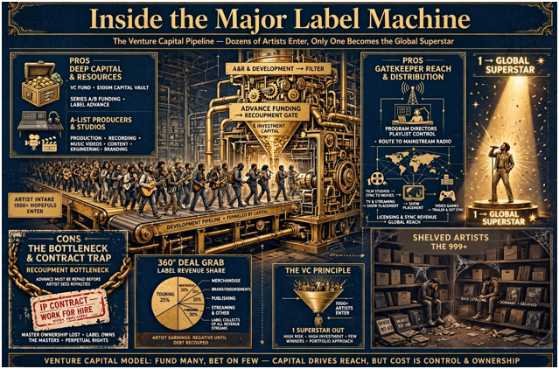
Major record labels run on venture capital principles. They sign dozens of acts knowing that one global smash funds the losses of twenty failed releases.
Major Record Deal Pros
- Access to Deep Capital: A major label provides liquidity. You receive upfront funds to hire A-list producers, book world-class mixing engineers, and execute cinematic video productions that indie budgets cannot touch.
- Commercial Gatekeeper Influence: Independent publicists work hard, but major radio promotion departments maintain decades-long relationships with commercial PDs (program directors), corporate brand executives, and festival talent buyers.
- Global Sync Teams: Major publishers and sync divisions place tracks directly with film studios, television networks, and video game franchises at volumes independent teams struggle to match.
Major Record Deal Cons
- The Recoupment Bottleneck: Advances are non-reciprocal corporate loans. The label withholds 100% of your 15% royalty share until every dollar spent on recording, music videos, independent radio promotion, and personal advances gets recovered.
- Loss of Intellectual Property: In almost every standard major contract, you deliver your tracks as “works made for hire.” The label owns the copyright to the master recordings permanently. Under the U.S. Copyright Office regulations, statutory termination rights under Section 203 do not effortlessly reclaim “work for hire” recordings.
- 360-Degree Ancillary Grabs: Modern majors rarely sign pure recording contracts. Their “multiple rights” clauses capture 10% to 30% of your gross earnings across touring, live appearances, merchandise, VIP ticketing, and third-party sponsorships.
- Shelving Risks: If an A&R executive departs or your debut single underperforms, corporate leadership can freeze your project. Because you are bound by an exclusivity clause, you cannot legally self-release that music elsewhere.
The Independent Music Contract Reality
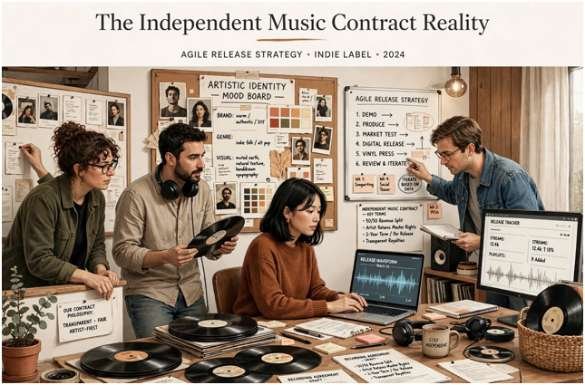
Independent labels operate with leaner teams and agile release strategies. Many curate distinct artistic identities, making them regular targets for artists seeking out independent music labels accepting demo submissions.
Independent Deal Pros
- Retaining Master Equity: Most independent agreements rely on fixed-term licensing contracts lasting five to ten years. Once the term ends or the costs clear, full exploitation rights revert to you.
- Favorable Splits: Indie labels typically split net profits 50/50 after hard manufacturing and promotional expenses. If you distribute via companies like DistroKid, TuneCore, or Symphonic, you retain up to 100% of net royalties.
- Direct Digital Royalties: Artists with master ownership collect both the featured artist and master owner shares directly through organizations like SoundExchange, keeping third-party administrative cuts to a minimum.
- Creative Sovereignty: Indie partners offer creative counsel without dictating your creative output. You maintain ultimate approval over mix versions, artwork, tracklists, and collaborators.
Independent Deal Cons
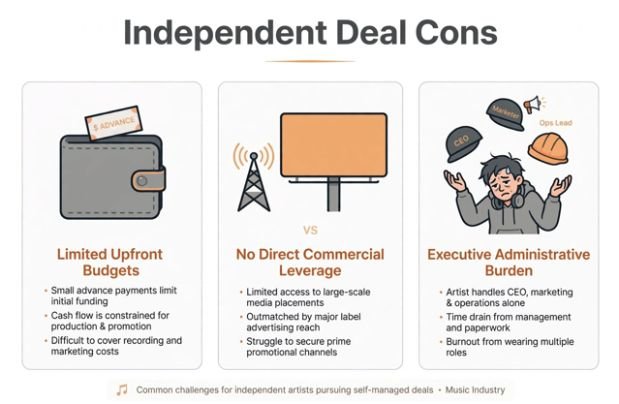
- Limited Upfront Budgets: Indie labels rarely issue massive advances. You fund your living expenses and often supply creative capital out of your own pocket.
- No Direct Commercial Leverage: Cracking Top 40 terrestrial radio or landing widespread billboard placement without major label infrastructure remains an uphill, expensive battle.
- Executive Administrative Burden: Operating as an independent artist means acting as the CEO, marketer, and operational lead of your own record company, increasing potential for creative fatigue.
The Real Recoupment Math: Major Advance vs. Indie Streaming
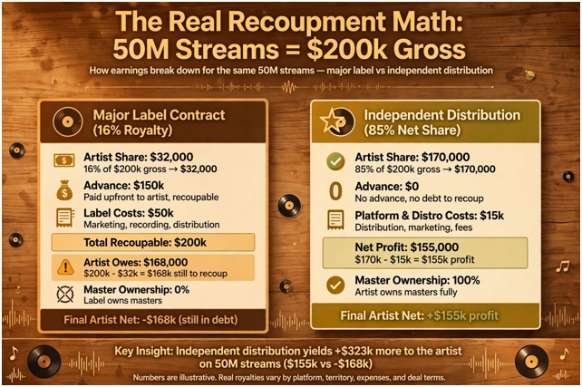
Most artists view an advance as earnings. In truth, your royalty rate determines how quickly you earn a single dollar beyond that check. Industry data documented by the Future of Music Coalition demonstrates that catalog ownership creates far more reliable lifetime revenue than large initial payouts.
Consider a project that generates 50,000,000 streams on Spotify and Apple Music, generating roughly $200,000 in gross master royalties (assuming an average payout of $0.004 per stream):
| Metric | Major Label Contract (16% Royalty) | Independent Distribution (85% Net Share) |
| Gross Master Revenue | $200,000 | $200,000 |
| Artist Royalty Share | 16% ($32,000) | 85% ($170,000) |
| Initial Cash Advance | $150,000 | $0 |
| Direct Recoupable Costs | $50,000 (Videos/Marketing) | $15,000 (Self-funded PR/Ads) |
| Total Recoupable Balance | $200,000 | $15,000 |
| Artist Pipeline Royalties Paid | $0 (Still owes $168,000 to recoup) | $155,000 (Net profit earned) |
| Master Rights Retained? | No (Owned by Label) | Yes (100% Artist) |
Under the major deal, the label collected $168,000 in gross profit from your music while your account remains deep in the red. Under the indie model, you pocketed $155,000 and retain ownership of the master recording forever.
How to Protect Your Catalog Before Signing
If you decide to sign a contract, negotiate these four baseline safeguards into the deal:
- Master Reversion Period: Require that ownership of your sound recordings reverts back to you within 7 to 10 years following initial commercial release.
- Release Commitment Clause: Mandate that if the label fails to commercially release your delivered project within 120 days, you can terminate the deal and buy back the masters at cost.
- Net Profit 360 Limits: Never surrender a cut of gross touring or merch income. Cap ancillary cuts strictly to net earnings from opportunities the company directly procures.
- Independent Accounting and Auditing: Secure audit rights with provisions requiring the company to pay audit fees if an examination discovers a royalty discrepancy greater than 5%.
Slay the Hype: Own Your Masters or Rent the Machine
Major record labels run high-stakes venture capital bets on pop culture, while independent agreements give you the keys to building a lasting, profitable small business. If your dream requires private jets, stadium tours, and global
Top 40 saturation, partnering with a major might be the right engine. If you want to own your work, secure high-margin streaming royalties, and protect your creative freedom, build your leverage independently first.
Never sign a contract under pressure. Retain a qualified entertainment attorney, analyze your recoupment math, and choose the business framework that serves your long-term independence.
Frequently Asked Questions
1. Do independent artists make more money than signed artists?
Per stream and sale, independent artists earn significantly higher margins because they retain 50% to 100% of royalties rather than a major label’s 15% to 20% cut.
2. What is a 360 deal in music?
A 360 deal allows a record label to collect percentages from non-record revenue streams, including touring, merchandise sales, publishing, and brand sponsorships.
3. Can a major record label drop you if you do not recoup?
Yes, labels exercise unilateral options between album cycles and regularly drop artists with unrecouped debt without forgiving the master rights.
4. How do I legally get my masters back from a label?
You can secure masters through a negotiated contract reversion clause, a direct catalog buyout, or statutory copyright termination under Section 203.
Leave a Reply