I raised $38,400 to record, press, and tour my third independent record. That success did not happen because I had a massive TikTok following. It worked because I treated the album launch like an equity-free venture fund.
Mastering real crowdfunding strategies for independent album production separates musicians who bring their master recordings to life from those who get left with half-finished demos.
If you step into a campaign expecting fans to stumble upon your page organically, your project will fail. You need calculated financial margins, targeted outreach, and an airtight pre-launch runway.
The Financial Blueprint: Budgeting Beyond the Studio
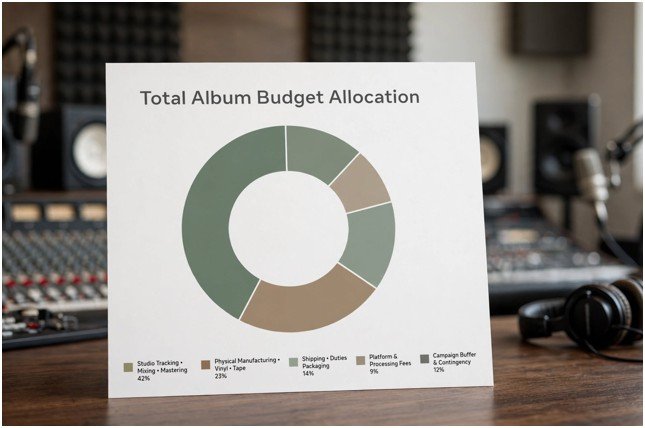
Most musicians budget solely for tracking, mixing, and mastering. They forget the administrative reality of delivering physical media. When I set up my financial breakdown, studio time consumed less than half the total capital requirement.
Total Album Budget Allocation
├── Studio Tracking, Mixing & Mastering : 42%
├── Physical Manufacturing (Vinyl, Tape) : 23%
├── Shipping, Duties & Packaging : 14%
├── Platform & Processing Fees (8-10%) : 9%
└── Campaign Buffer & Contingency : 12%
Account for Hidden Physical Fulfillment Leakage
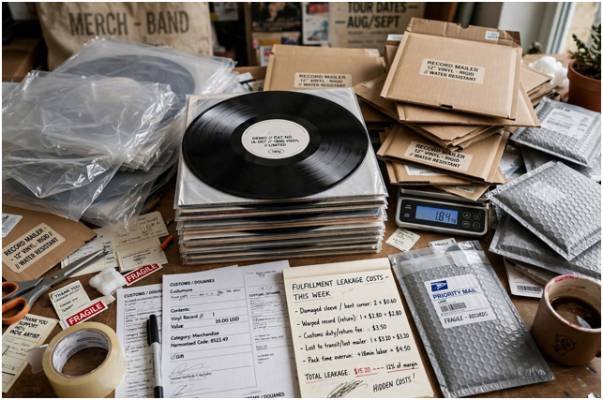
Vinyl production remains a centerpiece for music backers. According to data tracked by the Recording Industry Association of America (RIAA), physical media revenue continues to be driven by passionate collectors willing to pay premium prices.
However, pressing plants demand minimum order runs, test-pressing fees, and freight charges that catch independent creators off guard. Factor in 180-gram record mailers, poly sleeves, bubble mailers, and international customs declarations. Packaging materials alone can erode 15% of your net reward revenue if you do not calculate shipping charges by weight tier before launching.
Layering Alternative Capital and Grants
Do not force a single campaign to shoulder every production expense. Before asking your audience for backing, research competitive music grant opportunities for independent artists to cover early pre-production expenses. Grants offset baseline engineering fees, which lowers your public crowdfunding threshold. A lower public target lets your campaign hit 100% funding faster, triggering organic algorithm boosts across discovery feeds.
The Pre-Launch Playbook: The 35 Percent Secret
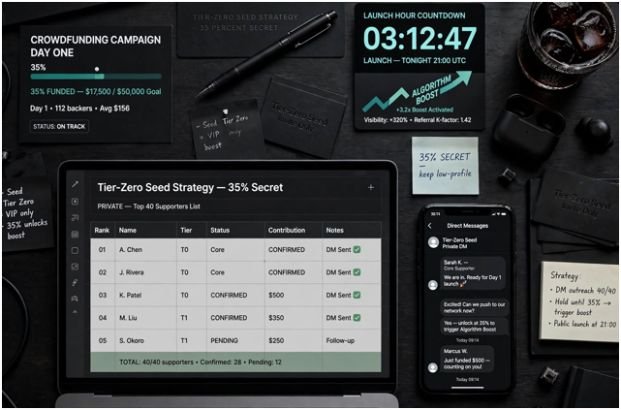
The first 48 hours determine campaign survival. Platforms favor momentum. When an algorithm detects rapid early pledges, it surfaces the project on curated discovery feeds and newsletter digests.
The Tier-Zero Seed Strategy
Never launch a public campaign sitting at zero dollars. I employ what I call the Tier-Zero Seed approach:
- Build a private spreadsheet of your top 40 supporters, family, and recurring listeners four weeks out.
- Personally call, message, or meet each contact individually.
- Secure committed pledge amounts in writing before the public page goes live.
- Send direct private links during your launch hour so those pledges register instantly.
Securing 30% to 35% of your funding goal on day one sends an undeniable signal of legitimacy to casual backers who visit later. For broader baseline parameters, review the Kickstarter Creator Handbook to align your timeline with established creator best practices.
Choosing the Right Campaign Engine
Pick your platform based on backer behavior rather than superficial feature lists:
| Platform | Model | Best For | Risk Profile |
| Kickstarter | All-or-Nothing | Defined album production runs with fixed release deadlines | Zero financial downside if underfunded; high motivation factor |
| Indiegogo | Flexible Funding | Projects with modular scope where partial funding still works | Must fulfill perks even if you hit only 40% of the financial target |
| Bandcamp Campaigns | Direct-to-Press | Vinyl runs aimed exclusively at existing core band listeners | Low fulfillment overhead; relies entirely on existing platform fans |
If your production depends on an expensive session orchestra or specialist mixing engineer, choose all-or-nothing. Delivering an album with incomplete funding leaves artists heavily out of pocket.
Reward Tier Design That Actually Converts
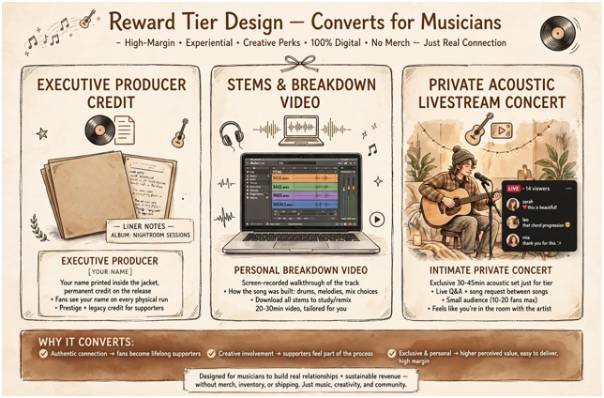
T-shirts and stickers carry miserable profit margins. After factoring in manufacturing and postage, an independent creator often clears under $6 on a $30 swag tier. Instead, build tiers that balance tangible goods with high-margin creative experiences.
Experiential Value Over Low-Margin Merchandise
Backers fund your record because they value your creative voice. Independent distribution analysis from Bandcamp Daily shows that dedicated fans routinely invest in exclusive, process-driven artifacts over standardized generic apparel:
- Executive Producer Credit ($300–$500): Include their name directly on the vinyl jacket liner notes and digital credits. Margins: 100%.
- Stems & Stems Breakdown Video ($40–$60): Share the raw session multi-tracks alongside a 20-minute screen walkthrough breaking down your arrangement. Margins: 100%.
- Private Acoustic Listening Stream ($75): Host an unlisted livestream concert playing the unreleased album front-to-back with live stories behind each song. Margins: 98%.
Protecting Your Master and Release Rights
Never pledge copyright ownership or publishing participation as a backer perk. Always review what rights do independent artists own under distribution deals before negotiating exclusive pre-release licenses with backers or outside sponsors.
Register your compositions early, and ensure every co-writer and producer signs split sheets before launching your campaign. Collect neighboring rights royalties worldwide through organizations like Sound Exchange so your mechanical and master income remains intact when physical and digital backers stream your project post-campaign.
Executing the 30-Day Campaign Window
Run your campaign for no more than 30 days. Longer windows do not yield more capital; they dilute urgency. Expect your backing velocity to resemble a distinct bathtub curve:
Pledges
│ \ / Final 48-Hour Surge
│ \ /
│ \_______________________________/
│ The Mid-Campaign Lull
└────────────────────────────────────── Time (30 Days)
During the mid-campaign lull (days 10 through 22), stop repeating the exact same “pledge now” link across social media. Pivot entirely to storytelling:
- Reveal isolated vocal tracks or guitar solo outtakes.
- Share the raw conceptual art sketches that did not make the front cover.
- Introduce an achievable Stretch Goal, such as pressing on colored heavyweight wax or adding a bonus b-side track, once you reach 100%.
FAQs About Album Crowdfunding
1. What is the ideal funding goal for an independent album production?
Calculate your exact studio and manufacturing costs, add 20% for taxes and shipping, and treat that final figure as your minimum viable baseline.
2. How long should an album crowdfunding campaign run?
Keep your campaign between 28 and 30 days to maximize early urgency and capitalize on final-hours alerts.
3. Should I use flexible or fixed funding for my album?
Choose fixed, all-or-nothing funding if your album requires a non-negotiable minimum capital injection to finish tracking, mixing, and pressing.
4. When should I ship physical backer rewards after the campaign ends?
Promise fulfillment dates 6 to 8 months after funding concludes to allow realistic buffer time for pressing plant delays.
Pack Up the Gear: Your Next Move
Stop treating album crowdfunding like a digital tip jar. It is an organized creative pre-order engine that validates your music before you spend thousands of dollars in the studio. Sit down today, audit your actual production numbers, and build your Tier-Zero list of 40 early believers. The funding follows the framework.
Leave a Reply