
I spent my first three years as a DIY creator believing my distributor gathered every cent my catalog earned. When I audited my catalog statements against my raw stream counts, I realized I had left nearly 20% of my total earnings sitting in collection society escrow accounts.
Understanding the independent artist revenue split streaming platforms pay out requires looking past aggregate stream counts. A single stream does not pay a flat statutory fee to a single party. Instead, every platform uses a multi-tiered revenue pool split across distinct legal copyrights.
How the Streaming Revenue Pool Actually Works
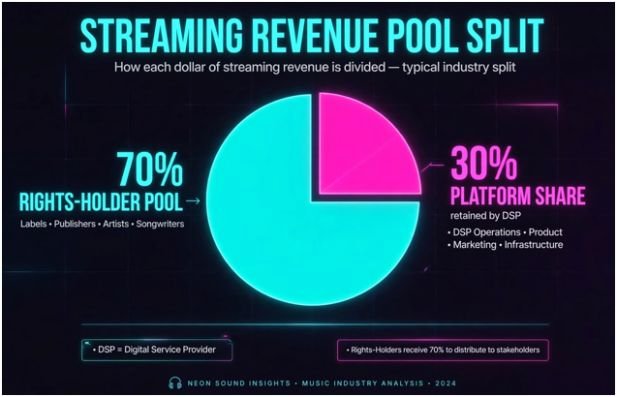
Digital streaming platforms (DSPs) such as Spotify, Apple Music, and TIDAL operate on a pro-rata revenue-share system rather than paying artists a fixed per-stream rate.
The Platform Cut vs. The Rights-Holder Pool
Every subscription dollar and ad impression enters a localized pool. DSPs deduct their cut first before disbursing the remainder to copyright owners.
| Allocation Segment | Approximate Share | Recipient Entity |
| Platform Share | ~30% | Retained by DSP for operational costs, bandwidth, and margin |
| Rights-Holder Pool | ~70% | Disbursed to distributors, labels, publishers, and songwriters |
The 70% pool distributes according to market share: if an artist accounts for 0.01% of all eligible streams in a territory during a billing period, that catalog receives 0.01% of the available pool.
The Split Breakdown: Master Rights vs. Publishing Rights
When someone streams your track, you trigger two separate intellectual property assets governed by copyright law. The U.S. Copyright Office legally differentiates between the recorded audio and the underlying composition. If you write and record your own songs, you own both sides.
| Royalty Stream | Percentage of Pool | Collection Channel | Required Registration |
| Master Royalties | ~80–85% | DSP $\rightarrow$ Digital Distributor | TuneCore, DistroKid, CD Baby |
| Mechanical Royalties | ~8–10% | DSP $\rightarrow$ Mechanical Licensing Body | The Mechanical Licensing Collective |
| Performance Royalties | ~6–8% | DSP $\rightarrow$ Performing Rights Org (PRO) | ASCAP, BMI, SESAC, PRS |
| Non-Interactive Master | Statutory (Varies) | DSP $\rightarrow$ Statutory Collective | SoundExchange |
Master Recording Royalties
The sound recording (the master) claims roughly 80% to 85% of the rights-holder pool. This payout flows directly to your distributor. If you utilize modern independent music distribution, you keep 85% to 100% of this chunk depending on whether you pay a flat annual subscription or a backend commission.
Composition and Publishing Royalties
The remaining 15% to 20% belongs to the composition: the melodies, lyrics, and song arrangements. This bucket divides into two distinct parts:
- Mechanical Royalties: Generated when music is reproduced digitally via on-demand streaming.
- Performance Royalties: Generated when music is publicly performed, broadcast, or transmitted digitally.
Distributors rarely collect publishing mechanicals or performance fees by default. Uncollected mechanicals land in the “black box” where unclaimed funds eventually get re-allocated to major publishers based on market share.
DSP Payout Estimates Across Major Platforms
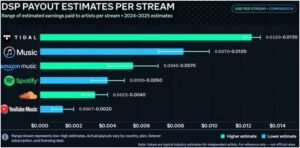
Payouts fluctuate monthly based on subscriber location, subscription tiers, and local ad markets. Free ad-supported streams pay fractions of what premium family or individual accounts yield.
| Platform | Estimated Effective Payout / Stream | Primary Revenue Model | Key Terms & Requirements |
| TIDAL | $0.012 – $0.013 | Premium subscription only | Artist-first model; highest consistent pool rate |
| Apple Music | $0.007 – $0.010 | Premium subscription only | No ad tier; consistent international rates |
| Amazon Music | $0.004 – $0.007 | Hybrid (Prime vs Unlimited) | Higher payouts tied strictly to Unlimited plans |
| Spotify | $0.003 – $0.005 | Freemium / Ad-supported | 1,000 streams minimum annually to generate royalties |
| SoundCloud | $0.0025 – $0.004 | Fan-Powered Royalties | Allocates subscription fees based on user listening habits |
| YouTube Music | $0.0007 – $0.002 | Ad-heavy / Video hybrid | Content ID monetization heavily affects payouts |
The Leaky Bucket: Where Unclaimed Royalties Vanish
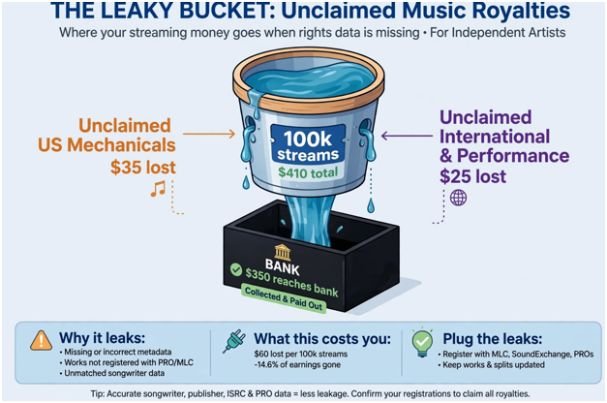
Here is a live audit of an independent release generating 100,000 streams in the United States on Spotify, assuming a standard average master rate of $0.0035:
- Gross Stream Payout Generated: ~$410
- Master Distribution Cut (to your bank via distributor): ~$350
- Unclaimed US Mechanicals (uncollected at The MLC): ~$35
- Unclaimed International & Performance Royalties: ~$25
- Total Value Abandoned: ~$60 per 100k streams
Scale those numbers to 1,000,000 streams, and an unmonitored catalog surrenders $600 or more in uncollected publishing revenue.
The Pipeline Fix: How I Set Up Complete Royalty Collection
Securing your total earnings requires a coordinated release process. Before distributing your next track, complete this administrative checklist:
- Upload via Digital Distribution: Use your distributor to push audio to DSPs and assign your ISRC codes.
- Register with a PRO: Submit titles and splits to ASCAP or BMI to capture writer and publisher performance income.
- Register Works with The MLC: Add track titles, ISWCs, and corresponding audio ISRCs inside the member portal to receive direct mechanical distributions.
- Claim Tracks on SoundExchange: Register as both the Featured Artist and the Sound Recording Copyright Owner (SRCO) to capture digital radio performances from Pandora and SiriusXM.
- Enlist a Publishing Administrator: Use an admin publisher if you want automated collection of mechanical royalties outside the US without managing local societies yourself.
Keep this workflow handy inside your self releasing an album checklist before every release date.
Stop Donating Your Residuals
Streaming margins remain lean, but abandoning your rights makes them thinner. Stop treating your digital distributor as a one-stop business manager. Claim your publishing registrations, match your ISRC codes, and collect every cent the algorithms generate.
Frequently Asked Questions
1. Does DistroKid or TuneCore collect my ASCAP and BMI royalties?
No, digital distributors only collect master recording royalties, leaving performance collections to your PRO.
2. What is the 1,000 stream threshold rule?
Spotify requires tracks to hit at least 1,000 streams within 12 months before disbursing recorded royalties.
3. How often do digital streaming services distribute payouts?
DSPs process royalties on a 60- to 90-day delay, sending reports monthly to distributors and quarterly to PROs.
4. What is the difference between an ISRC and an ISWC code?
An ISRC identifies the recorded audio file, while an ISWC identifies the underlying musical composition.
Leave a Reply