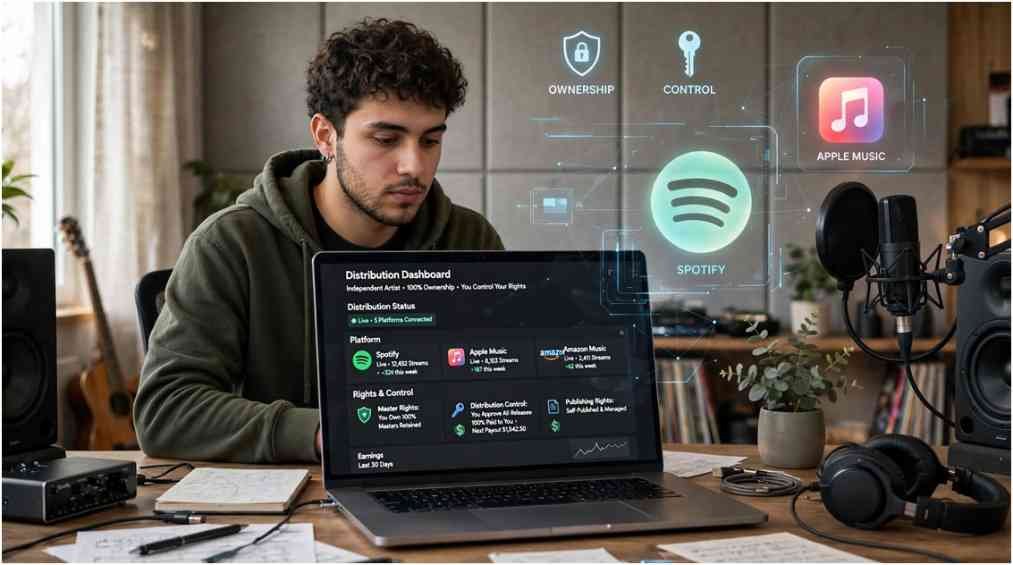
I learned the difference between owning music and controlling it the hard way. Early in my music career, I delivered a single through an aggregator, assuming “100% ownership” protected me everywhere. Two weeks later, my own YouTube channel received an automated copyright strike on my background instrumental.
Understanding what rights do independent artists own under distribution deals separates artists who build long-term catalogs from those who run into unexpected legal blocks. Under standard distribution agreements, you retain 100% ownership of your intellectual property. However, distributors require an exclusive limited license to exploit your tracks on streaming stores.
The Core Legal Separation: Masters vs. Compositions
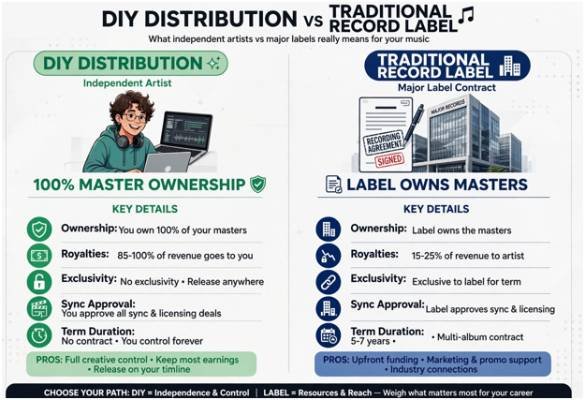
Every recorded track consists of two separate copyrights recognized by law. When you sign a distribution deal, the platform only operates on the sound recording, not the musical composition.
If you plan to scale your catalog or start an independent record label, you must know which copyrights you retain, which rights you license out, and where the boundaries sit.
┌─────────────────────────────────┐
│ Recorded Song Asset │
└────────────────┬────────────────┘
│
┌───────────────────────┴───────────────────────┐
▼ ▼
┌─────────────────────────┐ ┌─────────────────────────┐
│ Master Copyright │ │ Composition Copyright │
│ (Sound Recording ℗) │ │ (Musical Work/Lyrics ©)│
└────────────┬────────────┘ └────────────┬────────────┘
│ │
Monetized by: Digital Aggregators Monetized by: PROs, The MLC, Pub Admins
Revenue: Streaming, digital sales Revenue: Performance, mechanicals
Sound Recording Rights (The Master Copyright)
Under federal copyright law, as detailed by the U.S. Copyright Office, sound recordings (marked by the $\mathbb{P}$ symbol) embody the fixed audio performance.
When you release through DIY distributors, you remain the sole copyright owner of these audio recordings. You hold the exclusive right to duplicate, sell, and license that specific recording. The distributor receives a non-exclusive or release-exclusive right to distribute that audio file to digital service providers (DSPs) like Spotify and Apple Music.
Underlying Composition Rights (The Publishing Share)
The composition copyright (marked by the $\mathbb{C}$ symbol) protects the underlying melody, harmony, and lyrics. Standard distributors have zero claim to your songwriting.
Distributors do not register your songs with global mechanical collection societies or pitch your catalog for sync opportunities. To collect your mechanical royalties from streaming in the United States, you must register through The Mechanical Licensing Collective (The MLC).
International mechanicals and public performance royalties require separate registration with your domestic Performing Rights Organization (ASCAP, BMI, SESAC) or a dedicated publishing administrator.
Operational Rights You Keep (And What You License Away)
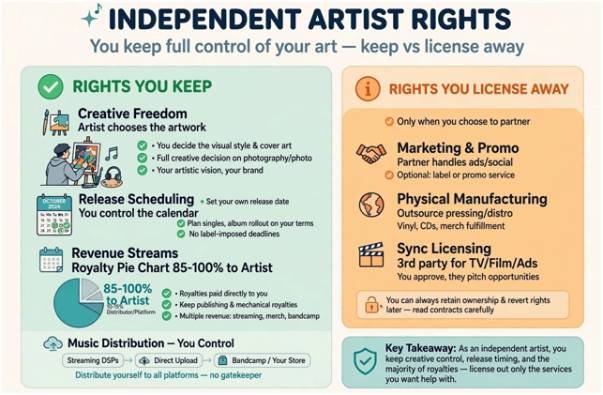
Retaining legal title to a work does not mean your distributor has no power over its digital footprint. You grant distributors specific administrative rights to do their jobs.
Creative Freedom and Release Scheduling
You retain complete creative autonomy. You choose your artwork, decide track orders, pick release dates, and pull singles off the market. Unlike major-label recording contracts, distributors cannot reject a mix because it lacks radio potential or mandate revisions to your visual assets.
Revenue Streams and Royalty Distribution
Distributors do not take your base rights, but their pricing models dictate your net independent artist revenue. Some platforms charge an upfront annual fee and pass through 100% of sales, while others charge zero upfront fees in exchange for a 9% to 15% backend commission.
Non-interactive digital performance royalties from platforms like SiriusXM or Pandora do not route through your distributor; those collect directly through SoundExchange.
Rights Comparison: DIY Distribution vs. Traditional Record Label Deals
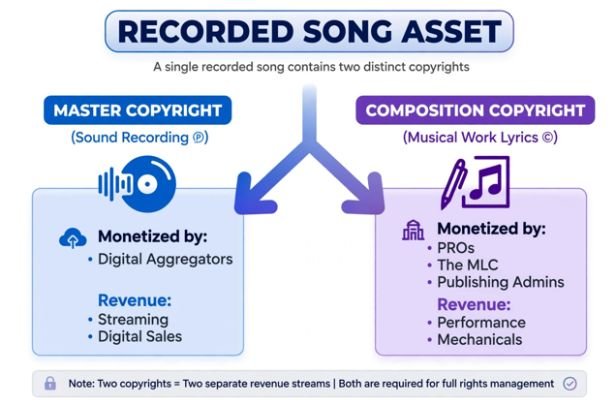
The fundamental difference between self-releasing and signing with an established record label comes down to whether you assign your property or license a service.
| Feature | DIY Distribution Deal | Traditional Record Label Contract |
| Master Ownership ($\mathbb{P}$) | 100% retained by the artist | Transferred or assigned to the label (“Work for Hire”) |
| Composition Rights ($\mathbb{C}$) | 100% retained by the songwriter | Often pressured into co-publishing agreements |
| Streaming Royalties | 85% to 100% paid directly to artist | 15% to 25% paid after full expense recoupment |
| Exclusivity | Limited to uploaded tracks | Strict personal exclusivity across all output |
| Sync Approval | Artist retains direct approval | Label controls sync and licensing terms |
| Term Duration | At-will or short renewal terms | Multi-album or fixed multi-year commitments |
Hidden Traps in Modern Distribution Agreements
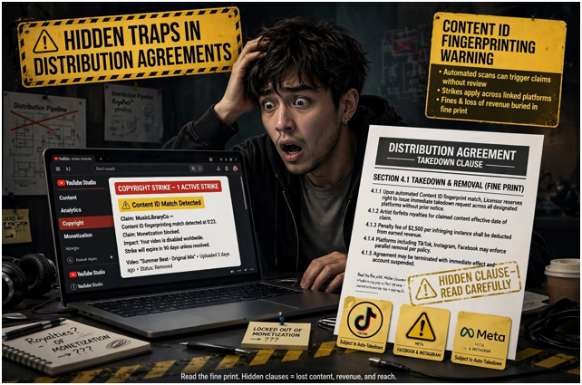
Even when a distributor advertises complete ownership, you must read the terms of service closely. Certain default clauses limit how you exploit your songs elsewhere.
YouTube Content ID and Social Monetization Sweeps
Many distributors bundle YouTube Content ID, TikTok, and Meta monetization as optional checkboxes or automatic defaults. If you grant them exclusive YouTube fingerprinting rights, their automated system flags any third party who uses your track—including your own social channels. If you plan to clear beats for other creators or lease backing tracks, never grant your distributor exclusive Content ID rights.
Takedown Clauses and Catalog Orphan Risks
Some subscription-based distributors unpublish your entire catalog from streaming services if your annual membership lapses. Unless you pay an additional legacy fee per track, you risk losing your playlist placements, stream counts, and algorithmic momentum. Commission-based models generally leave your music active indefinitely, as they deduct their fee directly from incoming payouts.
Frequently Asked Questions About Distribution Rights
1. Do digital music distributors own my master recordings?
No, distributors act as third-party aggregators and claim zero ownership over your master recordings.
2. Can I switch distributors without losing my stream counts?
Yes, as long as you reuse the original ISRC codes, track lengths, and exact metadata on the new platform.
3. Does my distributor collect my songwriting royalties?
No, distributors only collect sound recording revenue unless you separately purchase an optional publishing administration add-on.
4. Can I release music with another company while using a distributor?
Yes, standard distribution agreements are release-specific, meaning you can distribute other singles through different platforms.
Stop Signing Away Your Leverage
Owning your master recordings is the single greatest competitive advantage an independent musician holds. When you retain your copyrights, your catalog functions as an income-generating asset that you control indefinitely.
Before you click accept on that digital distribution terms of service, verify that the agreement contains no automatic exclusivity beyond the tracks you upload. Retain your publishing rights, maintain control over your digital fingerprinting, and audit your distributor agreements yearly to protect your sound.
Leave a Reply