
Landing airplay on non-commercial and college radio changed my music career. When I first learned how to submit music to independent radio stations, I wasted months sending blind blasts to generic addresses. Those emails ended up deleted unread.
Once I revamped my strategy to target curated, local shows with broadcast-ready assets, our tracks earned recurring spins across 34 stations nationwide.
Independent stations remain pure discovery hubs. Their music directors run on taste rather than corporate mandates, giving emerging artists an authentic launchpad.
[48-Hour Station Audit]
│
▼
[Broadcast-Ready Vault]
(WAV / 320k MP3 / Clean / One-Sheet)
│
▼
[Zero-Friction Pitch]
(Stream Link + Asset Folder)
│
▼
[Spin Tracking & Follow-Up]
The 48-Hour Station Audit: Finding Shows That Actually Spin Your Sound
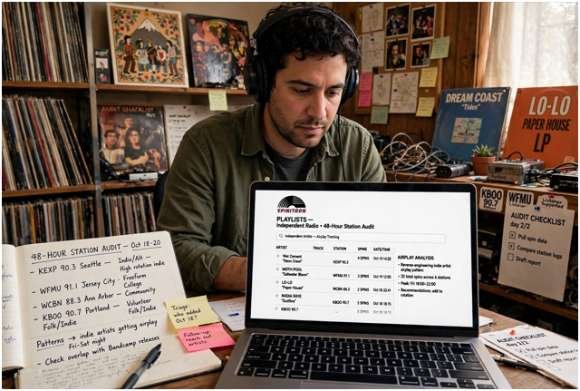
Curators spot shotgun spam immediately. My first rule is simple: never pitch a station until you run a two-day audit of their active programming schedule.
Reverse-Engineering Indie Artist Airplay
Start by tracking five independent artists in your sub-genre who sit just one tier above you. Inspect their social tags and radio charts to see which regional stations feature them. I catalog weekly programming blocks on community and college stations, cross-referencing playlists on platforms like Spinitron.
This research reveals which specific shows highlight your exact sub-genre, saving you from pitching an acoustic track to a midnight electronic segment. If your catalog also targets micro sync licensing opportunities, focus on shows that syndicate nationally.
Sifting Decision-Makers from Generic Inboxes
Avoid pitching to generic addresses like info@ or contact@. Review the station directory to identify the Music Director (MD) or the host running the specialty show. Music directors handle daytime rotation, but volunteer DJs curate their own evening specialty hours. Pitching the individual host guarantees your audio reaches the person queuing the board.
+——————–+————————+————————–+
| Role | Typical Programming | Submission Target Focus |
+——————–+————————+————————–+
| Music Director | General Rotation | Broad album/EP releases |
| Specialty Show DJ | Genre-Specific Blocks | Singles matching niche |
| Program Director | Station Format / Clock | Station-wide syndication |
+——————–+————————+————————–+
Building a Broadcast-Ready Radio Asset Vault
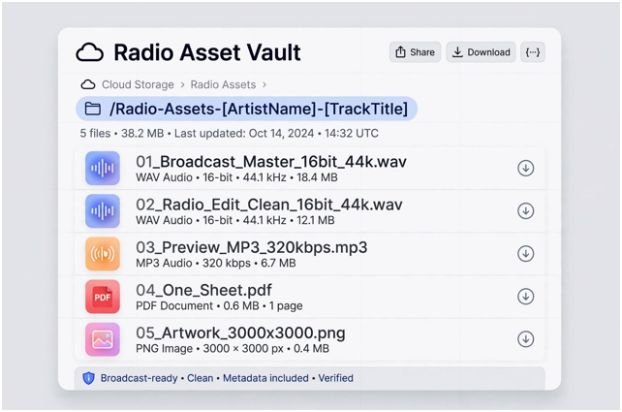
Radio stations operate under strict delivery requirements. When an MD likes your track, they need to air it immediately without emailing you back for technical fixes. Keep all your deliverables inside a clean cloud folder, ensuring public view permissions remain active.
/Radio-Assets-[ArtistName]-[TrackTitle]
│
├── 01_Broadcast_Master_16bit_44k.wav
├── 02_Radio_Edit_Clean_16bit_44k.wav
├── 03_Preview_MP3_320kbps.mp3
├── 04_One_Sheet_[ArtistName].pdf
└── 05_Artwork_3000x3000_HiRes.jpg
Mastering the FCC-Compliant Clean Edit
US broadcast transmitters answer directly to the Federal Communications Commission regarding profane and indecent material. Never assume non-commercial stations can bypass daytime decency standards. If your original mix contains explicit language, create an edited version using volume mutes or reversed syllables. Label the filename clearly as Radio Edit – Clean.
ID3 Metadata and ISRC Tagging Architecture
Stations automate their digital playout software, which reads track info directly from file tags. Incomplete tags cause files to show up as “Unknown Artist,” leading directors to discard them. Before uploading your MP3s and broadcast WAVs, write exhaustive metadata using tagging tools:
- Artist Name and Feature Credits
- Release Title and Track Number
- Clean/Explicit Status
- Contact Email and Primary Website
- International Standard Recording Code (ISRC) assigned via the official US ISRC Agency
Embedding your ISRC guarantees accurate tracking with performance rights organizations when your spin registers on station logs.
Structuring the Single-Page Radio One-Sheet
A one-sheet acts as your release résumé. Station programmers receive hundreds of releases every week and do not have time to read multi-page biographies. Format a one-page PDF containing:
- High-resolution album artwork and release date.
- A concise 80-word artist biography highlighting your sonic signature.
- Three distinct “Recommended If You Like” (RIYL) reference artists.
- Focus tracks with explicit running times, beats per minute (BPM), and intro countdown lengths.
- Direct links out to your socials and active fan platforms for independent music sales.
Industry guidelines from the National Association of Broadcasters emphasize clear, instant technical clarity on promotional literature.
Crafting the Zero-Friction Pitch Email
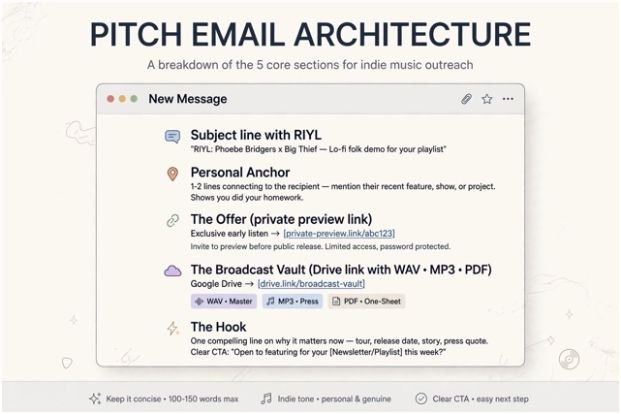
My open and response rates jumped past 40% when I cut my pitch copy down to three short paragraphs. Treat their inbox with respect. Never attach raw audio files, which trigger spam filters and overwhelm corporate storage limits.
PITCH EMAIL ARCHITECTURE
┌────────────────────────────────────────────────────────────────────────────┐
│ Subject: Music Submission: [Artist] – “[Song]” (RIYL: [Artist A, B]) │
├────────────────────────────────────────────────────────────────────────────┤
│ [Personal Anchor]: “Loved your recent set spinning [Recent Track]…” │
│ [The Offer]: Direct, private preview link (SoundCloud / DISCO) │
│ [The Broadcast Vault]: Google Drive / Dropbox link with WAV, MP3 & PDF │
│ [The Hook]: Key achievement, focus track timing, and clean edit flag │
└────────────────────────────────────────────────────────────────────────────┘
Real-World Pitch Teardown
Subject: Music Submission: The Static Pines – “Northern Sky” (RIYL: Wilco, War On Drugs)
Hi Sarah,
I loved your recent Sunday acoustic block on KXCI, especially your set featuring Skullcrusher. Your focus on layered Americana songwriting prompted me to send our latest single.
I front The Static Pines, an indie-folk project based in Flagstaff. Our new single, “Northern Sky” (out October 14), fits the atmosphere of your evening rotation.
- Stream the track: [Private Streaming Link]
- Download Broadcast Assets: [Dropbox Folder with 16-Bit WAV, MP3, Clean Radio Edit, One-Sheet]
“Northern Sky” runs 3:28 with an intro clock of 0:14, making it easy to talk over before the vocal hits. The song recently passed 50k independent streams with editorial support on Bandcamp.
Thanks for your time and for championing independent artists.
Best,
Marcus Cole
Phone: (555) 019-2834 | Website: thestaticpines.com
Notice how this structure provides every critical programming detail without requiring a single follow-up question.
Post-Submission Tracking and the Graceful Follow-Up
Track every submission inside a centralized spreadsheet. Log the station call sign, market location, contact name, date sent, and private stream link analytics.
Check your streaming link analytics to see if the recipient listened to your track. If seven business days pass without a reply, send a polite follow-up directly within the original email thread:
“Hi Sarah, checking in quickly on ‘Northern Sky’ for your Sunday rotation. Let me know if you need physical CDs or alternate file masters. Thanks again for your time!”
If you receive no response to your follow-up, mark the entry as passed and move forward. Station programmers rotate selections rapidly, and aggressive persistence burns professional bridges.
Frequently Asked Questions
1. What audio format do independent radio stations prefer?
Stations prefer uncompressed 16-bit / 44.1 kHz WAV files alongside tagged 320 kbps MP3 files for quick auditioning.
2. Should I send physical CDs or digital files to radio stations?
Check the station submission page directly; while most programmers prefer digital cloud links, some traditional stations still mandate physical mailers.
3. How far in advance should I submit music before my release date?
Send your pitch three to four weeks prior to your official release date so music directors have adequate lead time to program their logs.
4. Do independent radio stations pay performance royalties?
Yes, licensed terrestrial and internet stations submit playlist logs to PROs like ASCAP, BMI, and SESAC to distribute performance royalties.
Drop the Needle, Own Your Airwaves
Independent radio remains one of the few places where raw talent beats deep marketing budgets. Treat every station pitch like a creative partnership rather than a cold call. Organize your broadcast files, respect FCC regulations, and send concise emails that respect the curator’s schedule. Pick five target stations this afternoon, run your 48-hour audit, and submit your strongest single.
Leave a Reply