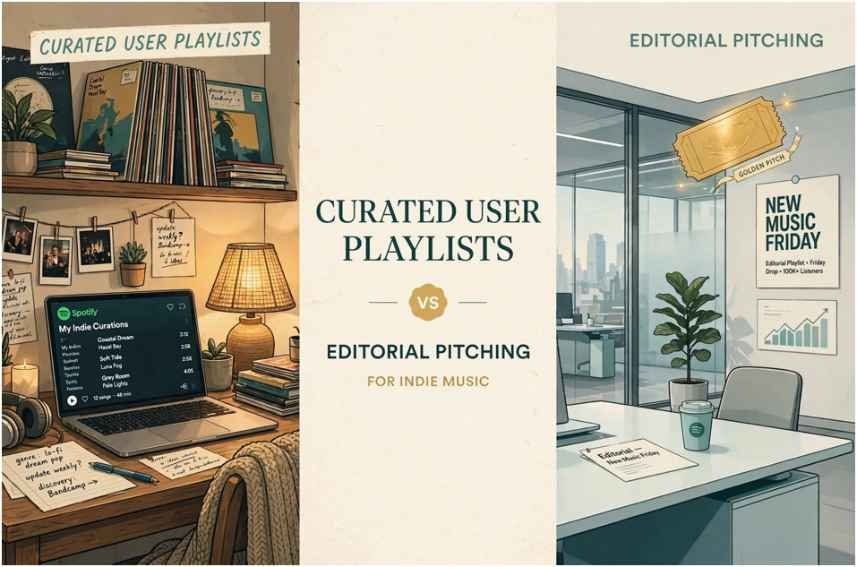
Choosing between curated user playlists vs editorial pitching for indie music often feels like deciding whether to buy a lottery ticket or grind out door-to-door sales.
I spent years assuming an editorial placement on Fresh Finds was the only milestone that mattered. Then I ran the numbers on my own catalog. A single editorial slot brought 45,000 passive streams over two weeks, followed by an immediate flatline.
Conversely, a coordinated push across 15 niche user-curated playlists triggered Spotify’s Discover Weekly engine for seven consecutive months.
To build a career that survives past release day, you must treat user curation as your algorithmic engine and editorial pitching as your zero-cost amplifier.
The Core Dilemma: Algorithmic Priming vs Flagship Reach
Streaming platforms do not reward hype; they reward measurable listener engagement. Understanding the distinct roles of independent tastemakers and platform gatekeepers dictates where your time and release budget should go.
Curated User Playlists: The Behavioral Engine
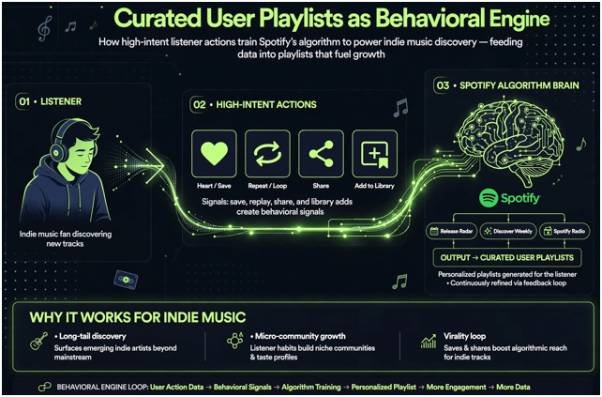
User-generated playlists are maintained by music bloggers, indie labels, and dedicated music fans. These tastemakers curate for ultra-specific vibes: late-night studying, highway night drives, or underground Midwestern emo.
When an indie artist lands on a focused user list, the listener rarely skips. They loop the track, share it, and add it to their personal libraries. According to submission data gathered by SubmitHub, high-intent third-party placements deliver up to four times higher profile-click rates than broad genre collections.
These genuine actions feed recommendation engines like Release Radar, Spotify Radio, and Discover Weekly. If you are refining your rollout schedule, pair this approach with our self releasing an album checklist for indie artists to ensure your timeline accounts for curator lead times.
Editorial Pitching: The Golden Ticket
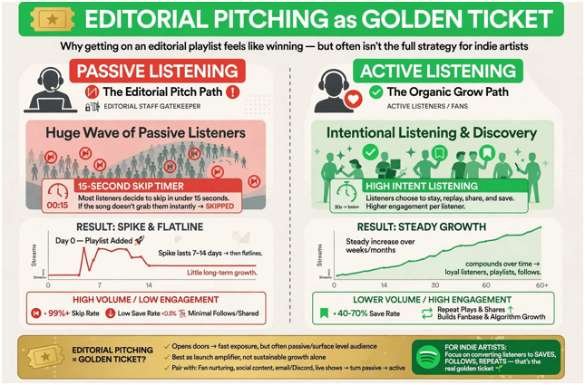
Editorial lists (New Music Friday, All New Indie) are assembled by in-house editorial staff at major streaming platforms. Landing one delivers immediate scale and immense industry prestige.
However, editorial listeners are passive skippers. If an editor places your delicate indie-folk ballad between two high-energy pop tracks, casual listeners skip within 15 seconds. High skip rates punish your internal algorithmic score.
Treat native editorial forms on Spotify for Artists as a mandatory, free routine—never as a standalone marketing strategy. Even when editors pass, the metadata submitted during the pitch indexes your sound profile within the platform’s categorization matrix.
Head-to-Head Comparison: Curated vs Editorial
The table below breaks down the structural, financial, and operational differences between both avenues.
| Strategic Metric | Curated User Playlists | Editorial Pitching |
| Primary Gatekeeper | Independent tastemakers, bloggers, super-fans | In-house platform editorial teams |
| Submission Cost | Free direct outreach; $2–$4 via review networks | 100% Free via native artist dashboards |
| Submission Window | Anytime (pre-release or months post-release) | Strict deadline (3–6 weeks before release) |
| Listener Behavior | Active listening, high saves, custom playlist adds | High-volume passive listening, higher skip rates |
| Impact on Algorithm | High: builds targeted behavioral data | Moderate: massive initial velocity, mixed signals |
| Longevity | Weeks to months; steady cumulative gains | 7 to 14 days before rotation or replacement |
The 6-Week Release Flywheel: How I Blend Both Strategies
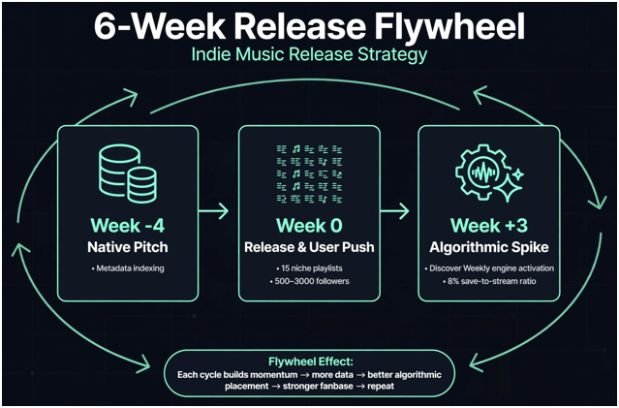
Stop treating these distribution channels as mutually exclusive competitors. Instead, connect them in a single pipeline.
[Week -4: Native Pitch] ➔ [Week 0: Release & User Push] ➔ [Week +3: Algorithmic Spike]
│ │ │
▼ ▼ ▼
(Metadata Indexing) (High-Intent Saves) (Editorial Re-Discovery)
- Four Weeks Before Release: Upload your finished master through your digital distributor. Submit your editorial pitch inside your streaming dashboard. Tag primary instruments, micro-genres, mood, and three sonic reference points.
- Release Week: Pivot entirely to verified user curators. Secure 10 to 20 placements across micro-playlists containing 500 to 3,000 followers. This deliberate audience targeting keeps skip rates low and save rates high.
- Three Weeks Post-Release: As your save-to-stream ratio crosses the 8% mark, recommendation algorithms activate. This secondary surge in daily active listeners flags your track on internal algorithmic dashboards, often prompting human editors to add your song to late-cycle playlists like Fresh Finds. While streaming brings passive ears, monetize that attention directly by funnelling active listeners into fan platforms for independent music sales.
Vetting the Minefield: Spotting Artificial Playlists Before You Pitch
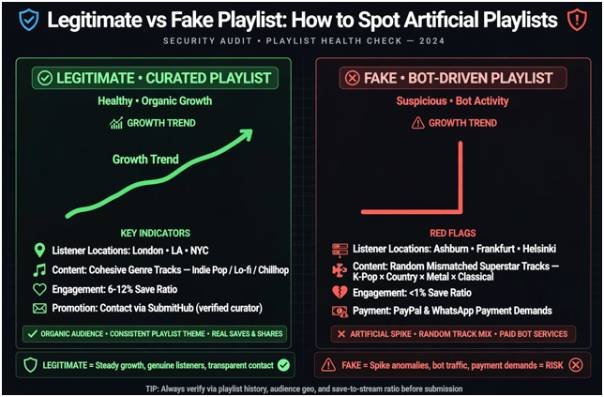
The independent playlist ecosystem contains predatory pay-for-play schemes that use click-farms. Buying your way onto an artificial playlist ruins your catalog data and risks track removal, a crackdown widely reported across the industry by Billboard.
Always audit a third-party playlist using the markers below before spending time or money pitching it.
| Verification Point | Legitimate Curated Playlist | Fake or Bot-Driven Playlist |
| Follower Growth Curve | Steady, stepped, natural fluctuation | Sharp vertical leaps of thousands in 24 hours |
| Top Audience Cities | Major metropolitan areas (London, LA, NYC) | Data-center clusters (Ashburn, Frankfurt, Helsinki) |
| Curator Contact Info | Submission platform links or plain submission emails | Demands direct PayPal or WhatsApp payments |
| Save-to-Stream Ratio | Typically 6% to 12% saves per stream | Less than 1% saves despite massive daily plays |
| Track Sequencing | Thematically cohesive, genre-consistent | Random sequencing with mismatched superstar tracks |
Ditch the Vanity Metrics and Play the Long Game
Chasing editorial placements while ignoring independent user curation is like trying to put a roof on a house that has no foundation. Editorial features look great in press releases, but user-curated playlists keep your royalties flowing long after release week ends.
Treat every niche playlist with 400 dedicated listeners as a direct pipeline to your next 50 true superfans. Submit your free editorial pitch early, spend your promotional energy on genuine human tastemakers, and let behavioral data handle the rest.
Frequently Asked Questions
1. Does getting rejected by editorial curators hurt my algorithmic reach?
No, editorial rejections do not penalize your track; the detailed genre tags you submit still train the recommendation engine.
2. When is the absolute deadline to submit an editorial pitch?
Submit your pitch at least 7 days before release for Release Radar inclusion, though 3 to 4 weeks is ideal for human review.
3. Are paid playlist submission platforms considered payola?
No, legitimate platforms charge for a curator’s guaranteed time and feedback, whereas payola involves paying for guaranteed placement.
4. Can user playlists trigger Discover Weekly without any editorial support?
Yes, high save rates and low skip rates on user playlists frequently trigger Discover Weekly without any editorial placement.
Leave a Reply