Category: creative arts

  • AI Songwriting Tools Versus Human Lyric Writing: Studio Truths

    AI Songwriting Tools Versus Human Lyric Writing: Studio Truths

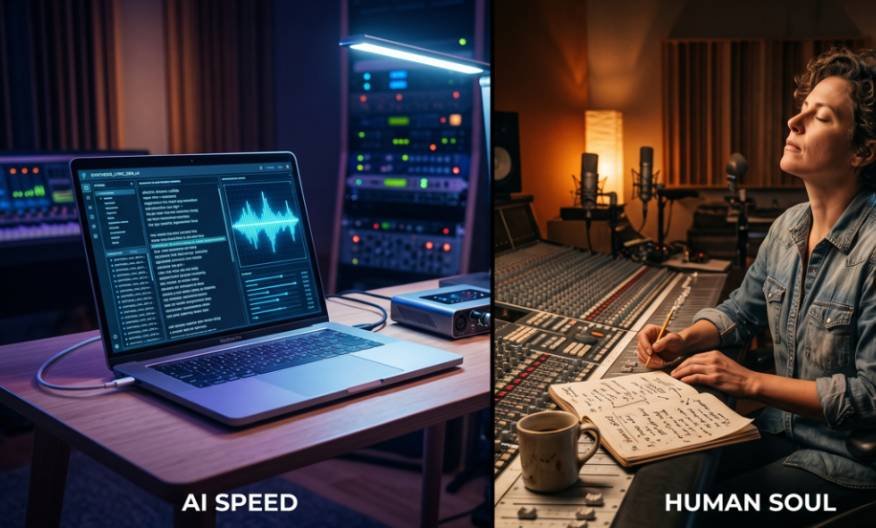
    When I opened a blank project file last month, staring down a brutal deadline, I did something I used to consider sacrilege: I asked an algorithmic model to sketch my chorus. Sitting at the console comparing AI songwriting tools versus human lyric writing showed me that machines deliver breathtaking speed, yet they cannot bleed onto a page. Songwriting demands blood, sweat, and memory.

    The collision of machine learning and songwriting is not a zero-sum war. It is a fundamental shift in how artists assemble words, balance cadence, and protect their intellectual property.

    The Studio Reality: Speed Against Authentic Soul

    Generating forty couplets in three seconds feels like a superpower until you try singing them aloud. Generative engines process text based on mathematical predictability. They analyze billions of lines to predict which syllable statistically belongs next.

    That statistical average is the exact enemy of memorable music. For artists who value individuality and creative freedom, understanding what indie means in music provides useful context for why personal voice and unconventional songwriting choices can matter so much.

    Where Generative Algorithms Hit a Creative Wall
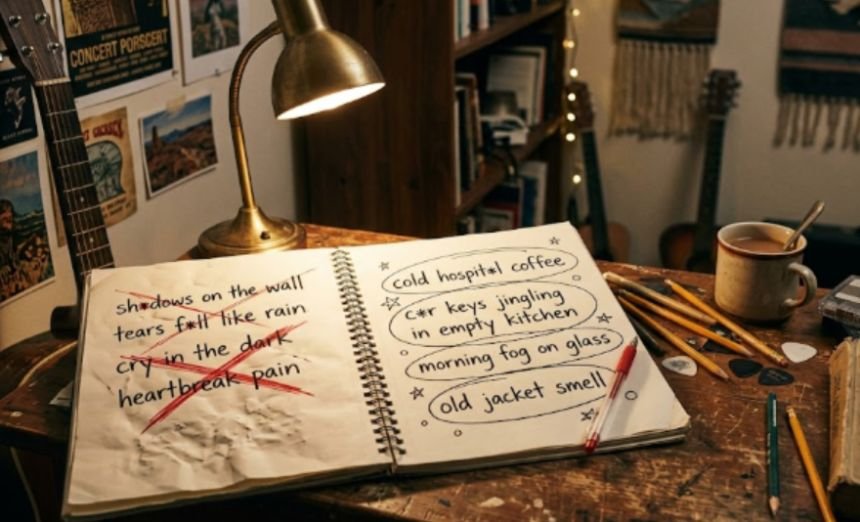
    Where Generative Algorithms Hit a Creative Wall

    Feed an engine a prompt about grief, and it gives you “shadows on the wall,” “echoes in the hall,” and “tears falling like rain.” The machine defaults to predictable AABB rhyme schemes and polished platitudes. It cannot capture the peculiar stench of cold hospital coffee or the sound of car keys jingling in an empty kitchen.

    Academic analyses from institutions like Berklee Online point out that while generative systems understand stylistic idioms, they lack cognitive context. They assemble language without understanding emotional weight. 

    When I tested a recent prompt asking for an indie-folk breakdown about estrangement, the engine served technically pristine stanzas. Yet, the lines were emotionally sterile. They sounded like a greeting card forced into four-four time.

    Why Human Vulnerability Survives the Mix

    Human lyricists write through the lens of lived friction. When songwriters create hooks, they do not rely on probabilistic math. They pull from private heartbreaks, cultural subtext, and unexpected sonic dissonances.

    A human writer knows when an imperfect slant rhyme hits harder than a perfect rhyme. Consider how great records balance cadence and silence. The hesitation before a confession in a bridge cannot be calculated by a neural network. Raw lived experience gives lyrics their sticky, enduring power.

    The Mechanics of Co-Creation: Building a Hybrid Lyric Workflow
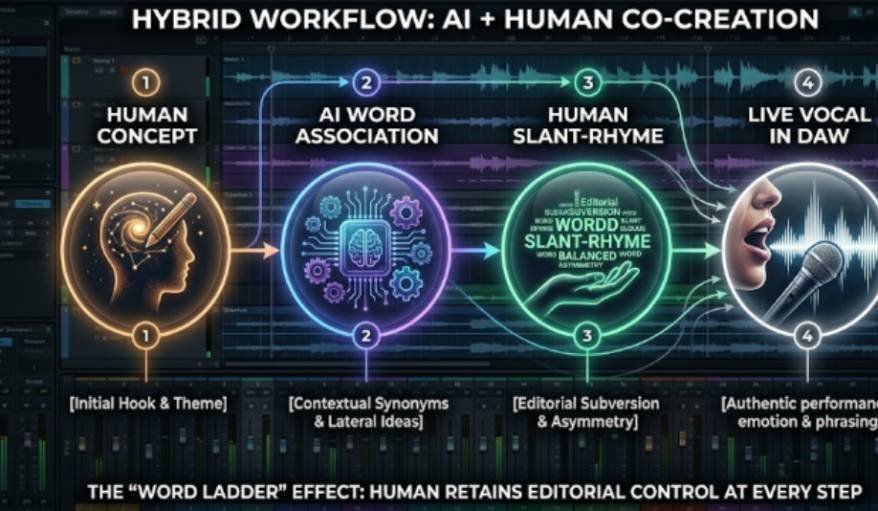
    The Mechanics of Co-Creation Building a Hybrid Lyric Workflow

    Treating technology as an outright replacement produces disposable tracks. Treating it as a studio companion transforms your creative output.

    I use text models as high-speed lateral thesauruses. When I get stuck on a repetitive rhyme scheme, I do not ask the tool to write the stanza. I ask it for fifteen concrete objects associated with a specific memory—like an abandoned coastal highway or a rusted radiator.

    My Hybrid Drafting Workflow:

    [Human Concept & Angle] 

             │

             ▼

    [AI Generates Atmospheric Word Association]

             │

             ▼

    [Human Selection & Slant-Rhyme Adaptation]

             │

             ▼

    [Live Vocal Phrasing & Structural Edits in DAW]

    Using Generative Engines as Contextual Rhyme Ladders

    If my chorus feels rhythmically stiff, I feed my draft into an engine and prompt: “Identify the meter of these lines and generate eight internal slant rhymes that avoid clichés.”

    The model acts as an interactive brainstormer. It suggests syllables I can twist, subvert, or discard entirely. The final phrasing remains entirely mine. This process saves hours of creative fatigue while keeping my personal voice at the center of the track.

    Protecting Your Copyright Footprint Inside Your DAW
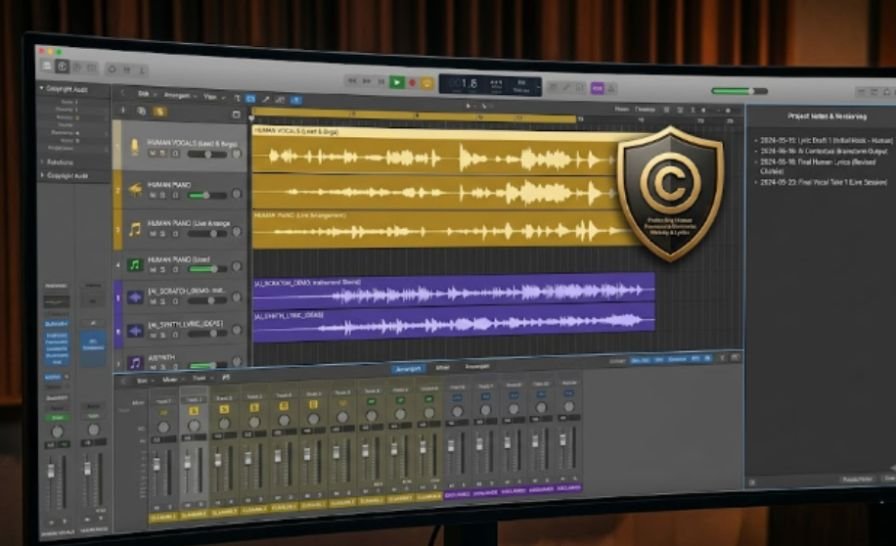
    Protecting Your Copyright Footprint Inside Your DAW

    Using these systems introduces serious legal considerations. The U.S. Copyright Office maintains that only human-authored expression qualifies for legal protection. Merely entering prompts does not grant you authorship over the raw text.

    Furthermore, international frameworks monitored by WIPO highlight growing global friction regarding AI training datasets and intellectual ownership.

    If an algorithm writes your entire verse verbatim, anyone can legally take that lyric and release it on their own project. To protect my work, I maintain a strict audit trail in my Digital Audio Workstation:

    • Labeling channels clearly ([Human_Vocals] versus [AI_Scratch_Demo]).
    • Saving dated lyric drafts in cloud documents showing my handwritten modifications.
    • Disclaiming purely machine-generated backing loops during registration while claiming full ownership of my melody, arrangement, and lyrics.

    Why Algorithms Fail the Hook Test

    Modern listening habits demand immediate payoff. Because short form music is changing modern songwriting, listeners decide whether to skip a track within the first five seconds.

    Machines struggle with immediate, unconventional economy. AI lyrics tend to be excessively wordy. They pack too many syllables into a measure, crowding the vocal performance and destroying pocket presence.

    When you sing a melody across a syncopated groove, you often need an odd, asymmetrical phrase to snag the ear. Human intuition recognizes when a single nonsense word or an abrupt lyrical pause works better than a complete sentence. Algorithmic prediction smooths out those rough edges, stripping away the friction that makes a chorus hook an earworm.

    Stop Treating Tech Like a Threat—Treat It Like an Intern
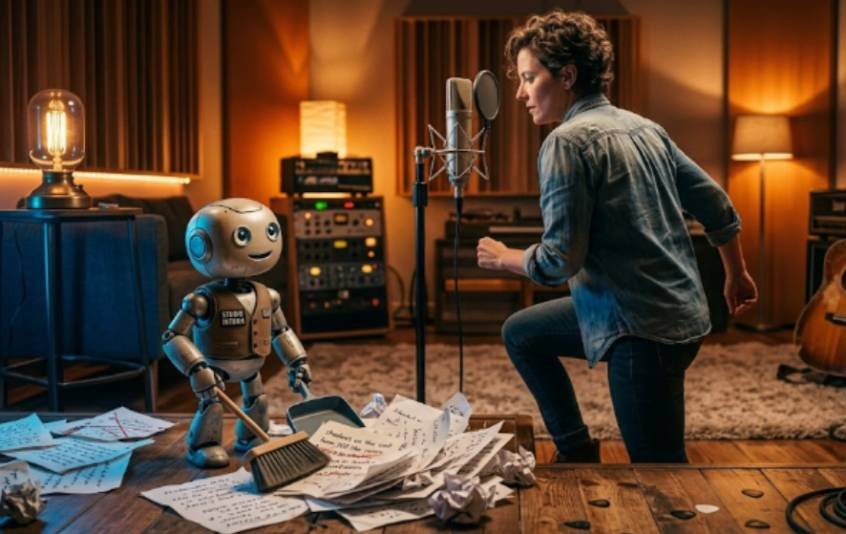
    Stop Treating Tech Like a Threat—Treat It Like an Intern

    Stop waiting for a machine to write your masterpiece, and stop fearing that it will make your voice obsolete. 

    An algorithm is an intern: eager, lightning-fast, and completely devoid of taste. Use it to sweep up dead ends, generate wild word associations, and test arrangements. Then step up to the microphone, cut the digital fluff, and tell the truth that only you can tell.

    Frequently Asked Questions 

    1. Can I copyright lyrics that an AI generated for my song?

    No, purely machine-generated lyrics enter the public domain because copyright law requires human authorship.

    2. How do I use AI lyric tools without sounding generic?

    Use AI exclusively as an associative thesaurus for imagery, then manually rewrite every line using personal details and irregular slant rhymes.

    3. Do commercial licenses from AI platforms grant true copyright ownership?

    No, platform subscription terms only grant contractual permission to monetize, not statutory federal copyright protection.

    4. What is the most obvious sign of an AI-generated song lyric?

    Predictable AABB rhyming patterns, abstract emotional clichés, and overly dense syllable counts that disregard natural vocal phrasing.
  • How Short Form Music Is Changing Modern Songwriting

    How Short Form Music Is Changing Modern Songwriting

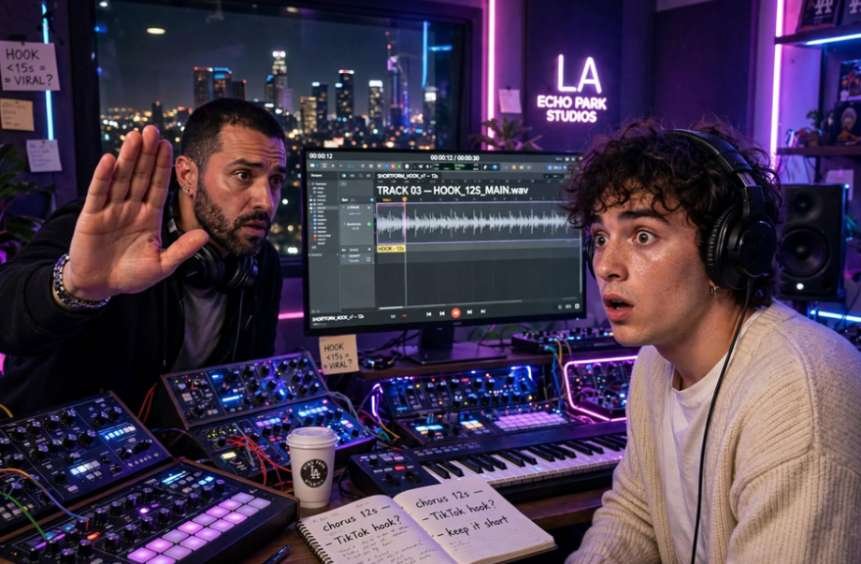
    I sat in a Los Angeles writing session last month where the lead producer halted our playback after just twelve seconds. We had crafted a lush, atmospheric synth intro, but he shook his head: “Nobody on Reels will wait through eight bars of reverb.” That moment cemented a shift I have witnessed across recording studios: how short form music is changing modern songwriting at every level of arrangement, lyricism, and commercial pacing.

    Songwriters no longer build slow burn ballads. Instead, we engineer tracks designed to capture fragmented digital attention spans across TikTok, Instagram Reels, and YouTube Shorts.

    The Front-Loaded Hook: Eliminating the 30-Second Buildup

    The classic pop formula (Intro → Verse → Pre-Chorus → Chorus) spent decades as the bedrock of radio hits. Today, that linear progression is practically obsolete. When listeners decide whether to swipe within milliseconds, delayed gratification is a liability.

    In my recent co-writes, we almost always start on beat one with the central vocal hook or the chorus. Placing the core melody at the opening bypasses the skip button entirely. By delivering immediate melodic value, the listener receives the song’s primary emotional payoff before they have a chance to look away.

    Dissecting the Death of the Traditional Bridge

    The traditional eight-bar middle-eight bridge—once vital for providing harmonic contrast and narrative tension—is disappearing from modern tracking sessions. Production teams view bridges as momentum killers that trigger listener drop-off.

    Rather than modulating keys or introducing a contrasting melodic motif, arrangements now favor constant energy. If an element does not directly reinforce the central hook or set up an immediate drop, it gets removed in the editing room.

    This kind of decision can become especially important when bands write songs together, since multiple musicians may contribute different ideas to the final arrangement.

    Writing for the 7-Second Retention Window

    Writing for the 7-Second Retention Window

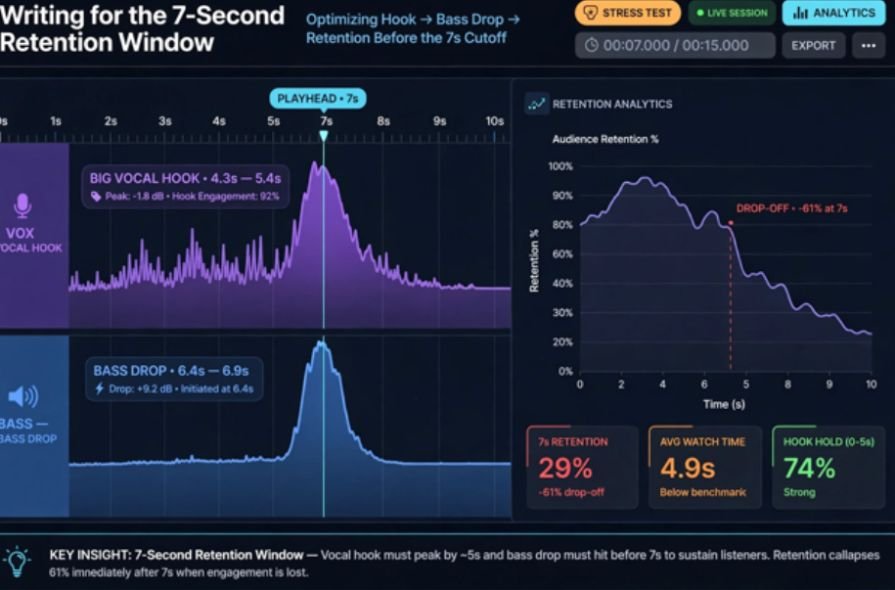
    Analytics from short-form platforms prove that user drop-off peaks within the first three to seven seconds. Modern songwriters treat these opening seconds as high-stakes real estate.

    During our tracking sessions, we use what we call the “seven-second stress test.” If the vocal melody, an unmistakable sound effect, or an aggressive bass drop does not occur before the playhead reaches seven seconds, we rewrite the top of the track. Leading institutions like the Berklee College of Music have even adapted their contemporary production coursework to address how viral snippet dynamics influence commercial arrangement.

    The Architecture of the 15-Second Loop

    Short-form platforms run on infinite repetition. Because video content loops continuously, songwriters construct audio that rewards cycling without causing ear fatigue.

    Classic Linear Pop:

    [Intro] ➔ [Verse] ➔ [Chorus] ➔ [Verse] ➔ [Chorus] ➔ [Bridge] ➔ [Chorus] ➔ [Outro/Fade]

    Modern Loopable Form:

    ┌─── [Instant Vocal Hook] ➔ [Micro-Verse] ➔ [Chorus Hook] ───┐

    └─────────────────── Seamless Cadence Loop ──────────────────┘

    Crafting Unresolved Harmonic Cadences

    Writing a loopable song requires rethinking traditional music theory resolutions. Resolving a progression to the tonic root chord signals a sense of finality. In social audio, finality encourages the user to swipe away.

    We now intentionally end choruses on unresolved chords, such as the IV (subdominant) or V (dominant) step. When the progression fails to resolve cleanly at the bar line, the ear naturally seeks resolution by cycling right back to the opening bar. The loop feels endless, artificially inflating repeat plays.

    Lyric Punchlines as Visual Cues

    Song lyrics have shifted from sprawling poetic narratives to more compact and conversational forms, reflecting a broader trend toward simpler, more straightforward, and repetitive lyrical structures.

    Modern songwriting increasingly favors conversational lyrics, using direct and accessible language rather than relying solely on elaborate poetic structures.

    Content creators require audio that provides immediate visual context for skits, transitions, makeup transformations, and lifestyle vlogs. For independent artists, curated user playlists vs. editorial pitching can also shape how their music reaches new listeners and gains exposure across digital platforms.

    Placement: Under “Lyric Punchlines as Visual Cues”

    When drafting lyrics, I ask myself: Can a creator act this line out in a three-second video? Lines that express sharp emotional contrasts, relatable grievances, or comedic punchlines perform significantly better than abstract imagery. The lyric functions simultaneously as music and as dialogue.

    Studio Economics: Sub-Two-Minute Arrangements and Algorithmic Payouts

    The creative restructuring of modern music is closely tied to streaming economics. Digital streaming providers register a monetized play once a track plays past the 30-second mark.

    A song that runs four minutes generates the exact same streaming royalty as a song that runs one minute and fifty seconds. However, the shorter song can be streamed twice as many times within the same listening hour.

    Chart data tracked by Billboard confirms this structural transformation: the average duration of Hot 100 charting songs has dropped by more than a minute over the past three decades.

    Academic studies from institutions like the UCLA Department of Statistics mirror these findings, illustrating that track runtimes across major streaming catalogs have consistently trended downward since the rise of on-demand platforms.

    Songwriting Dimension 2000s Pop Architecture Current Short-Form Pop
    Average Song Length 3:30 – 4:15 minutes 1:50 – 2:30 minutes
    First Vocal Entrance 0:15 – 0:30 seconds 0:01 – 0:04 seconds
    Structural Climax Dynamic Bridge / Key Change 15-Second Audio Hook
    Harmonic Cadence Resolved Root Cadence Unresolved / Circular Progression

    For self-funded artists funding their own tracking dates, exploring vetted music grant opportunities can offset early production costs while experimenting with these alternative formats. Pairing these resources with smart independent music distribution allows emerging musicians to deploy modular releases without label interference.

    Mobile-First Production: Mixing for Smartphone Speakers

    Mobile-First Production Mixing for Smartphone Speakers

    Songwriting and mixing are no longer separate phases; they happen in tandem. Because the overwhelming majority of short-form content is consumed through built-in phone speakers, studio mixing workflows have fundamentally changed.

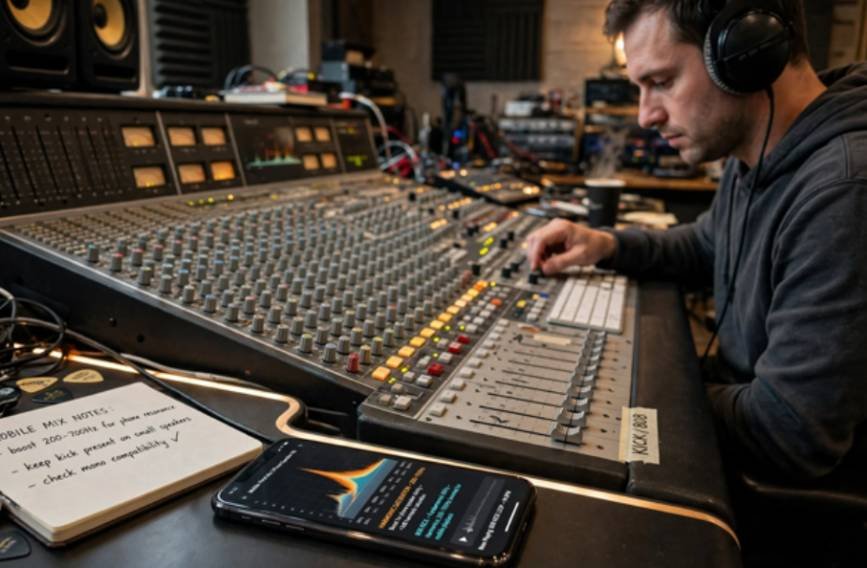
    Sub-bass frequencies below 60 Hz disappear completely on mobile hardware. To keep an 808 or kick drum audible, we apply aggressive harmonic saturation between 200 Hz and 700 Hz. This saturation tricks the human ear into perceiving low bass notes even on tiny speakers.

    Furthermore, lead vocals are placed 1 to 2 dB higher in the mix than traditional radio standards dictate. This forward vocal placement ensures lyrical punchlines cut through ambient room noise and compression artifacts.

    Frequently Asked Questions 

    1. Why are songs getting significantly shorter?

    Streaming platforms pay identical royalties after 30 seconds, financially incentivizing shorter tracks that achieve higher replay volume per hour.

    2. What is the most effective way to start a song for TikTok?

    Begin immediately on beat one with the vocal melody or a distinctive sound effect to prevent listeners from swiping away.

    3. Why do artists release sped-up and slowed-down versions of their songs?

    Releasing official alternate mixes captures creator-driven remix trends on social platforms while claiming all associated streaming revenue.

    4. Has short-form audio eliminated the traditional bridge completely?

    While not completely gone, bridges are routinely removed in contemporary commercial pop to maintain high energy and prevent audience drop-off.

    Stop Writing Tracks, Start Engineering Sonic Moments

    You do not need to abandon artistic integrity to thrive in the modern music landscape, but you must respect how the modern listener consumes art. Write songs that respect immediate attention spans, eliminate self-indulgent arrangements, and treat every 15-second block as a standalone experience.

    For emerging artists, the importance of stage presence for emerging artists becomes clear when translating recorded music into a memorable live experience.

    Before you book your next studio session, export a 15-second snippet of your chorus and test it directly against a phone speaker. If that isolated loop fails to turn heads without production context, return to the whiteboard and refine the melody.

  • How Songwriters Create Hooks That Work Beyond TikTok

    How Songwriters Create Hooks That Work Beyond TikTok

    Every producer and writer I share a studio with has felt the pressure: craft a 10-second vocal loop that immediately sparks an online trend. While a viral moment provides a short-term spike, it frequently leaves artists stranded with disposable streams and hollow catalogs. In my own co-writing sessions, discovering how songwriters create hooks that work beyond TikTok meant unlearning the habit of chasing isolated micro-dopamine hits.

    True musical longevity demands that a hook act as the structural, emotional, and melodic thesis of a complete three-minute record.

    The Problem with Snippet-First Composition

    The Problem with Snippet-First Composition

    Writing purely for an algorithm distorts song architecture. It is no secret that short form music is changing modern songwriting, compressing intros to near zero and eliminating the traditional bridge. Research from Ohio State University documented that average pop song intros shrank from roughly 23 seconds in the mid-1980s down to 5 seconds.

    When a melody exists solely to serve an algorithmic swipe, it burns out quickly. Listeners jump over to Spotify, find that the rest of the track lacks context or substance, and bounce before the 30-second mark. If you want your music added to personal libraries and curated user playlists where tracks spin for years, the hook must offer structural resolution, not just immediate novelty.

    Core Principles: Writing Beyond the 15-Second Clip

    Core Principles Writing Beyond the 15-Second Clip

    To build staying power into your choruses, shift your focus from standalone clips to cohesive song craft.

    1. Engineering the Narrative and Harmonic Runway

    An enduring hook derives power directly from the tension that precedes it. In a standalone video, a snippet needs zero backstory; in a complete song, the verses are the vital runway.

    • Narrative Stakes: The verse must establish the emotional conflict: who is speaking, what is on the line, and why the listener should care. When the chorus lands, it should feel like an earned realization rather than an arbitrary arrival.
    • Harmonic Relief: Withhold tonal resolution in your pre-chorus. Hovering on a minor iv chord or parking on an unresolved dominant V chord creates natural ear hunger. When the chorus finally lands on the tonic root, the listener experiences physical acoustic relief.

    2. Dialing in Melodic Symmetry and Contrast

    The human brain loves patterns, but it tunes out predictable loops. Enduring pop music relies on clear cognitive balance:

    • Symmetry via AABA: Deliver a sticky musical motif twice, divert expectations on the third line, and return home to stick the landing on the fourth.
    • Harmonic Toggling: Keep the vocal melody line identical during the chorus repeat while altering the underlying chord progression. This preserves familiarity while keeping the ear actively engaged.
    • Rhythmic Density Shift: If your verses rely on rapid-fire, syncopated phrasing, widen the chorus. Switch to elongated vowels and sustained whole notes. The dynamic shift commands instant focus.

    3. Stacking Hooks Across the Production

    Viral songs often pin their hopes on one single vocal trick. Classic records build an ecosystem of hooks that pass attention across the mix like a relay baton:

    • Phonetic Earworms: Incorporate universal non-verbal vocalizations (“la-la”, “whoa-oh”). They allow anyone to scream along regardless of language or lyric memory.
    • Lyrical Turn-of-Phrase: Write titles that present an intriguing contradiction or clear visual metaphor.
    • Instrumental Counter-Melodies: Craft a distinctive guitar riff, synth line, or bass ostinato beneath the vocal. When the singer breathes, the instrumental hook carries the pulse.
    • The Post-Chorus Tag: Add a secondary melodic phrase right when the listener assumes the section has wrapped. It prevents the arrangement from stalling.

    As educators at the Berklee College of Music often highlight, long-term careers are built on whole-song architecture rather than fragmented audio bites.

    4. Choosing Human Universality Over Viral Specificity

    Social algorithms reward hyper-niche internet subcultures and inside jokes. Stadium anthems, classic radio records, and timeless catalog hits require broad emotional truth.

    Strip your central lyric down to a fundamental human experience: existential dread, persistent hope, gut-wrenching grief, or mutual devotion. When an idea is emotionally open, millions of listeners can fit their own lives into your chorus.

    In the Studio: What A Full-Length Hook Test Looks Like

    In the Studio What A Full-Length Hook Test Looks Like

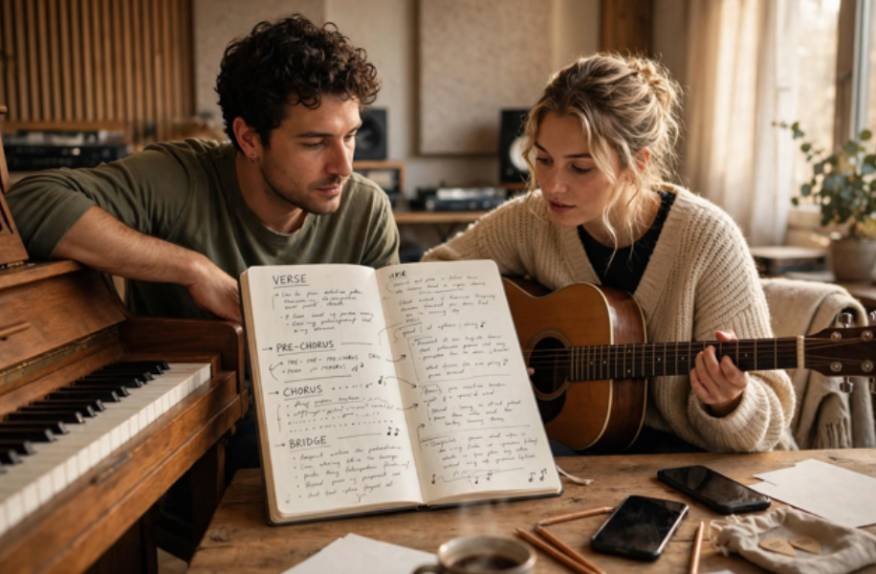
    Whenever we finish a demo, my collaborators and I run what we call the “Acoustic Translation Test.” We strip away 808s, vocal chops, and sidechain compression, sitting at an upright piano or acoustic guitar.

    If the chorus feels empty without production tricks, it is just audio candy. If the chord movement, melodic contour, and central lyric still evoke an emotional reaction with a single instrument, the foundation is sound. The American Society of Composers, Authors and Publishers (ASCAP) emphasizes that lasting song royalties are driven by melodic integrity, not temporary production fads.

    Don’t Just Stop the Scroll—Build a Catalog

    A viral snippet might grab a pair of eyes for ten seconds, but an architectural hook secures an audience for decades.

    A viral snippet might grab a pair of eyes for ten seconds, but an architectural hook secures an audience for decades. For listeners who want to move beyond viral clips, where to find new independent music can be just as important as how artists build songs that stand the test of time.

    Stop treating your chorus like social media bait. Write purposeful verses, build undeniable harmonic setups, and ground your message in universal truths.

    Sit at your instrument, mute the trends, and focus on finishing the entire narrative arc.

    Frequently Asked Questions

    1. What makes a song hook timeless instead of trendy?

    A timeless hook functions as the emotional payoff of the full song rather than an isolated soundbite.

    2. How do I stop listeners from skipping after hearing the viral snippet?

    Use the verse to create unresolved harmonic tension and an engaging story that makes the chorus feel earned.

    3. What is a stacked hook in modern pop production?

    A stacked hook layers vocal phrases, instrumental counter-melodies, and post-chorus tags to maintain continuous momentum.

    4. Can a song succeed on TikTok and still hold classic longevity?

    Yes, provided the viral snippet is built around universal human emotion and supported by strong full-song architecture.