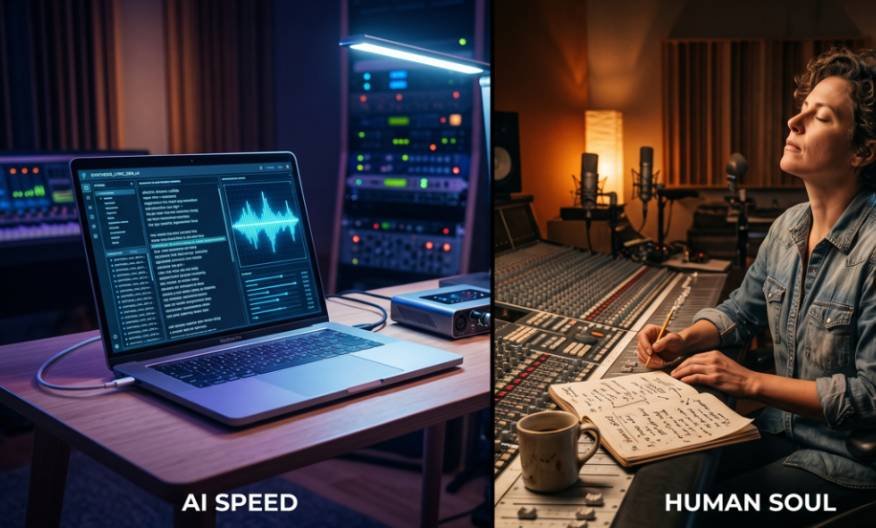
When I opened a blank project file last month, staring down a brutal deadline, I did something I used to consider sacrilege: I asked an algorithmic model to sketch my chorus. Sitting at the console comparing AI songwriting tools versus human lyric writing showed me that machines deliver breathtaking speed, yet they cannot bleed onto a page. Songwriting demands blood, sweat, and memory.
The collision of machine learning and songwriting is not a zero-sum war. It is a fundamental shift in how artists assemble words, balance cadence, and protect their intellectual property.
The Studio Reality: Speed Against Authentic Soul
Generating forty couplets in three seconds feels like a superpower until you try singing them aloud. Generative engines process text based on mathematical predictability. They analyze billions of lines to predict which syllable statistically belongs next.
That statistical average is the exact enemy of memorable music. For artists who value individuality and creative freedom, understanding what indie means in music provides useful context for why personal voice and unconventional songwriting choices can matter so much.
Where Generative Algorithms Hit a Creative Wall
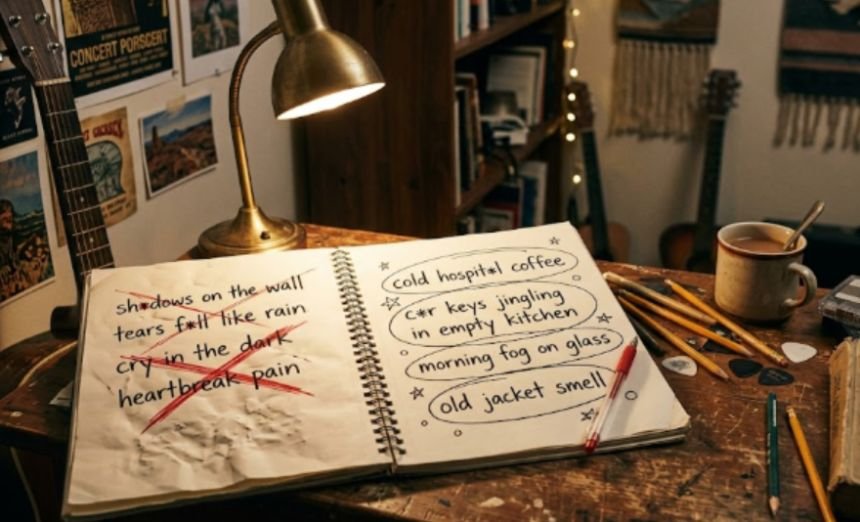
Feed an engine a prompt about grief, and it gives you “shadows on the wall,” “echoes in the hall,” and “tears falling like rain.” The machine defaults to predictable AABB rhyme schemes and polished platitudes. It cannot capture the peculiar stench of cold hospital coffee or the sound of car keys jingling in an empty kitchen.
Academic analyses from institutions like Berklee Online point out that while generative systems understand stylistic idioms, they lack cognitive context. They assemble language without understanding emotional weight.
When I tested a recent prompt asking for an indie-folk breakdown about estrangement, the engine served technically pristine stanzas. Yet, the lines were emotionally sterile. They sounded like a greeting card forced into four-four time.
Why Human Vulnerability Survives the Mix
Human lyricists write through the lens of lived friction. When songwriters create hooks, they do not rely on probabilistic math. They pull from private heartbreaks, cultural subtext, and unexpected sonic dissonances.
A human writer knows when an imperfect slant rhyme hits harder than a perfect rhyme. Consider how great records balance cadence and silence. The hesitation before a confession in a bridge cannot be calculated by a neural network. Raw lived experience gives lyrics their sticky, enduring power.
The Mechanics of Co-Creation: Building a Hybrid Lyric Workflow
Treating technology as an outright replacement produces disposable tracks. Treating it as a studio companion transforms your creative output.
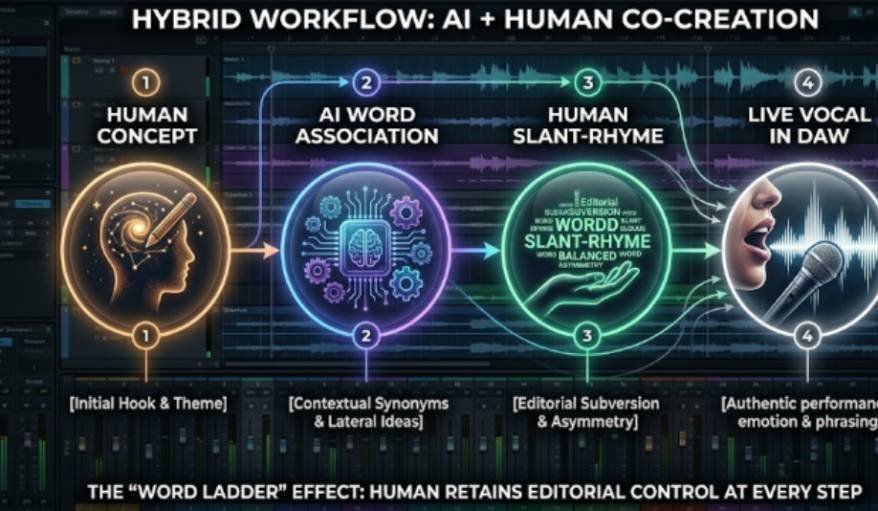
I use text models as high-speed lateral thesauruses. When I get stuck on a repetitive rhyme scheme, I do not ask the tool to write the stanza. I ask it for fifteen concrete objects associated with a specific memory—like an abandoned coastal highway or a rusted radiator.
My Hybrid Drafting Workflow:
[Human Concept & Angle]
│
▼
[AI Generates Atmospheric Word Association]
│
▼
[Human Selection & Slant-Rhyme Adaptation]
│
▼
[Live Vocal Phrasing & Structural Edits in DAW]
Using Generative Engines as Contextual Rhyme Ladders
If my chorus feels rhythmically stiff, I feed my draft into an engine and prompt: “Identify the meter of these lines and generate eight internal slant rhymes that avoid clichés.”
The model acts as an interactive brainstormer. It suggests syllables I can twist, subvert, or discard entirely. The final phrasing remains entirely mine. This process saves hours of creative fatigue while keeping my personal voice at the center of the track.
Protecting Your Copyright Footprint Inside Your DAW
Using these systems introduces serious legal considerations. The U.S. Copyright Office maintains that only human-authored expression qualifies for legal protection. Merely entering prompts does not grant you authorship over the raw text.
Furthermore, international frameworks monitored by WIPO highlight growing global friction regarding AI training datasets and intellectual ownership.
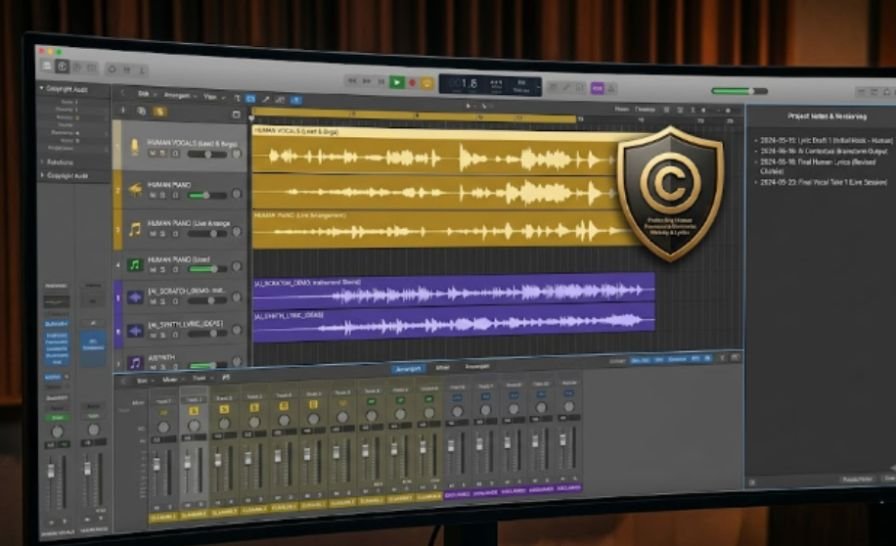
If an algorithm writes your entire verse verbatim, anyone can legally take that lyric and release it on their own project. To protect my work, I maintain a strict audit trail in my Digital Audio Workstation:
- Labeling channels clearly ([Human_Vocals] versus [AI_Scratch_Demo]).
- Saving dated lyric drafts in cloud documents showing my handwritten modifications.
- Disclaiming purely machine-generated backing loops during registration while claiming full ownership of my melody, arrangement, and lyrics.
Why Algorithms Fail the Hook Test
Modern listening habits demand immediate payoff. Because short form music is changing modern songwriting, listeners decide whether to skip a track within the first five seconds.
Machines struggle with immediate, unconventional economy. AI lyrics tend to be excessively wordy. They pack too many syllables into a measure, crowding the vocal performance and destroying pocket presence.
When you sing a melody across a syncopated groove, you often need an odd, asymmetrical phrase to snag the ear. Human intuition recognizes when a single nonsense word or an abrupt lyrical pause works better than a complete sentence. Algorithmic prediction smooths out those rough edges, stripping away the friction that makes a chorus hook an earworm.
Stop Treating Tech Like a Threat—Treat It Like an Intern
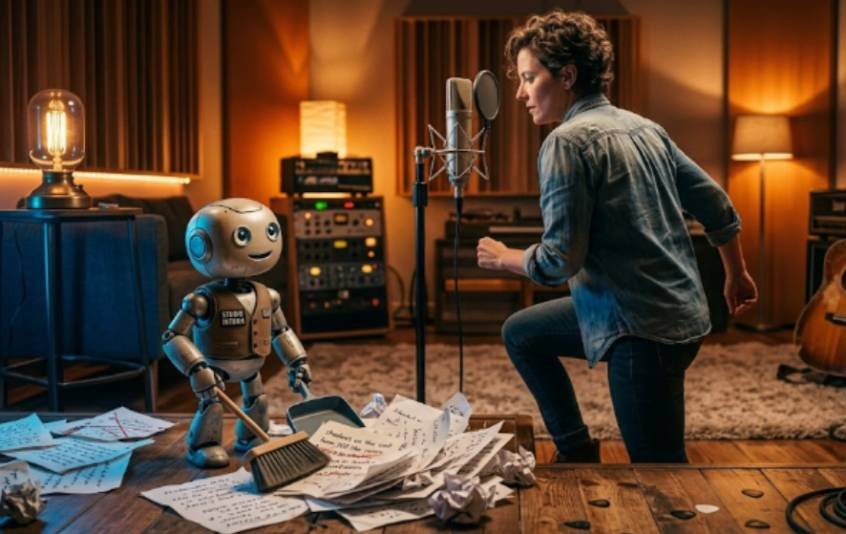
Stop waiting for a machine to write your masterpiece, and stop fearing that it will make your voice obsolete.
An algorithm is an intern: eager, lightning-fast, and completely devoid of taste. Use it to sweep up dead ends, generate wild word associations, and test arrangements. Then step up to the microphone, cut the digital fluff, and tell the truth that only you can tell.
Frequently Asked Questions
1. Can I copyright lyrics that an AI generated for my song?
No, purely machine-generated lyrics enter the public domain because copyright law requires human authorship.
2. How do I use AI lyric tools without sounding generic?
Use AI exclusively as an associative thesaurus for imagery, then manually rewrite every line using personal details and irregular slant rhymes.
3. Do commercial licenses from AI platforms grant true copyright ownership?
No, platform subscription terms only grant contractual permission to monetize, not statutory federal copyright protection.
4. What is the most obvious sign of an AI-generated song lyric?
Predictable AABB rhyming patterns, abstract emotional clichés, and overly dense syllable counts that disregard natural vocal phrasing.
Leave a Reply