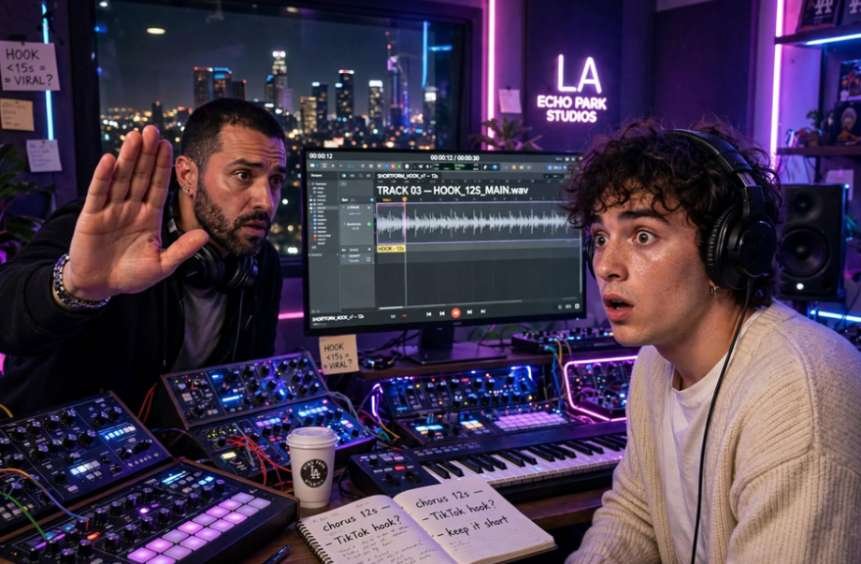
I sat in a Los Angeles writing session last month where the lead producer halted our playback after just twelve seconds. We had crafted a lush, atmospheric synth intro, but he shook his head: “Nobody on Reels will wait through eight bars of reverb.” That moment cemented a shift I have witnessed across recording studios: how short form music is changing modern songwriting at every level of arrangement, lyricism, and commercial pacing.
Songwriters no longer build slow burn ballads. Instead, we engineer tracks designed to capture fragmented digital attention spans across TikTok, Instagram Reels, and YouTube Shorts.
The Front-Loaded Hook: Eliminating the 30-Second Buildup
The classic pop formula (Intro → Verse → Pre-Chorus → Chorus) spent decades as the bedrock of radio hits. Today, that linear progression is practically obsolete. When listeners decide whether to swipe within milliseconds, delayed gratification is a liability.
In my recent co-writes, we almost always start on beat one with the central vocal hook or the chorus. Placing the core melody at the opening bypasses the skip button entirely. By delivering immediate melodic value, the listener receives the song’s primary emotional payoff before they have a chance to look away.
Dissecting the Death of the Traditional Bridge
The traditional eight-bar middle-eight bridge—once vital for providing harmonic contrast and narrative tension—is disappearing from modern tracking sessions. Production teams view bridges as momentum killers that trigger listener drop-off.
Rather than modulating keys or introducing a contrasting melodic motif, arrangements now favor constant energy. If an element does not directly reinforce the central hook or set up an immediate drop, it gets removed in the editing room.
This kind of decision can become especially important when bands write songs together, since multiple musicians may contribute different ideas to the final arrangement.
Writing for the 7-Second Retention Window
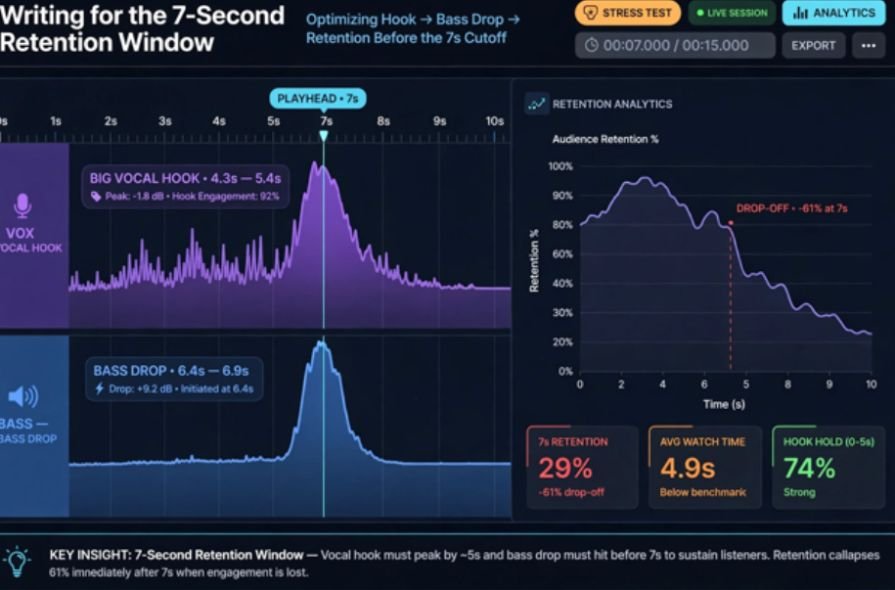
Analytics from short-form platforms prove that user drop-off peaks within the first three to seven seconds. Modern songwriters treat these opening seconds as high-stakes real estate.
During our tracking sessions, we use what we call the “seven-second stress test.” If the vocal melody, an unmistakable sound effect, or an aggressive bass drop does not occur before the playhead reaches seven seconds, we rewrite the top of the track. Leading institutions like the Berklee College of Music have even adapted their contemporary production coursework to address how viral snippet dynamics influence commercial arrangement.
The Architecture of the 15-Second Loop
Short-form platforms run on infinite repetition. Because video content loops continuously, songwriters construct audio that rewards cycling without causing ear fatigue.
Classic Linear Pop:
[Intro] ➔ [Verse] ➔ [Chorus] ➔ [Verse] ➔ [Chorus] ➔ [Bridge] ➔ [Chorus] ➔ [Outro/Fade]
Modern Loopable Form:
┌─── [Instant Vocal Hook] ➔ [Micro-Verse] ➔ [Chorus Hook] ───┐
└─────────────────── Seamless Cadence Loop ──────────────────┘
Crafting Unresolved Harmonic Cadences
Writing a loopable song requires rethinking traditional music theory resolutions. Resolving a progression to the tonic root chord signals a sense of finality. In social audio, finality encourages the user to swipe away.
We now intentionally end choruses on unresolved chords, such as the IV (subdominant) or V (dominant) step. When the progression fails to resolve cleanly at the bar line, the ear naturally seeks resolution by cycling right back to the opening bar. The loop feels endless, artificially inflating repeat plays.
Lyric Punchlines as Visual Cues
Song lyrics have shifted from sprawling poetic narratives to more compact and conversational forms, reflecting a broader trend toward simpler, more straightforward, and repetitive lyrical structures.
Modern songwriting increasingly favors conversational lyrics, using direct and accessible language rather than relying solely on elaborate poetic structures.
Content creators require audio that provides immediate visual context for skits, transitions, makeup transformations, and lifestyle vlogs. For independent artists, curated user playlists vs. editorial pitching can also shape how their music reaches new listeners and gains exposure across digital platforms.
Placement: Under “Lyric Punchlines as Visual Cues”
When drafting lyrics, I ask myself: Can a creator act this line out in a three-second video? Lines that express sharp emotional contrasts, relatable grievances, or comedic punchlines perform significantly better than abstract imagery. The lyric functions simultaneously as music and as dialogue.
Studio Economics: Sub-Two-Minute Arrangements and Algorithmic Payouts
The creative restructuring of modern music is closely tied to streaming economics. Digital streaming providers register a monetized play once a track plays past the 30-second mark.
A song that runs four minutes generates the exact same streaming royalty as a song that runs one minute and fifty seconds. However, the shorter song can be streamed twice as many times within the same listening hour.
Chart data tracked by Billboard confirms this structural transformation: the average duration of Hot 100 charting songs has dropped by more than a minute over the past three decades.
Academic studies from institutions like the UCLA Department of Statistics mirror these findings, illustrating that track runtimes across major streaming catalogs have consistently trended downward since the rise of on-demand platforms.
| Songwriting Dimension | 2000s Pop Architecture | Current Short-Form Pop |
| Average Song Length | 3:30 – 4:15 minutes | 1:50 – 2:30 minutes |
| First Vocal Entrance | 0:15 – 0:30 seconds | 0:01 – 0:04 seconds |
| Structural Climax | Dynamic Bridge / Key Change | 15-Second Audio Hook |
| Harmonic Cadence | Resolved Root Cadence | Unresolved / Circular Progression |
For self-funded artists funding their own tracking dates, exploring vetted music grant opportunities can offset early production costs while experimenting with these alternative formats. Pairing these resources with smart independent music distribution allows emerging musicians to deploy modular releases without label interference.
Mobile-First Production: Mixing for Smartphone Speakers
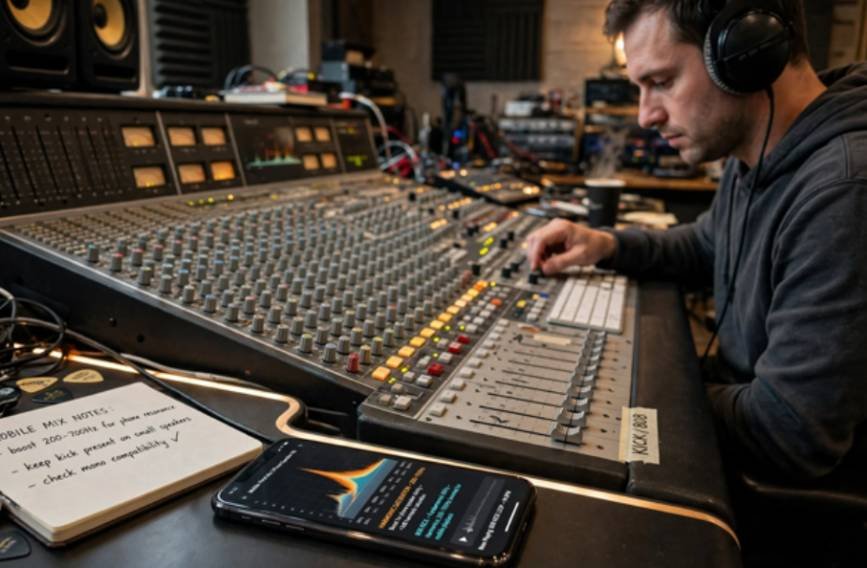
Songwriting and mixing are no longer separate phases; they happen in tandem. Because the overwhelming majority of short-form content is consumed through built-in phone speakers, studio mixing workflows have fundamentally changed.
Sub-bass frequencies below 60 Hz disappear completely on mobile hardware. To keep an 808 or kick drum audible, we apply aggressive harmonic saturation between 200 Hz and 700 Hz. This saturation tricks the human ear into perceiving low bass notes even on tiny speakers.
Furthermore, lead vocals are placed 1 to 2 dB higher in the mix than traditional radio standards dictate. This forward vocal placement ensures lyrical punchlines cut through ambient room noise and compression artifacts.
Frequently Asked Questions
1. Why are songs getting significantly shorter?
Streaming platforms pay identical royalties after 30 seconds, financially incentivizing shorter tracks that achieve higher replay volume per hour.
2. What is the most effective way to start a song for TikTok?
Begin immediately on beat one with the vocal melody or a distinctive sound effect to prevent listeners from swiping away.
3. Why do artists release sped-up and slowed-down versions of their songs?
Releasing official alternate mixes captures creator-driven remix trends on social platforms while claiming all associated streaming revenue.
4. Has short-form audio eliminated the traditional bridge completely?
While not completely gone, bridges are routinely removed in contemporary commercial pop to maintain high energy and prevent audience drop-off.
Stop Writing Tracks, Start Engineering Sonic Moments
You do not need to abandon artistic integrity to thrive in the modern music landscape, but you must respect how the modern listener consumes art. Write songs that respect immediate attention spans, eliminate self-indulgent arrangements, and treat every 15-second block as a standalone experience.
For emerging artists, the importance of stage presence for emerging artists becomes clear when translating recorded music into a memorable live experience.
Before you book your next studio session, export a 15-second snippet of your chorus and test it directly against a phone speaker. If that isolated loop fails to turn heads without production context, return to the whiteboard and refine the melody.
Leave a Reply