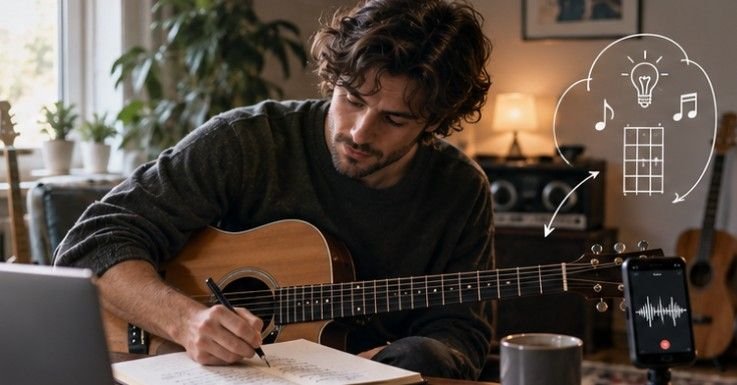
A band does not need four people staring at the same lyric sheet to write collaboratively. Some of the strongest group-written songs begin with one unfinished riff, a rough phone recording, a drum groove, or even a lyric nobody knows how to finish.
That flexibility is the simplest answer to how do bands write songs together: they combine individual strengths rather than forcing every member to contribute in exactly the same way. One musician might create the chord progression, another reshape the structure, while someone else finds the vocal hook that makes the entire song click. The difficult part is rarely generating ideas. It is deciding which ideas deserve to survive.
There Is No Single Band Songwriting Formula
Professional songwriting education reflects this variety. Berklee College of Music teaches collaborative models ranging from traditional composer-and-lyricist partnerships to production-led pop, R&B, and hip-hop workflows. Its coursework also covers virtual collaboration, decision-making, coauthorship, and creative conflict. That is useful because bands usually fall somewhere between four basic methods.
| Writing method | How it starts | Works especially well when |
| Primary songwriter | One member brings chords, lyrics, melody, or a demo | The group has a clear creative leader |
| Rehearsal-room jam | A riff, groove, or rhythm develops spontaneously | Members communicate well musically |
| Building-block method | Members add individual parts in stages | Everyone has different specialist strengths |
| Remote collaboration | Demos, stems, lyrics, or project files are exchanged | Members cannot regularly work in one room |
Most bands eventually combine several of these approaches instead of choosing only one, like for a music collective.
One Member Brings the Skeleton
Probably the fastest arrangement is having one person arrive with the core song already established.
They may have a verse, chorus, chords, melody, lyrics, or acoustic demo. The drummer then changes the rhythmic character. The bassist finds movement between chords. The guitarist adds counter-melodies, while the vocalist adjusts phrasing until the song becomes comfortable to perform.
The original writer provides direction without necessarily dictating every detail.
This distinction matters. A songwriter may write the composition while other musicians create distinctive performance or arrangement parts. Under U.S. Copyright Office guidance, authorship of a musical work relates to who created its music or lyrics; simply being a member of the performing band does not automatically make someone a co-author of the composition. Bands should clarify that difference before releasing music rather than arguing about it afterward.
Other Songs Grow Out of a Jam
At the opposite extreme, nobody arrives with a song.
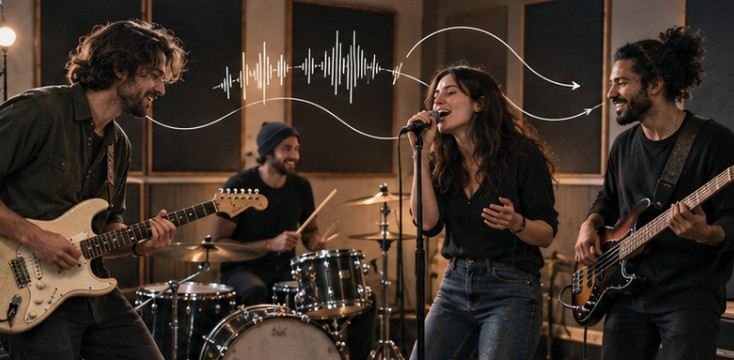
A drummer plays a pattern. The bassist responds. A guitarist discovers a progression over it. Someone records the rehearsal while the singer experiments with sounds, words, or melodic fragments.
After five minutes of improvisation, there may be thirty seconds worth keeping. That thirty seconds is enough. The mistake is expecting a jam to produce a perfectly structured song in real time. A better process is to treat improvisation as raw material. Record everything, identify the strongest moment, and rebuild around it.
The second session should therefore be less about jamming and more about editing.
Ask:
Does the riff still feel interesting after eight repetitions?
Can the listener recognize where the chorus begins?
Does the vocal melody compete with another instrument?
Is there enough contrast between sections?
Could one section disappear without hurting the song?
Those questions turn spontaneous creativity into composition.
The Building-Block Method Gives Everyone Space
Some musicians generate their best ideas alone even as small music venue ventures.
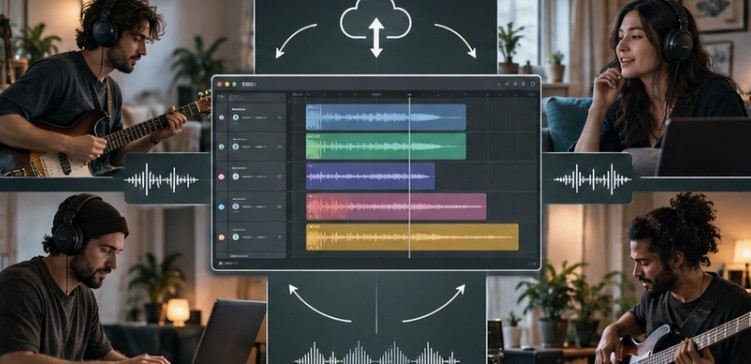
A guitarist might send a 90-second demo to the drummer. The drummer records a groove and returns it. The bassist adds another layer. The vocalist develops a melody and lyrics before everybody meets to revise the arrangement.
Berklee’s graduate collaborative songwriting curriculum specifically includes remote workflows, task division, team communication, song splits, copyright, and web-based collaboration, showing how intertwined modern songwriting and production have become.
This method can be especially effective when one dominant personality tends to control rehearsal-room sessions. Working separately gives quieter members time to develop ideas without competing for attention.
Its weakness is obvious: endless versions. Label files clearly, choose one person to maintain the current master version, and decide when experimentation stops.
Why Band Songwriting Sometimes Fails
Creative disagreement is not evidence that a band cannot write together. The larger problem is usually unclear decision-making.
Four musicians may each hear a different version of the song. One wants a longer introduction. Another wants to reach the chorus immediately. The drummer wants rhythmic complexity while the vocalist needs more space.
Instead of arguing over personal preference, test both versions. Record the long intro and short intro. Listen the following day. Ask which version communicates the song better.
Separating creation from evaluation also helps. Constant criticism while ideas are still being generated can stop a session before anything interesting emerges. Write freely first. Edit aggressively later.
Songwriting Credit Is Not the Same as Band Membership
This deserves special attention for American bands.
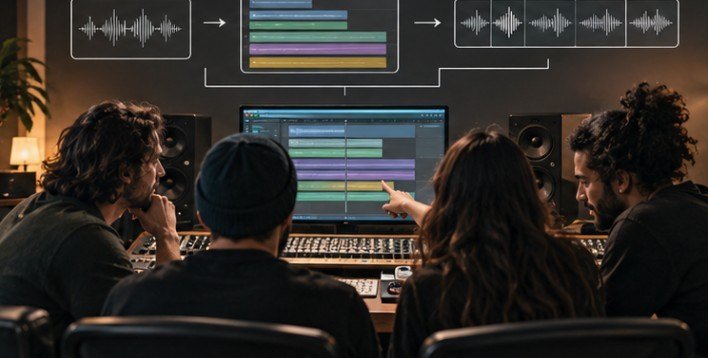
The U.S. Copyright Office describes a joint work as one prepared by multiple authors who intend their contributions to become parts of one unified work. Joint authors can become co-owners of the copyright.
That does not mean every rehearsal suggestion automatically establishes songwriting ownership.
Bands may choose equal splits for relationship or business reasons, but they should make that choice intentionally. Discuss credits while memories are fresh, document the agreement, and obtain professional legal advice when significant money, publishing, labels, or licensing deals are involved.
Famous partnerships also demonstrate how differently collaboration can operate. The Songwriters Hall of Fame describes Bernie Taupin delivering lyrics that Elton John would then set to music—a clearly divided creative partnership that still produced unified songs.
Frequently Asked Questions
1. Do all band members normally write the songs?
No. Some bands have one main songwriter, while others divide music, lyrics, arrangement, and production among several members. The method depends on the personalities and skills involved.
2. How do bands write songs together without arguing?
Separate idea generation from editing, record competing versions, establish who makes final decisions, and evaluate ideas according to what improves the song rather than who proposed them.
3. Should every band member receive songwriting credit?
Not automatically. Songwriting authorship and performing membership are different concepts. Bands should identify actual creative contributions and agree on ownership before commercial release.
4. Can a band write songs remotely?
Yes. Members can exchange demos, stems, lyrics, MIDI files, and DAW sessions, then meet virtually or in person to make final structural and creative decisions.
What Makes Collaborative Writing Actually Work
The most productive answer to how do bands write songs together is not “everyone contributes equally.” It is that everyone contributes where they are strongest.
A great drummer may transform a weak riff without writing a lyric. A bassist may discover the musical transition that finally makes two sections belong together. A singer may replace ten complicated lines with one unforgettable phrase.
The goal is not to prove whose idea was best. It is to recognize the moment when several separate ideas stop sounding like individual contributions and start sounding like one song. That is usually when the band has finished writing.
Leave a Reply