
Every producer and writer I share a studio with has felt the pressure: craft a 10-second vocal loop that immediately sparks an online trend. While a viral moment provides a short-term spike, it frequently leaves artists stranded with disposable streams and hollow catalogs. In my own co-writing sessions, discovering how songwriters create hooks that work beyond TikTok meant unlearning the habit of chasing isolated micro-dopamine hits.
True musical longevity demands that a hook act as the structural, emotional, and melodic thesis of a complete three-minute record.
The Problem with Snippet-First Composition

Writing purely for an algorithm distorts song architecture. It is no secret that short form music is changing modern songwriting, compressing intros to near zero and eliminating the traditional bridge. Research from Ohio State University documented that average pop song intros shrank from roughly 23 seconds in the mid-1980s down to 5 seconds.
When a melody exists solely to serve an algorithmic swipe, it burns out quickly. Listeners jump over to Spotify, find that the rest of the track lacks context or substance, and bounce before the 30-second mark. If you want your music added to personal libraries and curated user playlists where tracks spin for years, the hook must offer structural resolution, not just immediate novelty.
Core Principles: Writing Beyond the 15-Second Clip
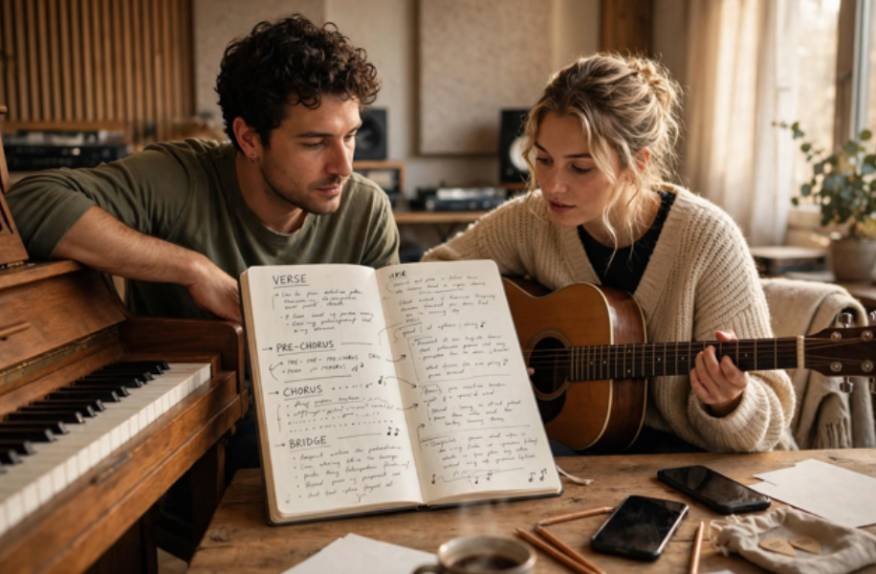
To build staying power into your choruses, shift your focus from standalone clips to cohesive song craft.
1. Engineering the Narrative and Harmonic Runway
An enduring hook derives power directly from the tension that precedes it. In a standalone video, a snippet needs zero backstory; in a complete song, the verses are the vital runway.
- Narrative Stakes: The verse must establish the emotional conflict: who is speaking, what is on the line, and why the listener should care. When the chorus lands, it should feel like an earned realization rather than an arbitrary arrival.
- Harmonic Relief: Withhold tonal resolution in your pre-chorus. Hovering on a minor iv chord or parking on an unresolved dominant V chord creates natural ear hunger. When the chorus finally lands on the tonic root, the listener experiences physical acoustic relief.
2. Dialing in Melodic Symmetry and Contrast
The human brain loves patterns, but it tunes out predictable loops. Enduring pop music relies on clear cognitive balance:
- Symmetry via AABA: Deliver a sticky musical motif twice, divert expectations on the third line, and return home to stick the landing on the fourth.
- Harmonic Toggling: Keep the vocal melody line identical during the chorus repeat while altering the underlying chord progression. This preserves familiarity while keeping the ear actively engaged.
- Rhythmic Density Shift: If your verses rely on rapid-fire, syncopated phrasing, widen the chorus. Switch to elongated vowels and sustained whole notes. The dynamic shift commands instant focus.
3. Stacking Hooks Across the Production
Viral songs often pin their hopes on one single vocal trick. Classic records build an ecosystem of hooks that pass attention across the mix like a relay baton:
- Phonetic Earworms: Incorporate universal non-verbal vocalizations (“la-la”, “whoa-oh”). They allow anyone to scream along regardless of language or lyric memory.
- Lyrical Turn-of-Phrase: Write titles that present an intriguing contradiction or clear visual metaphor.
- Instrumental Counter-Melodies: Craft a distinctive guitar riff, synth line, or bass ostinato beneath the vocal. When the singer breathes, the instrumental hook carries the pulse.
- The Post-Chorus Tag: Add a secondary melodic phrase right when the listener assumes the section has wrapped. It prevents the arrangement from stalling.
As educators at the Berklee College of Music often highlight, long-term careers are built on whole-song architecture rather than fragmented audio bites.
4. Choosing Human Universality Over Viral Specificity
Social algorithms reward hyper-niche internet subcultures and inside jokes. Stadium anthems, classic radio records, and timeless catalog hits require broad emotional truth.
Strip your central lyric down to a fundamental human experience: existential dread, persistent hope, gut-wrenching grief, or mutual devotion. When an idea is emotionally open, millions of listeners can fit their own lives into your chorus.
In the Studio: What A Full-Length Hook Test Looks Like

Whenever we finish a demo, my collaborators and I run what we call the “Acoustic Translation Test.” We strip away 808s, vocal chops, and sidechain compression, sitting at an upright piano or acoustic guitar.
If the chorus feels empty without production tricks, it is just audio candy. If the chord movement, melodic contour, and central lyric still evoke an emotional reaction with a single instrument, the foundation is sound. The American Society of Composers, Authors and Publishers (ASCAP) emphasizes that lasting song royalties are driven by melodic integrity, not temporary production fads.
Don’t Just Stop the Scroll—Build a Catalog
A viral snippet might grab a pair of eyes for ten seconds, but an architectural hook secures an audience for decades.
A viral snippet might grab a pair of eyes for ten seconds, but an architectural hook secures an audience for decades. For listeners who want to move beyond viral clips, where to find new independent music can be just as important as how artists build songs that stand the test of time.
Stop treating your chorus like social media bait. Write purposeful verses, build undeniable harmonic setups, and ground your message in universal truths.
Sit at your instrument, mute the trends, and focus on finishing the entire narrative arc.
Frequently Asked Questions
1. What makes a song hook timeless instead of trendy?
A timeless hook functions as the emotional payoff of the full song rather than an isolated soundbite.
2. How do I stop listeners from skipping after hearing the viral snippet?
Use the verse to create unresolved harmonic tension and an engaging story that makes the chorus feel earned.
3. What is a stacked hook in modern pop production?
A stacked hook layers vocal phrases, instrumental counter-melodies, and post-chorus tags to maintain continuous momentum.
4. Can a song succeed on TikTok and still hold classic longevity?
Yes, provided the viral snippet is built around universal human emotion and supported by strong full-song architecture.
Leave a Reply