
When I launched my first self-released EP, commercial radio wouldn’t even open my emails. Like most DIY artists, I lacked a five-figure PR budget or a major distributor behind me. That dynamic changed entirely once I shifted my focus to pitching independent music to college radio promoters and student music directors (MDs).
Within six weeks, three regional campus stations added my lead single to medium rotation, creating a ripple effect that boosted my streaming profile and landed my band headlining club gigs in college towns I had never visited.
College radio remains one of the few true discovery platforms in an algorithm-dominated industry. Campus music directors and student DJs are not bound by commercial corporate playlists; their mission is to uncover fresh, boundary-pushing artists. If you want to break onto the airwaves, you must pitch like a seasoned professional while respecting the unique rhythms of campus broadcasting.
Understanding the College Radio Gatekeeper Ecosystem
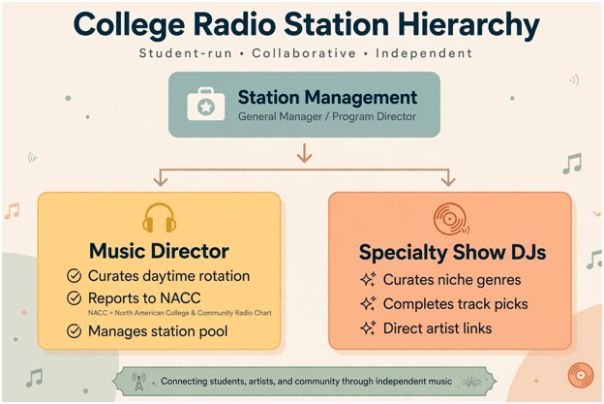
Early on, I wasted months firing blind emails to generic info@station.org addresses. Understanding station hierarchy is critical to securing airplay.
┌────────────────────────────────────────────────────────┐
│ STATION MANAGEMENT │
│ General Manager / Program Director │
└──────────────────────────┬─────────────────────────────┘
│
┌─────────────┴─────────────┐
▼ ▼
┌─────────────────────────┐ ┌─────────────────────────┐
│ MUSIC DIRECTOR │ │ SPECIALTY SHOW DJS │
│ • Curates daytime rota │ │ • Curate niche genres │
│ • Reports to NACC │ │ • Complete track picks │
│ • Manages station pool │ │ • Direct artist links │
└─────────────────────────┘ └─────────────────────────┘
General Music Directors vs. Specialty Show Hosts
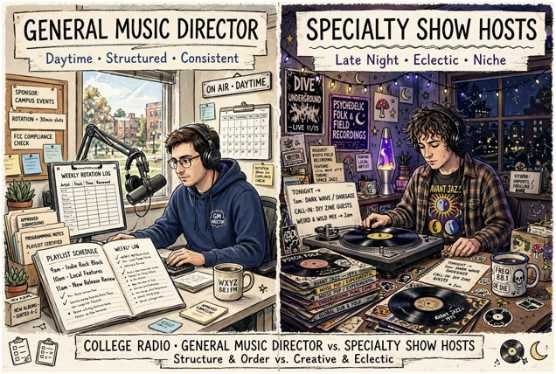
College radio programming splits into two primary avenues:
- The Music Director (MD): The MD manages the station’s general library, sorts incoming submissions, and selects tracks for regular daytime rotation (Heavy, Medium, and Light rotation tiers). If your music fits indie rock, dream pop, bedroom pop, or alternative singer-songwriter, the MD is your target.
- Specialty Show Hosts: If you produce niche electronic, hip-hop, ambient, hardcore, or metal, avoid the general daytime MD. Late-night and weekend programming is almost always helmed by volunteer student DJs who possess total curation autonomy. Pitch these hosts directly by name.
I always cross-reference station schedules and monitor their real-time spins using Spinitron. If a DJ ran an hour of shoegaze last Thursday, that is the exact person who needs to see your track.
Respecting the Academic Calendar and Tuesday Add Cycles
College stations mirror the university calendar. Outreach sent during mid-December finals, early January breaks, or summer vacations will sit unopened in a crowded inbox. Focus your campaigns between September and November, or February and April.
Furthermore, non-commercial stations report their playlist additions to the North American College and Community Chart (NACC) every Tuesday by 2:00 PM EST. Music directors usually assemble their add-lists on Sunday night and Monday afternoon. Send your pitches on Thursday or Friday morning so they sit near the top of the stack when weekly curation begins.
Preparing an Airtight, Radio-Ready Asset Package
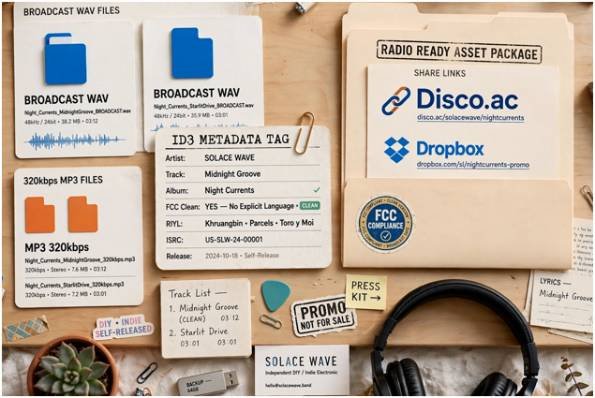
Music directors sort through hundreds of pitches weekly. When I audited submission habits with a former MD at a major Midwestern college station, they noted that over 70% of independent emails are discarded simply because links require permission requests, files are unorganized, or tracks contain unedited profanity.
Broadcast Audio Formats and FCC Compliance
Stations broadcast under strict Federal Communications Commission (FCC) guidelines. Airing unedited profanity exposes a station to heavy fines or license revocation.
Provide a folder containing both lossless broadcast WAV files (24-bit or 16-bit / 44.1kHz) and high-bitrate MP3s (320kbps). Every track must feature clean ID3 metadata:
- Artist Name, Track Title, Album Name, Year, and Primary Genre
- The Comment Field: Clearly state whether the track is broadcast-ready (e.g., FCC Clean / Radio Edit / RIYL: Alvvays, Japanese Breakfast).
Never send raw audio files as direct email attachments. Use a seamless, public hosting link like Disco.ac, Dropbox, or a private SoundCloud playlist featuring download buttons.
The Single-Page One-Sheet Formula
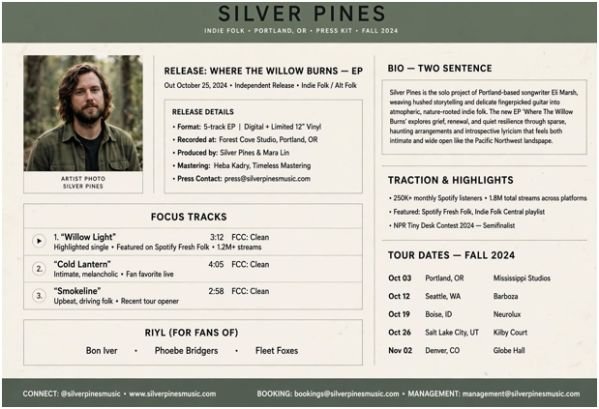
Attach a single-page PDF “one-sheet” to your submission. A great one-sheet saves the music director from hunting across the web for context. Keep it under one page and ensure it highlights:
- Core Release Details: Artist name, release date, record label (or self-released), and geographic hometown.
- Focus Tracks: Point directly to one or two priority singles, including exact runtimes and FCC status.
- RIYL / FFO: Two or three recognizable “Recommended If You Like” reference artists to establish your sonic territory instantly.
- Two-Sentence Bio: A concise summary of your sonic identity and recent momentum.
- Traction & Context: Notable press quotes, previous spins on other independent radio stations, or regional tour dates.
Anatomy of a High-Conversion Radio Pitch
When pitching independent music to college radio promoters, brevity wins. Keep your email between three and five sentences.
Writing Subject Lines That Demand a Click
Skip vague subject lines like “Check out my new song.” Music directors scan for genre, relevance, and compliance. Use this structure:
Music Submission: [Artist Name] – “[Track Title]” ([Primary Genre] / FFO: [Artist A, Artist B])
My Battle-Tested Email Outreach Template
Here is the exact pitch email I rely on for college campaigns:
Plaintext
Subject: Music Submission: Silver Pines – “Ghost Town” (Indie Rock / FFO: Snail Mail, Metric)
Hi Jordan,
I love your Thursday afternoon indie rotation on WXTJ, especially your recent spin of the new Wednesday single.
I’m an independent indie-rock artist from Richmond, VA, and I’m submitting my upcoming single, “Ghost Town” (out Oct 24th), for your daytime playlist consideration. It’s an upbeat, guitar-driven track recorded with clean broadcast specs.
Listen & Download Here: [Public Disco / Dropbox Link]
Quick Specs: 3:18 | 100% FCC Clean | RIYL: Snail Mail, Metric, Beach Bunny
The link above contains broadcast WAVs, 320kbps MP3s, a 1-page one-sheet, and press photos. We’re on tour through Virginia this November and would love to cut custom station liners or stop by for a short in-studio session if you’re interested.
Thank you for championing independent artists,
Alex Vance / @silverpinesmusic / (555) 019-2834
Send a single follow-up email precisely seven to ten days later on the same thread. If you don’t receive a reply, move on. College stations run on volunteer hours; relentless badgering burns bridges.
Leveraging Airplay into Real Career Momentum
Securing spins on college radio is not a vanity metric—it provides tangible commercial leverage. When campus stations begin spinning your release, document every play. Tag the station and host on social media to build public goodwill.
Furthermore, demonstrable radio traction serves as vital social proof when pitching music supervisors for micro sync licensing opportunities.
Supervisors for independent films, web series, and gaming look for records that already hold third-party tastemaker validation. Use your NACC chart position or station spins as leverage in your sync pitches to prove your sound connects with engaged listeners.
Break the Airwaves: Your Next Move
Securing college radio play isn’t a mysterious club reserved for well-funded labels; it is an exercise in preparation, respect, and targeted execution.
Pick three target campus stations in your state today, audit their recent Spinitron playlists, and assemble your radio-ready package.
One committed student DJ spinning your track in heavy rotation can ignite the regional buzz your project deserves.
Beyond the Airwaves: FAQs About College Radio Promotion
1. How far in advance should I submit music to college radio?
Submit your music two to four weeks before your official release date so music directors have time to review, download, and schedule tracks.
2. Can I pitch songs with explicit language to campus radio?
No; FCC regulations strictly prohibit profanity on non-commercial terrestrial broadcasts, so you must supply a clean radio edit.
3. How do I check if college stations are playing my music?
Track airplay using the NACC weekly charts, monitoring station logs on Spinitron, or receiving alerts via digital tracking tools.
4. What is the difference between a college radio promoter and a music director?
A music director is a station employee who curates broadcasts, whereas an independent promoter is a third party hired by an artist to pitch their music to those directors.
Leave a Reply