
I blew $2,500 on my first indie record push hiring a traditional boutique agency. The result? Two obscure write-ups, zero Spotify algorithmic movement, and an inbox full of form-letter apologies from my account manager.
That expensive mistake taught me how modern media consumption actually works. Running successful independent music PR campaigns on a budget does not require a deep-pocketed investor. It requires an organized strategy that values writer relationships, sharp visual positioning, and audience conversion over empty prestige.
The Myth of the $3,000 Music PR Retainer
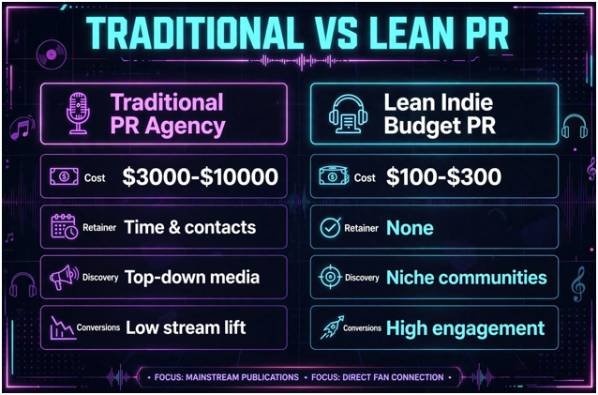
Most publicists charge between $1,500 and $4,000 monthly, demanding a three-month non-refundable commitment. That financial model made sense when gatekeepers at print magazines and terrestrial radio controlled discovery.
┌─────────────────────────────────────────────────────────────┐
│ TRADITIONAL VS. LEAN PR │
├──────────────────────────────┬──────────────────────────────┤
│ Traditional PR Agency │ Lean Indie Budget PR │
├──────────────────────────────┼──────────────────────────────┤
│ Cost: $3,000 – $10,000 │ Cost: $100 – $300 total │
│ Retainer: Time & contacts │ Retainer: None │
│ Discovery: Top-down media │ Discovery: Niche communities │
│ Conversions: Low stream lift │ Conversions: High engagement │
└──────────────────────────────┴──────────────────────────────┘
Where Major Label PR Money Actually Goes
Retainers fund hours and access, not guaranteed headlines. A publicist cannot force an editor at Pitchfork or Rolling Stone to review an unproven record. When major labels invest five figures into campaign publicity, they are buying persistent relationship maintenance across broad multi-artist rosters.
The Lean PR Conversion Reality
Music coverage rarely delivers immediate direct streams on its own. Modern listeners do not jump from a dense text review straight to Apple Music to stream a full discography. Instead, press provides authoritative social proof. Securing reviews validates your art so industry bookers, playlist curators, and skeptical listeners take your music seriously.
Phase 1: Assembling a Frictionless Digital EPK
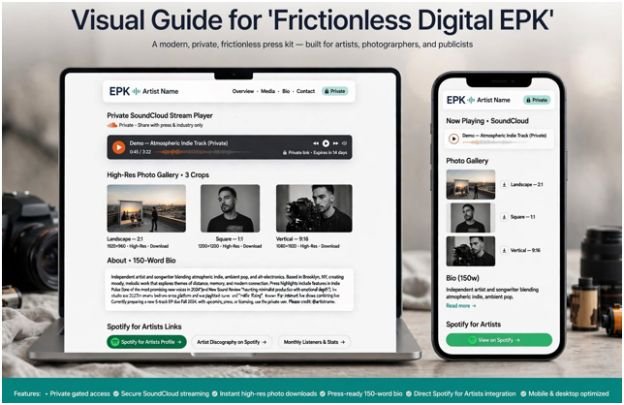
Before sending cold outreach emails, you need an Electronic Press Kit (EPK) that respects an editor’s limited attention span. Never attach MP3 files, ZIP archives, or heavy PDF documents directly to an email.
Visuals and Aesthetic Framing
Your photos dictate whether a curator reads your pitch or clicks delete. Book a local photographer who understands current subculture aesthetics. Deliver three distinct orientation crops: wide landscape, standard square, and 9:16 vertical portraits. Keep your visual palette aligned with your sound so writers immediately identify your creative world.
Unreleased Streams and Editorial Assets
Host your EPK on a dedicated, unlisted web link using simple tools or Bandzoogle. Ensure it contains:
- A private, streamable SoundCloud or Dropbox link that plays smoothly on mobile devices.
- A single downloadable folder housing high-resolution images and clear credit metadata.
- A concise 150-word bio highlighting your artistic lineage, unique background hook, and release dates.
- Active, claimed links to your profiles on Spotify for Artists and social media platforms.
Phase 2: The Direct DIY Media Pitching Engine
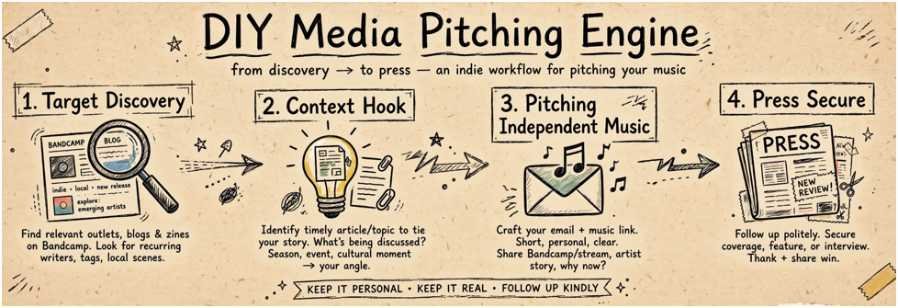
Landing organic reviews requires consistent personal communication rather than mass BCC mailings. Editors want to know why you belong in their publication right now.
Target Discovery ──► Context Hook ──► Pitching Independent Music ──► Press Secure
Finding Hungry Mid-Tier Journalists
Skip national consumer publications during early campaigns and target grassroots outlets instead. Scan platforms like Bandcamp Daily to find writers who consistently champion regional talent and sub-genre releases.
Read recent articles from independent blogs, look up who covers emerging releases, and log their direct contact information inside a simple spreadsheet.
Writing a Cold Pitch That Secures Replies
When pitching independent music, brevity outperforms self-indulgent essays. Follow this tested cold outreach framework:
Subject: Private Stream: [Artist Name] – “[Track Title]” (RIYL: [Notable Reference 1], [Notable Reference 2])
Hey [Writer Name],
Loved your recent analysis on [Specific Article they wrote]. Your breakdown of that record’s production style caught my attention.
I am releasing my new single “[Track Title]” on [Date]. It blends [Micro-Genre] with [Distinct Narrative Hook/Theme]. Given your focus on [Writer’s Niche], I wanted to share this early private stream: [Direct Stream Link].
The full digital EPK with press photos and release details is available here: [EPK Link]. Happy to coordinate an early track premiere or short Q&A if it fits your editorial calendar.
Thanks for your time and ears,
[Your Name]
Always send outreach at least four to six weeks prior to your official release date. Editors finalize calendars far in advance, and reaching out days before release guarantees missed coverage.
Phase 3: Deploying Micro-PR and Curator Aggregators
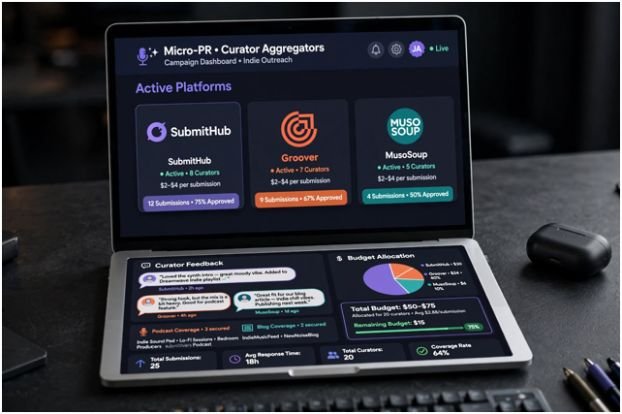
When you have a modest promotional budget between $100 and $300, crowd-sourced pitching networks offer reliable paths to get featured on independent music blogs and podcasts without long-term retainers.
Groover and SubmitHub Budget Allocation
Services like SubmitHub and Groover let you pitch individual bloggers, playlisters, and micro-tastemakers for $2 to $4 per submission. Curators must listen to your track and provide actionable feedback within a strict multi-day deadline.
Allocate $50 to $75 across 20 carefully vetted curators in your exact sub-genre. Review each curator’s past approval rates and check whether their blog embeds yield genuine community discussion rather than bot activity.
Crowd-Sourced Editorial Coverage via MusoSoup
MusoSoup shifts the pitching dynamic by operating as an open marketplace. You pay an upfront campaign fee (around $40 to $60) to submit your press-ready single to their platform.
Curators, indie radio hosts, and zine writers browse active submissions and offer coverage options directly to you. This approach frequently unlocks podcast appearances, playlist additions, and regional blog reviews for minimal capital.
The Amplifier Effect: Turning Small Press Into Major Fan Conversions
The primary value of independent press is not direct traffic; it is third-party credibility. According to consumer trust frameworks explored in the Harvard Business Review, third-party editorial validation dramatically reduces consumer purchase and streaming hesitation.
[Secured Niche Blog Review]
│
▼
[Pull Quote: “Essential dark-pop single”]
│
▼
[Overlay on 9:16 Meta/TikTok Ad]
│
▼
[35% Reduction in Cost-Per-Click]
Extract the single most compelling quote from your blog coverage and overlay it across 9:16 vertical video assets running on Meta ads. When prospective listeners see an authentic pull-quote from a music outlet, your ad click-through rates rise while your cost-per-stream drops. A $50 micro-PR review turns into the creative fuel for a highly profitable paid discovery campaign.
Frequently Asked Questions About Indie PR
1. How far in advance should I start an independent music PR campaign?
Begin pitching press outlets four to six weeks before release to accommodate editorial lead times.
2. How much money do I need for a DIY music PR push?
You can execute an effective campaign for $100 to $300 using curated pitching tools and direct outreach.
3. Do music blogs still help you gain Spotify streams?
Blogs build vital industry credibility that lowers your digital ad acquisition costs, though they rarely generate massive raw streams alone.
4. Can I run a PR campaign after my single is already released?
Post-release PR is much harder to pitch, as most editors only consider unreleased music for premiere features.
Ditch the Checkbook and Own Your Rollout
Stop treating press coverage like a lottery ticket you must buy from an expensive middleman. Treat PR as an iterative direct-response system. Build a clean EPK, pitch writers who genuinely love your genre, and use your press clippings to supercharge your social ads. Put the money you saved on a publicist directly into your studio production or digital ad spend, and control your own musical momentum.
Leave a Reply