I spent years uploading masters through nearly every digital aggregator on the web, watching small royalty percentages vanish into hidden contract clauses. Finding the best digital music distribution for independent musicians comes down to your release velocity, long-term catalog security, and how each distributor treats your publishing data.
A bad choice leaves your songs trapped behind recurring subscription paywalls or bleeds your streaming profits via perpetual backend commissions.
How often do you drop music ?
+——————————-+
| How often do you drop music? |
+—————+—————+
|
+—————-+—————-+
| |
1-2 Tracks / Year 3+ Tracks / Year
| |
[ Pay-Per-Release ] [ Flat Subscription ]
CD Baby ($9.99/single) DistroKid ($24.99/yr)
– Permanent hosting – Unlimited drops
– No renewal anxiety – 100% streaming payouts
– 9% commission on DSPs – Songs drop if plan lapses
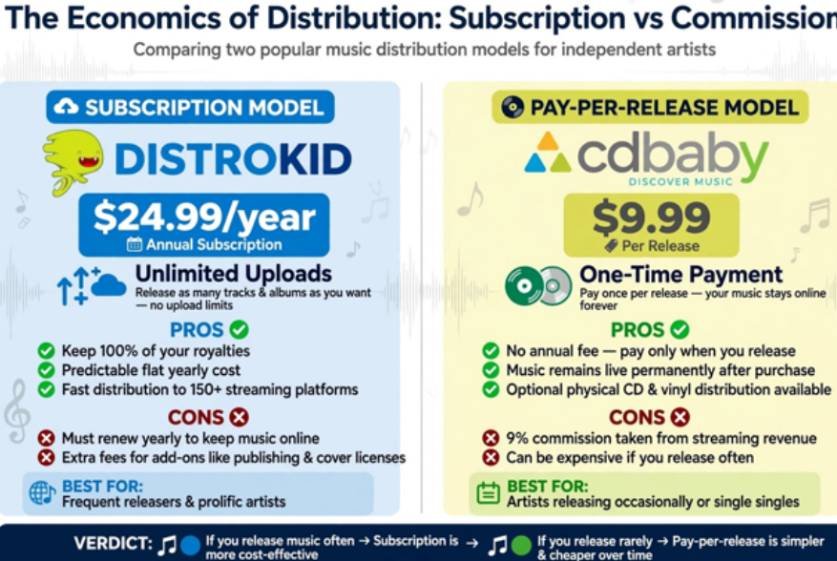
The Economics of Distribution: Subscription vs. Commission
Aggregators divide into two pricing camps: annual recurring fees and one-off upload charges.
Flat-Fee Subscriptions: DistroKid and Ditto Music
If you drop multiple tracks a year, subscription services offer high financial leverage. DistroKid charges $24.99 annually on its baseline Musician plan, allowing unlimited uploads while you keep 100% of your streaming revenue. Its automated split-payment system handles collaborator payouts seamlessly.
The compromise sits in the fine print. Scheduling custom release dates requires upgrading to the Musician Plus tier ($44.99/year). Essential marketing tools like YouTube Content ID monetization carry recurring annual surcharges ($4.95/track/year plus a 20% cut).
Ditto Music operates on a similar unlimited baseline, bundling pre-save smart links, chart registration, and sync licensing opportunities into its middle tiers.
Pay-Per-Release Stability: CD Baby and Legacy Hosting
CD Baby bypasses recurring annual bills. You pay a one-time fee of $9.99 for a single or $14.99 for an album, and your discography stays on streaming platforms permanently.
The trade-off is a 9% commission on all digital streaming and download earnings. If you release music sporadically, this model eliminates the anxiety of having your life’s work pulled down due to a failed credit card renewal.
Direct-to-Opportunity Networks: UnitedMasters and SoundCloud
Certain aggregators act as hybrid label partners. UnitedMasters funnels independent tracks directly to brand curation teams at the NBA, ESPN, and Twitch. SoundCloud for Artists merges standard global distribution with direct fan engagement and Fan-Powered Royalties, making it a compelling pipeline for hip-hop and electronic producers who prioritize grassroots community support.
Independent musicians can further expand their reach by learning how to submit music to independent radio stations and getting their tracks in front of curated audiences.
Independent musicians can also use independent music PR campaigns to build awareness around new releases and reach audiences beyond streaming platforms.
Calculating the 5-Year True Cost of 15 Singles
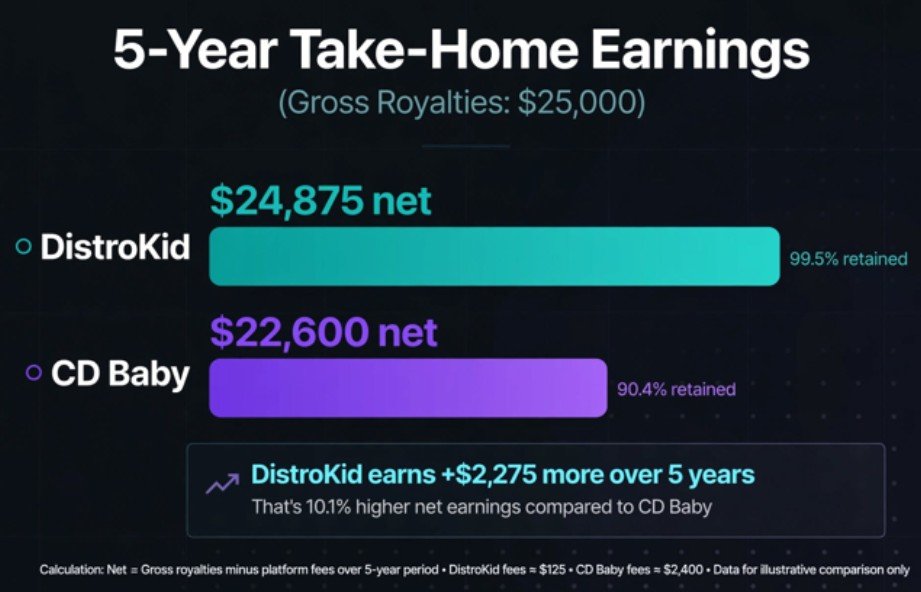
A distributor advertising a cheap sign-up fee can end up costing thousands more down the road. Let us examine what happens when releasing three singles per year over five years (15 tracks total) across different earning scenarios.
5-Year Take-Home Earnings
(Gross Royalties: $25,000)
DistroKid ======================================= ($24,875 net)
CD Baby ================================= ($22,600 net)
+———-+———-+———-+———-+
$0 $7,000 $14,000 $21,000 $28,000
- Upfront baseline costs: DistroKid costs $124.95 ($24.99 × 5 years). CD Baby costs $149.85 ($9.99 × 15 singles).
- Low-volume catalog ($500 gross streaming income): DistroKid yields $375.05 net after subscription fees. CD Baby takes its 9% commission ($45) plus the $149.85 setup cost, leaving $305.15 net. DistroKid edges ahead by $69.90.
- Breakthrough catalog ($25,000 gross streaming income): DistroKid yields $24,875.05 net. CD Baby takes $2,250 in commission, yielding $22,600.15 net. DistroKid yields $2,274.90 more.
However, if you cancel your DistroKid account after year five without purchasing the $29-per-track “Leave a Legacy” option, your songs face delisting. CD Baby’s releases remain hosted forever with zero ongoing maintenance fees.
The Metadata Trap That Silently Kills Artist Earnings
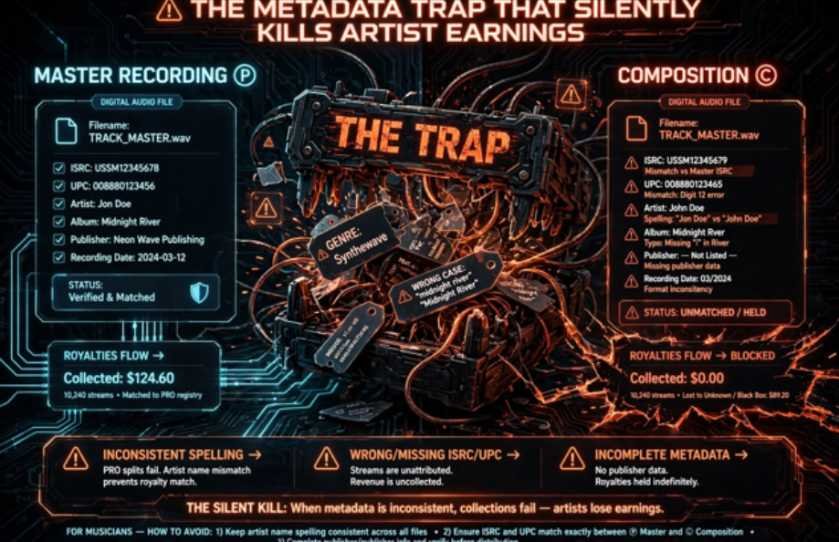
Distribution is only half the battle. If your digital audio files lack sound metadata hygiene, your royalties become untraceable “black box” revenue held by collecting societies.
- Verify your ISRC and UPC codes: Ensure your distributor assigns free, unique International Standard Recording Codes to every sound recording.
- Standardize spelling across DSPs: Consult the Spotify for Artists Metadata Guidelines. Inconsistent contributor tags split your algorithmic listener profile. Once your release metadata is consistent, promoting the music through independent music blogs and podcasts can also help expand its reach and build exposure beyond streaming platforms.
- Separate masters from publishing: Digital distribution handles the master sound recording (the ℗ line). It does not collect mechanical or performance royalties generated by the underlying musical composition (the © line).
- Register with primary collection agencies: Secure master rights through the US Copyright Office Circular 56, log composition mechanicals with The MLC, and collect digital non-interactive performance royalties through SoundExchange.
Direct Comparison: Platform Features and Royalty Retention
| Platform | Pricing Model | Royalty Cut | Best Use Case | Notable Limitations | Reference & Documentation |
| DistroKid | $24.99/year (Unlimited) | 0% | High-output indie artists | Paid add-ons for YouTube Content ID and custom release dates | DistroKid Documentation |
| CD Baby | $9.99/single, $14.99/album | 9% | Archival or sporadic releases | Percentage cut scales poorly on viral hits | CD Baby Pricing |
| TuneCore | From $24.99/year (Unlimited) | 0% | Career artists needing publishing | Basic plans gate select promotional features and new stores | TuneCore Plans |
| SoundCloud for Artists | Tiered subscription | 0% external | Electronic & hip-hop acts | Smaller external streaming network reach than traditional aggregators | SoundCloud for Artists |
| UnitedMasters | Tiered / Free split tiers | 0% – 10% | Urban acts seeking sync/brand deals | Full commercial sync pitching requires higher-tier approval | UnitedMasters |
Frequently Asked Questions
1. Which distributor delivers fastest to Spotify and Apple Music?
DistroKid consistently pushes tracks to Spotify and Apple Music within 24 to 72 hours, outpacing traditional manual aggregators.
2. Do independent music distributors own my master recordings?
Reputable digital distributors act solely as delivery pipelines and claim zero ownership over your underlying master copyrights.
3. What happens to my songs if I stop paying my annual subscription?
Unless you paid for permanent legacy protection, subscription-based distributors remove your catalog from streaming platforms once billing lapses.
4. Can I change digital distributors without losing my stream counts?
You can migrate distributors without losing stream counts by using the exact same ISRC codes, track lengths, and metadata fields.
Stop Overthinking the Aggregator and Pick Your Lane
Do not let analysis paralysis hold your tracks captive on an external hard drive. If you write, mix, and drop music continuously throughout the year, launch a DistroKid or Ditto subscription to maximize your earnings.
If you work deliberately on concept projects and value permanent hosting without maintenance fees, upload via CD Baby. Pick the economic structure matching your workflow, lock down your metadata, and release your art into the wild.
Leave a Reply