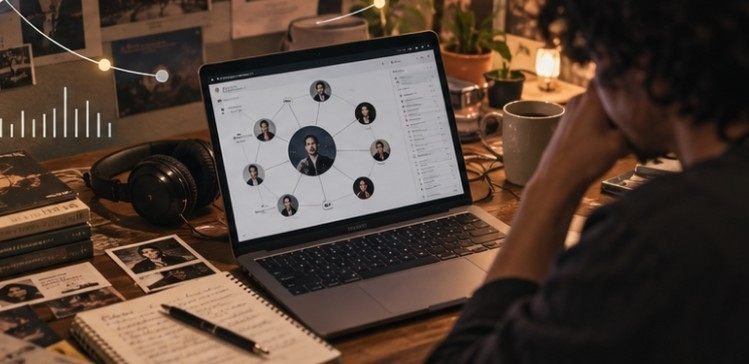
Streaming platforms can place millions of songs one tap away while quietly making a listener’s musical world feel smaller. Recommendation systems are designed to predict what I am likely to enjoy based on previous behavior. That convenience is useful, but discovery becomes more interesting when I deliberately interrupt it.
Learning how to find music outside the algorithm means replacing prediction with curiosity: listening to human DJs, tracing album credits, exploring archives, visiting record stores, attending small shows, and following scenes rather than playlists. The reward is not merely finding more music. It is discovering sounds I would never have known to request.
Why Algorithmic Music Discovery Can Feel Repetitive
Most recommendation engines have a difficult job. They must balance familiarity with novelty while trying to avoid suggesting music a listener immediately skips.
Research presented at the Web Conference examined Spotify listening behavior and found that algorithmically driven listening was associated with lower consumption diversity, while listeners who became more musically diverse tended to increase organic, self-directed listening. The researchers did not conclude that recommendation algorithms are inherently harmful; rather, the study highlights the tension between immediate relevance and broader exploration.
That explains a familiar experience: play enough dreamy indie rock, acoustic folk, or alternative R&B and recommendations may gradually become variations on what you already know. Algorithms are excellent assistants. They do not have to be your only record collector.
Start With People Instead of Predictions
One of the simplest ways to escape automated recommendations is to put another human being between you and the next song.
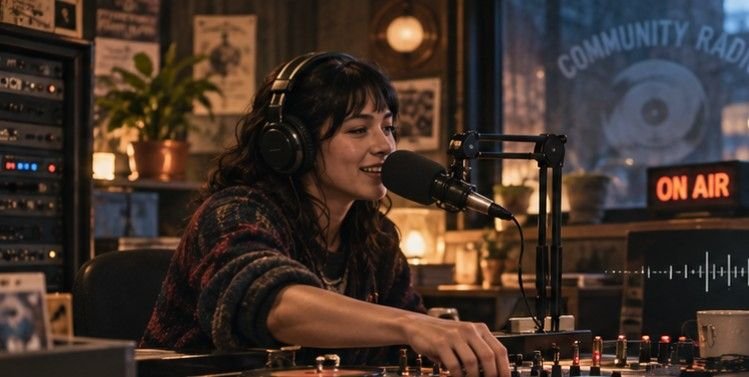
Listen to Freeform and College Radio
College radio remains particularly useful because many stations allow DJs to build programs around personal knowledge rather than rigid commercial formats.
UC Berkeley’s KALX, for example, describes its programming as freeform radio created by student and community volunteers. DJs are encouraged to move across genres specifically to broaden listeners’ musical experiences. That unpredictability is the point.
Instead of typing “artists similar to…” into a streaming service, find a college station in another city and listen for 30 minutes without skipping. Write down anything that catches your attention.
Community radio archives can take this even further. The American Archive of Public Broadcasting preserves programs covering folk, jazz, international music and other recordings that may rarely appear in personalized streaming feeds.
Follow the People Behind a Record
A favorite album is not one discovery. It is a map containing dozens of possible discoveries.

Open its credits and look beyond the headline artist. Search for its producer, engineer, drummer, featured vocalist, arranger or mastering engineer.
Suppose an album has a distinctive guitar texture. Instead of asking a streaming app for similar songs, identify the guitarist and investigate their session credits. You may end up moving from indie rock into experimental jazz, ambient music or a regional scene that shares almost no obvious genre label with the original album.
Use the same method with record labels. Independent labels often develop recognizable communities even when their artists sound different.
Touring relationships provide another clue. Check which artists open shows for musicians you already enjoy. Small support acts are often being selected by artists, promoters or local scenes before recommendation systems have collected much listener data about them.
Dig Through Music Archives Like a Researcher
Music discovery becomes much more interesting when you stop treating every search as a hunt for something released this week. The Library of Congress holds millions of recorded sound items spanning more than a century, including commercial recordings, broadcasts, folk recordings and formats ranging from cylinders to CDs.
Its collections can become a discovery engine based on history rather than popularity. Explore the Library of Congress recorded-sound collections. Search by a place, decade, instrument or tradition rather than an artist name. Try “Louisiana folk music,” “early electronic recordings,” “Appalachian ballads” or “Chicago jazz.”
The Smithsonian offers another route. Folkways Records was created to document an unusually broad range of music, spoken-word material and cultural sound. Smithsonian Folkways recordings states that the original Folkways catalog included 2,168 titles and that its recordings remain available rather than being routinely deleted from circulation. Archives work especially well when your listening has become dominated by whatever is newest.
Use Databases Differently From Streaming Apps
Sites such as Rate Your Music, Album of the Year and music-library catalogs work best when you search with constraints. Do not simply open a “best albums ever” list.
Choose something oddly specific:
- country: Brazil
- year: 1982
- style: post-punk
- format: EP
- popularity: relatively obscure
Or search one genre and move backward decade by decade.
The Music Library Association has spent years documenting the challenges involved in music discovery because music can be organized through composers, performers, instrumentation, recordings, works and many other relationships. Its work is a useful reminder that genre tags alone represent only one path through music.
Go Somewhere Algorithms Cannot Follow You
Physical discovery introduces something digital recommendations struggle to reproduce: accidents.

Walk into an independent record store and choose a section you rarely visit. Instead of asking an employee for the most popular release, ask what they have been playing repeatedly that month.
Then inspect the record itself. Read liner notes. Look at labels, recording locations and personnel. Notice who thanked whom. Follow those names later.
Live music works similarly. Small clubs, house shows, community festivals, college venues and DIY spaces expose listeners to opening artists they did not select beforehand. A ticket purchased for one band may introduce three others. That lack of control is useful.
Try the Three-Door Music Discovery Method
If my recommendations begin feeling predictable, I use a simple rule: every discovery session must enter music through three different “doors.”
| Door | What to Do | What It Breaks |
| Human | Hear a DJ, friend, critic or record-store employee’s pick | Personalization loop |
| Historical | Explore an archive, old chart, label catalog or past decade | Recency bias |
| Network | Follow a producer, collaborator, label or opening act | Genre similarity |
Spend roughly 15 minutes on each door.
Do not immediately save everything. Listen long enough to decide whether something genuinely interests you.
This matters because escaping recommendations does not mean replacing one giant playlist with another. The aim is to practice active discovery.
Build a Personal Discovery Trail
For anyone wondering how to find music outside the algorithm consistently, keep a small discovery log.bRecord the artist, track, how you found it and one thing that interested you. After 20 discoveries, review the list.
If almost everything came from one source, change your method. If nearly every artist comes from the same country, decade or genre, deliberately explore elsewhere.
The test is simple: could you have predicted most of your discoveries before you started? If yes, you are probably still traveling inside familiar territory.
Frequently Asked Questions
1. How do I discover music without Spotify recommendations?
Try college and community radio, record-store recommendations, live shows, label catalogs, music archives, artist credits and independently curated music communities.
2. Is algorithmic music discovery bad?
No. Recommendation systems are convenient and can reveal excellent music. Problems arise mainly when automated recommendations become your only method of discovering artists.
3. Where can I find obscure music online?
Explore Bandcamp, independent-label catalogs, college-radio playlists, historical audio archives, specialized music databases and communities centered on specific genres or regional scenes.
4. How often should I search for music outside recommendation algorithms?
Even one deliberate discovery session each week can diversify your listening. Rotate between human-curated radio, archives, artist networks, physical records and local performances.
Make Discovery Unpredictable Again
The strange thing about unlimited access to music is that unlimited choice can still produce remarkably predictable listening.
I think the best answer to how to find music outside the algorithm is not abandoning streaming technology. It is refusing to let prediction become the only doorway through which music reaches me. Follow a session musician. Hear a college DJ’s midnight selection. Pull an unfamiliar record from a bin. Search a 70-year-old archive.
The next song worth loving may not resemble anything you already play—and that is precisely why you might never find it by asking a system to give you more of the same.
Leave a Reply