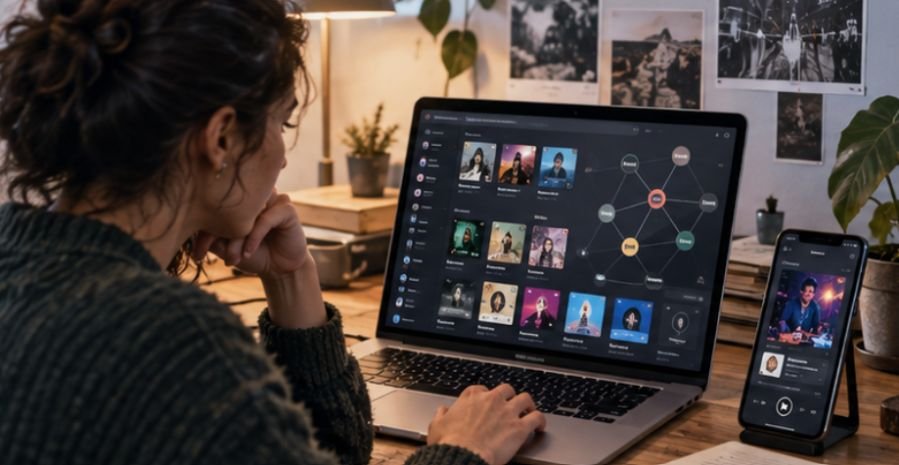
Some of the most interesting music never reaches a personalized recommendation feed. It may be playing on a college radio station at midnight, sitting deep inside an independent label catalog, appearing on a DJ’s tracklist, or getting passed around a tiny online community before wider audiences notice it.
That is why learning how to find new music without Spotify can actually expand your taste rather than limit it. Instead of waiting for software to predict what you will enjoy, you deliberately move between human curators, local scenes, music databases, radio archives, labels, and listeners whose tastes are different from your own.
The goal is not to avoid technology. It is to stop allowing one recommendation system to define the boundaries of your listening.
Why Music Discovery Feels Narrower Than It Should
Recommendation algorithms are extremely useful when convenience matters. Their weakness is that personalization tends to begin with information they already have about you.
If you repeatedly listen to psychedelic rock, indie folk, or Southern hip-hop, a platform becomes increasingly good at serving adjacent music. That can be satisfying, but genuine discovery often happens when something interrupts those expectations.
This is where human-curated radio remains surprisingly powerful.
Seattle’s nonprofit KEXP, for example, continues to operate around DJ-led discovery, live sessions, specialty shows, and emerging artists. Its current programming includes hand-selected new music rather than relying solely on personalized recommendations.
The difference is important. A DJ can intentionally place two unrelated records together because the contrast is interesting. An algorithm usually has stronger incentives to minimize that kind of unpredictability.
Start With Human-Curated Radio
Internet radio is one of the easiest places to begin because someone else has already done the digging.
Instead of searching for “new indie music,” find a DJ or station whose judgment you trust. Listen to the program regularly and note anything that catches your attention.
KEXP is particularly useful for alternative, independent, international, electronic, rock, hip-hop, and experimental music. Stations such as NTS Radio and Los Angeles-based Dublab offer another route into specialist scenes, while freeform radio can move from jazz to punk to obscure electronic music without worrying about maintaining a personalized profile.
These listening habits can also lead you toward emerging artist meaning, especially when radio exposure introduces musicians who are developing their audiences without yet having widespread mainstream recognition.
Don’t Ignore College Radio
American college stations remain excellent sources for music that has not yet reached mainstream rotation.
KZSU at Stanford University streams programming online and describes itself as a non-commercial station run by volunteers from Stanford and the surrounding community. Its schedule ranges across established genres, experimental programming, and unfamiliar artists.
UC Berkeley’s KALX programming archive provides another useful example. Its freeform playlists routinely mix older recordings with newly added releases rather than separating music into tightly controlled recommendation categories.
The trick is to save the DJ or program name, not merely the song. A good curator can become a renewable source of discoveries.
Dig Through Bandcamp Like a Record Store
Bandcamp works best when you treat it less like a streaming app and more like a digital record shop.
Start with a genre you already enjoy, then move sideways into related tags. Instead of searching broadly for “electronic,” try regional scenes, subgenres, record labels, or combinations such as ambient techno, experimental hip-hop, Appalachian folk, desert rock, or Chicago jazz.
When you find one strong release, inspect its label and the other artists connected to it.
That simple habit is one of the fastest ways to uncover music because independent labels often develop recognizable tastes. One artist can lead to five labelmates, which can lead to another label, another city, and an entirely different scene.
Use Genre Maps, but Understand Their Limits
Every Noise at Once became famous for turning thousands of genre classifications into a giant interactive musical map. It remains useful when you want to understand relationships between styles or discover strange micro-genres far beyond standard categories.
There is one important limitation.
The main map reflects data collected through November 2023 and is now largely a historical snapshot rather than a continuously updated representation of emerging music. Some API-dependent features have also experienced interruptions.
So use it as a map of possibilities, not as your primary source for this week’s releases. A productive method is to identify three unfamiliar genres there, then search those genre names on Bandcamp, radio archives, YouTube, music forums, or record-label catalogs.
Let Music Databases Take You Deeper
Community databases such as Rate Your Music work differently from recommendation feeds because discovery can begin with charts, genres, release years, listener-created lists, ratings, and extremely specific combinations of filters.
Instead of asking, “What sounds like this artist?” try questions such as:
“What were listeners rating highly in underground jazz in 2025?”
“What shoegaze albums came from South America?”
“What records combine post-punk and electronic music?”
That shift from similarity-based listening to question-based research produces much stranger results.
Historical archives can take the idea even further.
The Library of Congress Recorded Sound Research Center holds roughly 3.5 million recordings spanning more than a century, including folk, jazz, classical, popular music, musical theater, radio broadcasts, and other material.
Its collections will not replace a new-release feed, but they are exceptionally useful for tracing where contemporary sounds came from.
Explore Music by Culture Instead of Popularity
Sometimes the best way to find unfamiliar music is to stop searching by genre entirely.
Search by region, language, instrument, tradition, community, or historical period. For listeners who want to take that regional approach further, how to find local bands near you can provide a practical framework for discovering artists through local scenes, venues, community events, and the people already connected to them.
The Smithsonian Folkways collection is particularly valuable for this approach. Smithsonian Folkways exists to document and preserve culturally diverse music and sound, and its catalog reaches far beyond the categories typically emphasized by commercial streaming services.
Its curated playlists also provide selections built around artists, regions, histories, and themes rather than your previous listening behavior.
That makes cultural exploration one of the strongest answers to how to find new music without Spotify when you feel trapped inside familiar genres.
Follow DJs Through Their Tracklists
If you enjoy electronic music, dance music, festival sets, or club culture, DJ tracklists can function like discovery maps.
Sites such as 1001Tracklists allow listeners to identify tracks appearing in DJ sets. Rather than searching for artists individually, start with a DJ whose taste you enjoy and investigate the unfamiliar records inside a recent set.
Then follow the producers, labels, remixers, and featured vocalists attached to those tracks.
This method works because DJs frequently expose listeners to records before those tracks become widely discussed outside their scenes.
Use People as Recommendation Engines
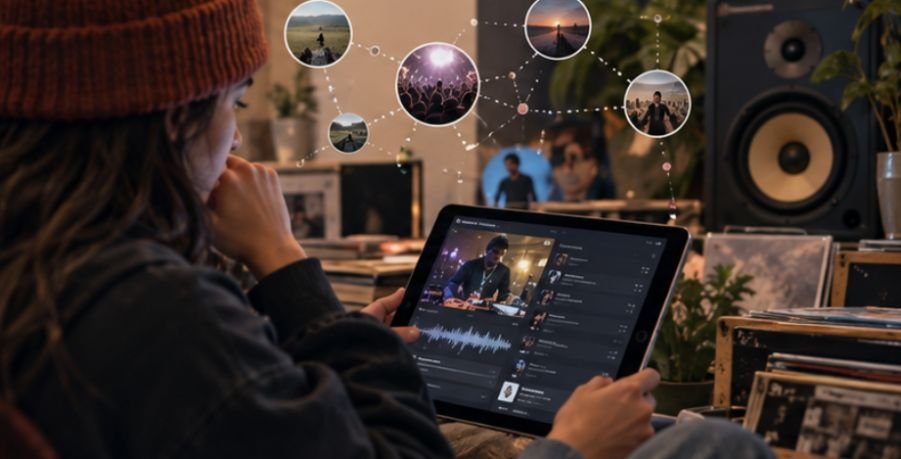
Reddit communities, Discord servers, music forums, record-store employees, local promoters, friends, critics, and musicians provide something software struggles to replicate: context.
How to discover bands before they get famous often starts with these human connections, because local recommendations, conversations around emerging artists, and community knowledge can reveal musicians long before they become prominent in mainstream recommendation feeds.
Don’t simply ask, “Recommend me music.”
Give people clues.
Try: “I like the atmosphere of this album but want something less polished,” or, “I want slow, guitar-heavy records that aren’t metal.”
Specific questions usually produce more interesting recommendations because humans can interpret qualities that are difficult to reduce to genre labels.
Try the 30-Minute Music Discovery Routine
A repeatable routine prevents music discovery from becoming endless browsing.
| Time | Action | Goal |
| 0–5 minutes | Pick one radio show, DJ, genre, or label | Establish a starting point |
| 5–12 minutes | Save three unfamiliar artists | Create leads |
| 12–20 minutes | Explore their labels, collaborators, or scenes | Move beyond the original source |
| 20–25 minutes | Check a database or community discussion | Add context |
| 25–30 minutes | Listen to one full track from five artists | Decide what deserves deeper listening |
Do this once or twice a week and maintain a simple “listen later” list.
The important rule is to avoid evaluating every discovery after 15 seconds. Unfamiliar music often requires more patience precisely because it does not resemble what your existing listening history has trained you to expect.
What Doesn’t Work as Well
Replacing Spotify with another highly personalized service may change the interface without changing your discovery habits.
Likewise, jumping randomly among thousands of releases quickly creates decision fatigue. Pure chart browsing has another limitation: popularity still influences what rises to the surface.
A stronger system combines several sources. Let a human curator introduce the artist, a database explain the genre, a label reveal related musicians, and a community provide context. That mixture creates discovery rather than endless recommendation consumption.
Frequently Asked Questions
1. How can I discover independent artists without Spotify?
Use Bandcamp tags, independent labels, college radio, nonprofit stations, local venue calendars, music forums, and DJ playlists. Following labels and curators is usually more productive than repeatedly searching individual artists.
2. What is the easiest way to find unfamiliar genres?
Explore genre maps, university radio schedules, specialist DJ programs, music databases, and cultural archives. Choose one unfamiliar style and follow its artists, labels, regional scenes, and influences.
3. Is college radio still useful for finding new music?
Yes. Stations such as KZSU and KALX still broadcast volunteer- or DJ-curated programming that can include new, experimental, local, and less commercially visible music.
4. How to find new music without Spotify if I don’t know where to start?
Choose one favorite artist, identify their label or influences, then explore one radio program and one community recommendation connected to them. Save five unfamiliar artists and listen without using personalized recommendations.
Make Discovery Deliberate Again
The biggest advantage of leaving a recommendation feed occasionally is not that algorithms are bad. It is that surprise becomes your responsibility again.
Spend half an hour following a college DJ, dig through an independent label’s catalog, explore a Smithsonian collection, or investigate a genre you cannot even pronounce yet. Some sessions will produce nothing memorable. Others will uncover an artist you follow for years.
That unpredictability is the point. Great music discovery should occasionally confuse you before it impresses you. The next record you love may already exist somewhere outside your usual feed—you simply need to change where you look.
Leave a Reply