Category: Independent Music

  • What Rights Do Independent Artists Own Under Distribution Deals?

    What Rights Do Independent Artists Own Under Distribution Deals?

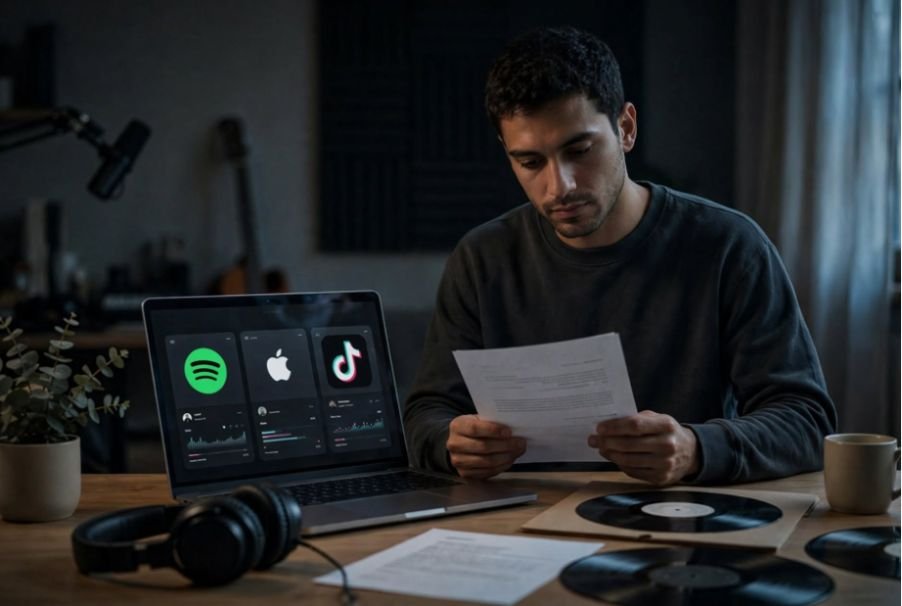
    I learned the difference between owning music and controlling it the hard way. Early in my music career, I delivered a single through an aggregator, assuming “100% ownership” protected me everywhere. Two weeks later, my own YouTube channel received an automated copyright strike on my background instrumental.

    Understanding what rights do independent artists own under distribution deals separates artists who build long-term catalogs from those who run into unexpected legal blocks. Under standard distribution agreements, you retain 100% ownership of your intellectual property. However, distributors require an exclusive limited license to exploit your tracks on streaming stores.

    The Core Legal Separation: Masters vs. Compositions
    The Core Legal Separation: Masters vs. Compositions

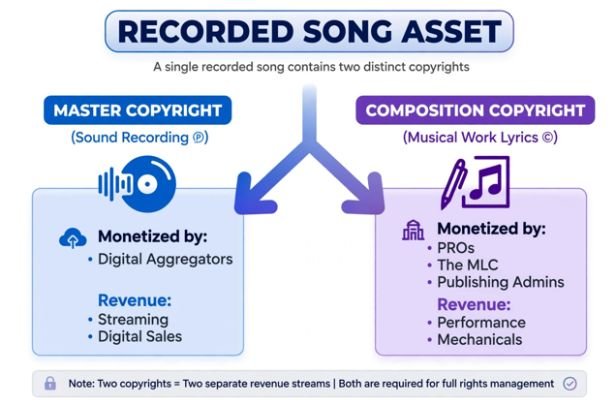
    Every recorded track consists of two separate copyrights recognized by law. When you sign a distribution deal, the platform only operates on the sound recording, not the musical composition. 

    If you plan to scale your catalog or start an independent record label, you must know which copyrights you retain, which rights you license out, and where the boundaries sit.

                                ┌─────────────────────────────────┐

                                 │       Recorded Song Asset       │

                                 └────────────────┬────────────────┘

                                                  │

                          ┌───────────────────────┴───────────────────────┐

                          ▼                                               ▼

             ┌─────────────────────────┐                     ┌─────────────────────────┐

             │    Master Copyright     │                     │  Composition Copyright  │

             │   (Sound Recording ℗)   │                     │  (Musical Work/Lyrics ©)│

             └────────────┬────────────┘                     └────────────┬────────────┘

                          │                                               │

             Monetized by: Digital Aggregators               Monetized by: PROs, The MLC, Pub Admins

             Revenue: Streaming, digital sales               Revenue: Performance, mechanicals

    Sound Recording Rights (The Master Copyright)

    Under federal copyright law, as detailed by the U.S. Copyright Office, sound recordings (marked by the $\mathbb{P}$ symbol) embody the fixed audio performance.

    When you release through DIY distributors, you remain the sole copyright owner of these audio recordings. You hold the exclusive right to duplicate, sell, and license that specific recording. The distributor receives a non-exclusive or release-exclusive right to distribute that audio file to digital service providers (DSPs) like Spotify and Apple Music.

    Underlying Composition Rights (The Publishing Share)

    The composition copyright (marked by the $\mathbb{C}$ symbol) protects the underlying melody, harmony, and lyrics. Standard distributors have zero claim to your songwriting.

    Distributors do not register your songs with global mechanical collection societies or pitch your catalog for sync opportunities. To collect your mechanical royalties from streaming in the United States, you must register through The Mechanical Licensing Collective (The MLC).

    International mechanicals and public performance royalties require separate registration with your domestic Performing Rights Organization (ASCAP, BMI, SESAC) or a dedicated publishing administrator.

    Operational Rights You Keep (And What You License Away)
    Operational Rights You Keep (And What You License Away)

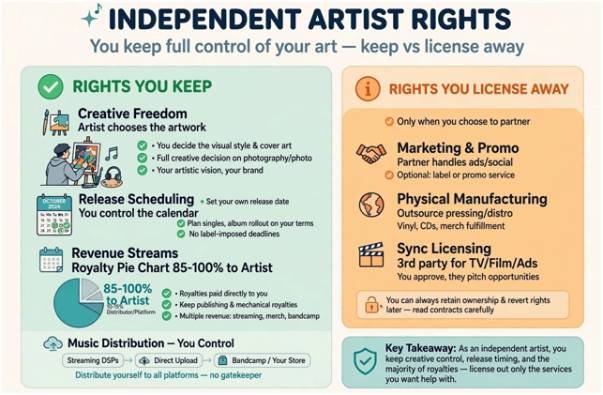
    Retaining legal title to a work does not mean your distributor has no power over its digital footprint. You grant distributors specific administrative rights to do their jobs.

    Creative Freedom and Release Scheduling

    You retain complete creative autonomy. You choose your artwork, decide track orders, pick release dates, and pull singles off the market. Unlike major-label recording contracts, distributors cannot reject a mix because it lacks radio potential or mandate revisions to your visual assets.

    Revenue Streams and Royalty Distribution

    Distributors do not take your base rights, but their pricing models dictate your net independent artist revenue. Some platforms charge an upfront annual fee and pass through 100% of sales, while others charge zero upfront fees in exchange for a 9% to 15% backend commission.

    Non-interactive digital performance royalties from platforms like SiriusXM or Pandora do not route through your distributor; those collect directly through SoundExchange.

    Rights Comparison: DIY Distribution vs. Traditional Record Label Deals
    Rights Comparison: DIY Distribution vs. Traditional Record Label Deals

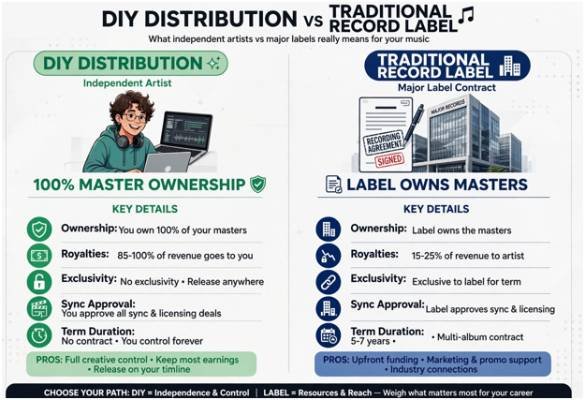
    The fundamental difference between self-releasing and signing with an established record label comes down to whether you assign your property or license a service.

    Feature DIY Distribution Deal Traditional Record Label Contract
    Master Ownership ($\mathbb{P}$) 100% retained by the artist Transferred or assigned to the label (“Work for Hire”)
    Composition Rights ($\mathbb{C}$) 100% retained by the songwriter Often pressured into co-publishing agreements
    Streaming Royalties 85% to 100% paid directly to artist 15% to 25% paid after full expense recoupment
    Exclusivity Limited to uploaded tracks Strict personal exclusivity across all output
    Sync Approval Artist retains direct approval Label controls sync and licensing terms
    Term Duration At-will or short renewal terms Multi-album or fixed multi-year commitments

    Hidden Traps in Modern Distribution Agreements

    Hidden Traps in Modern Distribution Agreements

    Even when a distributor advertises complete ownership, you must read the terms of service closely. Certain default clauses limit how you exploit your songs elsewhere.

    YouTube Content ID and Social Monetization Sweeps

    Many distributors bundle YouTube Content ID, TikTok, and Meta monetization as optional checkboxes or automatic defaults. If you grant them exclusive YouTube fingerprinting rights, their automated system flags any third party who uses your track—including your own social channels. If you plan to clear beats for other creators or lease backing tracks, never grant your distributor exclusive Content ID rights.

    Takedown Clauses and Catalog Orphan Risks

    Some subscription-based distributors unpublish your entire catalog from streaming services if your annual membership lapses. Unless you pay an additional legacy fee per track, you risk losing your playlist placements, stream counts, and algorithmic momentum. Commission-based models generally leave your music active indefinitely, as they deduct their fee directly from incoming payouts.

    Frequently Asked Questions About Distribution Rights

    1. Do digital music distributors own my master recordings?

    No, distributors act as third-party aggregators and claim zero ownership over your master recordings.

    2. Can I switch distributors without losing my stream counts?

    Yes, as long as you reuse the original ISRC codes, track lengths, and exact metadata on the new platform.

    3. Does my distributor collect my songwriting royalties?

    No, distributors only collect sound recording revenue unless you separately purchase an optional publishing administration add-on.

    4. Can I release music with another company while using a distributor?

    Yes, standard distribution agreements are release-specific, meaning you can distribute other singles through different platforms.

    Stop Signing Away Your Leverage

    Owning your master recordings is the single greatest competitive advantage an independent musician holds. When you retain your copyrights, your catalog functions as an income-generating asset that you control indefinitely.

    Before you click accept on that digital distribution terms of service, verify that the agreement contains no automatic exclusivity beyond the tracks you upload. Retain your publishing rights, maintain control over your digital fingerprinting, and audit your distributor agreements yearly to protect your sound.

  • How to Start an Independent Record Label at Home: The Complete Blueprint

    How to Start an Independent Record Label at Home: The Complete Blueprint

    I launched my first record imprint from a laptop on an IKEA desk with less than $1,000 in seed money. Learning how to start an independent record label at home does not require venture capital or industry connections anymore. It requires disciplined accounting, ruthless contract clarity, and an automated royalty pipeline.

    Modern digital gatekeepers have crumbled. Independent labels now capture market share because they move quickly, test niche audiences, and treat artists as collaborative partners rather than debt liabilities.

    Setting Up the Legal and Financial Machine

    Setting Up the Legal and Financial Machine

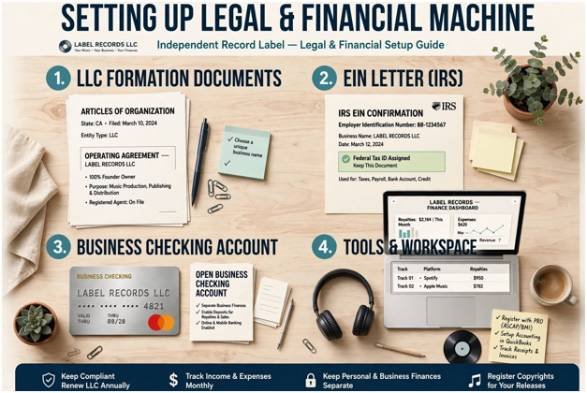
    A bedroom label remains an expensive hobby until you form a legal barrier between your personal checking account and your master recordings.

    Business Entity and Tax Isolation

    File articles of organization for a Limited Liability Company (LLC) through your Secretary of State or reference registration workflows at the SBA.gov. An LLC shields your personal home, car, and savings from infringement liabilities or contract disputes.

    Once your LLC receives its Employer Identification Number (EIN) from the IRS, open a dedicated business checking account. Route every dollar of streaming income, tape sale revenue, and software expense through this single hub. Mixing personal groceries with mastering invoices destroys your liability shield and complicates annual tax returns.

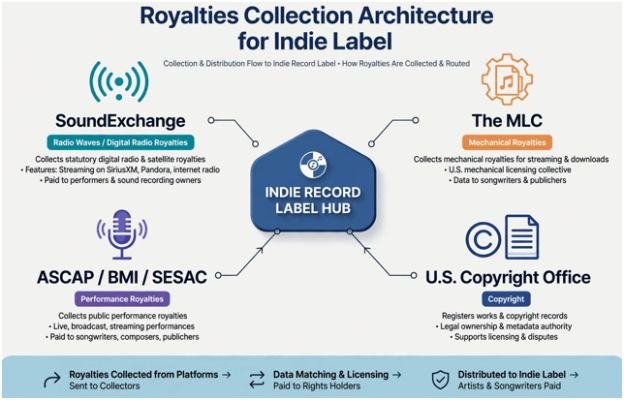
    Royalties Collection Architecture

    Royalties Collection Architecture

    Distribution aggregators deliver your music to streaming platforms, but they leave significant master-side royalties uncollected. You must register your entity across direct industry collection agencies to claim every micro-penny owed.

    Organization Registration Type Revenue Stream Collected
    SoundExchange Master Rights Owner Non-interactive digital performance royalties (Pandora, SiriusXM, webcasts)
    The MLC Mechanical Administrator Digital audio mechanical royalties from interactive streaming services
    ASCAP / BMI / SESAC Publishing Entity Public performance royalties for underlying compositions
    US Copyright Office Form SR (Sound Recording) Statutory legal copyright protection for master recordings

    Affiliate your label with SoundExchange as both a sound recording copyright owner and a designated payee. Have your songwriters register their works directly through TheMLC.com to capture statutory mechanicals.

    Distribution Infrastructure and Account Tiers

    Do not sign up for a single-artist distributor plan. Home-based labels need administrative dashboards capable of managing multiple artist profiles, distinct ISRC allocations, and automated split payments.

    Selecting Multi-Artist Pipelines

    Pick distributors that support enterprise label routing. DistroKid’s “Ultimate” plan, TuneCore for Labels, and CD Baby Pro offer multi-artist tiers with automated payment splitting. Automated split features save hours of tedious manual accounting each month by paying your artists their percentages directly at the distributor level.

    Distribution Partner Best Feature for Home Labels Starting Multi-Artist Cost Cut on Royalties
    DistroKid (Ultimate) Automated split-pay to artist accounts ~$89.99/year 0%
    TuneCore (Breakthrough/Pro) Robust global reporting and mechanical support ~$49.99/year 0% on streaming
    CD Baby Legacy physical distribution sync + sync licensing Fee per release ($9.99+) 9% digital sales cut

    Structuring Bulletproof 50/50 Indie Contracts

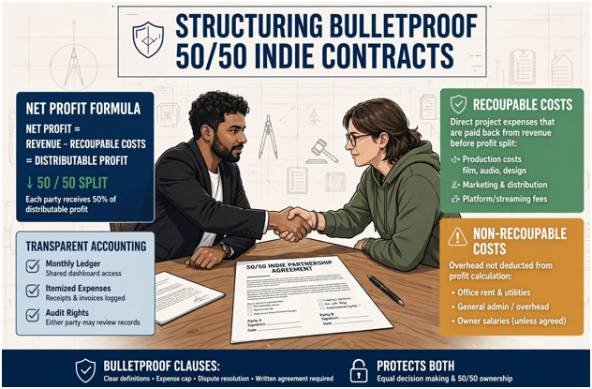
    Structuring Bulletproof 50/50 Indie Contracts

    Early DIY labels often rely on handshakes. Handshakes lead to severed friendships and frozen catalog rights. You need written, signed agreements before spending money on third-party mixing or mastering. 

    Weighing independent music contract pros and cons early clarifies whether an exclusive license or a pure catalog acquisition suits your risk profile.

    Defining Net Profits and Allowable Deductions

    The industry gold standard for modern boutique imprints is the 50/50 Net Profit Agreement. Under this framework, the artist retains their underlying copyright, granting your label an exclusive exploitation license for a fixed duration (typically 3 to 5 years).

    Net profit is gross receipts minus approved, itemized direct out-of-pocket costs:

    $$\text{Net Profit} = \text{Gross Receipts} – \text{Approved Direct Costs}$$

    Do not deduct general label overhead, home Wi-Fi bills, or equipment upgrades from an artist’s royalty statements.

    Cost Category Recoupable from Net Receipts? Non-Recoupable Label Expense?
    Mastering & Audio Restoration Yes No
    Direct Digital Ad Spend (Meta/TikTok) Yes (Capped in contract) No
    Vinyl / Tape Manufacturing Yes No
    Cover Art Graphic Design Yes No
    Label Hardware / DAW Plugins No Yes (Label overhead)
    Standard Business Legal Filings No Yes (Label overhead)

    Establish a clear reversion clause. If the project fully recoups its initial investment within the contract term, ownership and distribution access return to the artist at the end of the license window.

    The 8-Week Release Operations Plan

    Dropping music the day after receiving a final master guarantees obscurity. Algorithmic streaming ecosystems require lead time to index metadata and populate pitch queues. Once your roster grows and you join the ranks of independent music labels accepting demo submissions, running a standardized operational schedule keeps multiple artists organized.

    Week -8: Receive uncompressed 24-bit/48kHz masters, hi-res square cover art, and metadata splits.

    Week -6: Deliver files to distributor; verify ISRC and UPC code generation.

    Week -4: Pitch track through Spotify for Artists and Amazon Music for Artists dashboards.

    Week -3: Secure localized press coverage, niche blog features, and playlist curator outreach.

    Week -2: Deliver short-form video creative assets (vertical visualizers, teasers, reels).

    Week -1: Launch pre-save campaigns and send direct-to-fan email newsletters.

    Week  0: Release Day: Trigger social ad spend, update DSP profile banners, ship physical pre-orders.

    Week +2: Audit initial streaming figures, pay direct recoupment deductions, assess playlist traction.

    Register the final sound recording with the Copyright.gov database using Form SR to lock in statutory damage protections against unauthorized sampling or sync infringement.

    Stop Overthinking the Artwork: Go Press Play

    Perfectionism kills more record labels than bad contracts. You do not need a four-room facility in Nashville or an analog tape machine to matter. You need three standout releases, spotless legal hygiene, transparent accounting statements, and total dedication to your artists’ creative visions. Set up your LLC, lock in your distribution pipeline, and launch your first catalog number this month.

    Frequently Asked Questions

    1. How much does it cost to start an independent record label from home?

    Most home operators launch legally for $500 to $1,500, covering state LLC formation fees, a multi-artist distribution subscription, and initial mastering costs.

    2. Do I need a lawyer to draft indie label recording contracts?

    While using vetted contract templates works for early releases, having an entertainment attorney review your master agreement prevents costly future disputes.

    3. Can I run a record label from home without owning the master recordings?

    Yes, modern indie labels routinely operate on exclusive licensing deals where artists retain ownership while the label handles commercial exploitation for an agreed timeframe.

    4. How do bedroom labels make money from streaming?

    Labels collect net streaming payouts directly from their digital distributor and retain an agreed split (typically 50%) after recouping direct release expenses.

  • Major Record Deal vs Independent Music Contract Pros and Cons

    Major Record Deal vs Independent Music Contract Pros and Cons

    When I received my first recording offer ten years ago, I thought a six-figure advance meant instant wealth. It took an entertainment attorney five minutes to show me I was essentially taking out a high-interest mortgage on my own creative voice. Weighing a major record deal vs independent music contract pros and cons comes down to one fundamental trade-off: trading equity and creative control for institutional leverage, or keeping your masters and building long-term enterprise value.

    Both paths build viable careers. However, signing the wrong agreement without understanding how royalties, master ownership, and marketing budgets function will derail your momentum for years.

    The Core Trade-Off: Global Clout vs. Master Ownership

    The three major record conglomerates—Universal Music Group, Sony Music Entertainment, and Warner Music Group—control roughly 70% of the global recorded music market. They operate massive marketing machines capable of commanding commercial radio, securing billboard campaigns, and pitching worldwide DSP (Digital Service Provider) playlists.

    Independent music companies, ranging from boutique imprints to powerhouse operations like Beggars Group or EMPIRE, operate on artist-first revenue splits. Knowing how do independent record labels sign artists reveals their emphasis on data, organic audience engagement, and sustainable catalog growth over mass-market churn.

    Side-by-Side Comparison

    Contract Feature Major Record Deal Independent Contract DIY / Distribution Deal
    Typical Advance $100,000 to $2,000,000+ $5,000 to $100,000 $0 (Self-funded)
    Royalty Share 14% to 20% (Standard) 50% profit-share (Common) 85% to 100% net receipts
    Master Ownership Label owns in perpetuity Artist retains (or 5–10 yr license) Artist owns 100%
    Scope of Contract 360 Deal (Touring, Merch, Sync) Recording rights only (Standard) Digital pipeline only
    Release Control Label decides release dates & singles Mutual agreement with artist Full artist discretion
    Recoupment Scope Video, marketing, tour support, advance Direct manufacturing & release costs Distribution fees only

    Inside the Major Label Machine

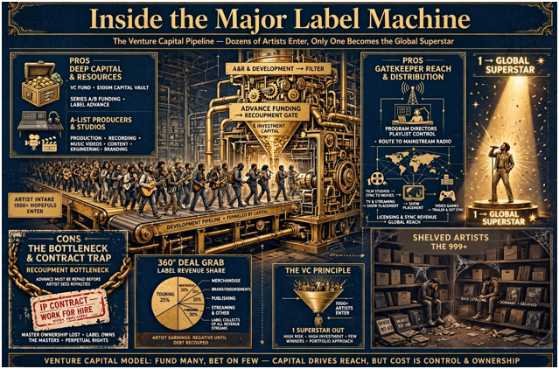
    Inside the Major Label Machine

    Major record labels run on venture capital principles. They sign dozens of acts knowing that one global smash funds the losses of twenty failed releases.

    Major Record Deal Pros

    • Access to Deep Capital: A major label provides liquidity. You receive upfront funds to hire A-list producers, book world-class mixing engineers, and execute cinematic video productions that indie budgets cannot touch.
    • Commercial Gatekeeper Influence: Independent publicists work hard, but major radio promotion departments maintain decades-long relationships with commercial PDs (program directors), corporate brand executives, and festival talent buyers.
    • Global Sync Teams: Major publishers and sync divisions place tracks directly with film studios, television networks, and video game franchises at volumes independent teams struggle to match.

    Major Record Deal Cons

    • The Recoupment Bottleneck: Advances are non-reciprocal corporate loans. The label withholds 100% of your 15% royalty share until every dollar spent on recording, music videos, independent radio promotion, and personal advances gets recovered.
    • Loss of Intellectual Property: In almost every standard major contract, you deliver your tracks as “works made for hire.” The label owns the copyright to the master recordings permanently. Under the U.S. Copyright Office regulations, statutory termination rights under Section 203 do not effortlessly reclaim “work for hire” recordings.
    • 360-Degree Ancillary Grabs: Modern majors rarely sign pure recording contracts. Their “multiple rights” clauses capture 10% to 30% of your gross earnings across touring, live appearances, merchandise, VIP ticketing, and third-party sponsorships.
    • Shelving Risks: If an A&R executive departs or your debut single underperforms, corporate leadership can freeze your project. Because you are bound by an exclusivity clause, you cannot legally self-release that music elsewhere.

    The Independent Music Contract Reality

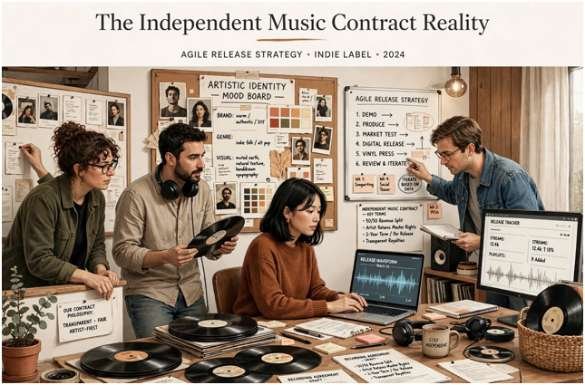
    The Independent Music Contract Reality

    Independent labels operate with leaner teams and agile release strategies. Many curate distinct artistic identities, making them regular targets for artists seeking out independent music labels accepting demo submissions.

    Independent Deal Pros

    • Retaining Master Equity: Most independent agreements rely on fixed-term licensing contracts lasting five to ten years. Once the term ends or the costs clear, full exploitation rights revert to you.
    • Favorable Splits: Indie labels typically split net profits 50/50 after hard manufacturing and promotional expenses. If you distribute via companies like DistroKid, TuneCore, or Symphonic, you retain up to 100% of net royalties.
    • Direct Digital Royalties: Artists with master ownership collect both the featured artist and master owner shares directly through organizations like SoundExchange, keeping third-party administrative cuts to a minimum.
    • Creative Sovereignty: Indie partners offer creative counsel without dictating your creative output. You maintain ultimate approval over mix versions, artwork, tracklists, and collaborators.

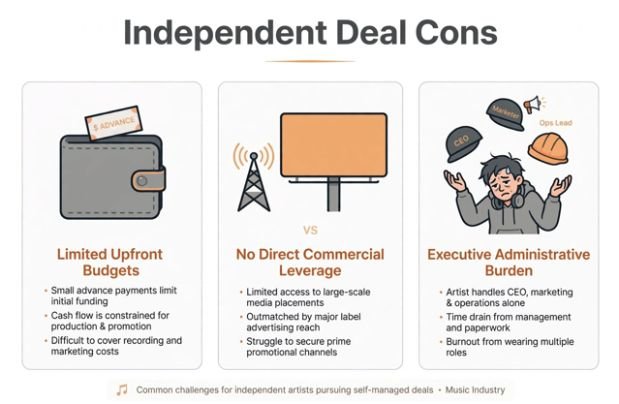
    Independent Deal Cons

    Independent Deal Cons

    • Limited Upfront Budgets: Indie labels rarely issue massive advances. You fund your living expenses and often supply creative capital out of your own pocket.
    • No Direct Commercial Leverage: Cracking Top 40 terrestrial radio or landing widespread billboard placement without major label infrastructure remains an uphill, expensive battle.
    • Executive Administrative Burden: Operating as an independent artist means acting as the CEO, marketer, and operational lead of your own record company, increasing potential for creative fatigue.

    The Real Recoupment Math: Major Advance vs. Indie Streaming

    The Real Recoupment Math: Major Advance vs. Indie Streaming

    Most artists view an advance as earnings. In truth, your royalty rate determines how quickly you earn a single dollar beyond that check. Industry data documented by the Future of Music Coalition demonstrates that catalog ownership creates far more reliable lifetime revenue than large initial payouts.

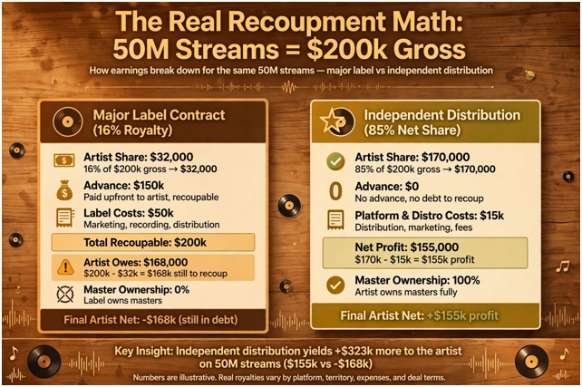
    Consider a project that generates 50,000,000 streams on Spotify and Apple Music, generating roughly $200,000 in gross master royalties (assuming an average payout of $0.004 per stream):

    Metric Major Label Contract (16% Royalty) Independent Distribution (85% Net Share)
    Gross Master Revenue $200,000 $200,000
    Artist Royalty Share 16% ($32,000) 85% ($170,000)
    Initial Cash Advance $150,000 $0
    Direct Recoupable Costs $50,000 (Videos/Marketing) $15,000 (Self-funded PR/Ads)
    Total Recoupable Balance $200,000 $15,000
    Artist Pipeline Royalties Paid $0 (Still owes $168,000 to recoup) $155,000 (Net profit earned)
    Master Rights Retained? No (Owned by Label) Yes (100% Artist)

    Under the major deal, the label collected $168,000 in gross profit from your music while your account remains deep in the red. Under the indie model, you pocketed $155,000 and retain ownership of the master recording forever.

    How to Protect Your Catalog Before Signing

    If you decide to sign a contract, negotiate these four baseline safeguards into the deal:

    1. Master Reversion Period: Require that ownership of your sound recordings reverts back to you within 7 to 10 years following initial commercial release.
    2. Release Commitment Clause: Mandate that if the label fails to commercially release your delivered project within 120 days, you can terminate the deal and buy back the masters at cost.
    3. Net Profit 360 Limits: Never surrender a cut of gross touring or merch income. Cap ancillary cuts strictly to net earnings from opportunities the company directly procures.
    4. Independent Accounting and Auditing: Secure audit rights with provisions requiring the company to pay audit fees if an examination discovers a royalty discrepancy greater than 5%.

    Slay the Hype: Own Your Masters or Rent the Machine

    Major record labels run high-stakes venture capital bets on pop culture, while independent agreements give you the keys to building a lasting, profitable small business. If your dream requires private jets, stadium tours, and global

    Top 40 saturation, partnering with a major might be the right engine. If you want to own your work, secure high-margin streaming royalties, and protect your creative freedom, build your leverage independently first.

    Never sign a contract under pressure. Retain a qualified entertainment attorney, analyze your recoupment math, and choose the business framework that serves your long-term independence.

    Frequently Asked Questions

    1. Do independent artists make more money than signed artists?

    Per stream and sale, independent artists earn significantly higher margins because they retain 50% to 100% of royalties rather than a major label’s 15% to 20% cut.

    2. What is a 360 deal in music?

    A 360 deal allows a record label to collect percentages from non-record revenue streams, including touring, merchandise sales, publishing, and brand sponsorships.

    3. Can a major record label drop you if you do not recoup?

    Yes, labels exercise unilateral options between album cycles and regularly drop artists with unrecouped debt without forgiving the master rights.

    4. How do I legally get my masters back from a label?

    You can secure masters through a negotiated contract reversion clause, a direct catalog buyout, or statutory copyright termination under Section 203.

  • Top Independent Music Labels Accepting Demo Submissions: The Definitive Pitch Guide

    Top Independent Music Labels Accepting Demo Submissions: The Definitive Pitch Guide

    I spent years sending cold MP3 attachments into dead inboxes before learning the hard truth about modern music discovery. If you want to get signed, you must target the top independent music labels accepting demo submissions using the exact technological workflows their A&R teams prioritize. 

    A cold pitch is an engineering problem as much as an artistic one. Labels filter through hundreds of tracks daily, discarding files that violate submission guidelines before listening to a single note.

    Navigating the landscape requires knowing where to look, how to pitch, and how to protect your career equity.

    What Top Indie Record Labels Actually Look for in a Demo

    Independent labels operate on lean teams and focused budgets. Unlike majors, they rarely sign unproven artists based on vague potential or incomplete rough takes. They sign turnkey assets that integrate seamlessly into their release rosters.

    The 20-Second Drop Rule

    The 20-Second Drop Rule

    When I track listening metrics on A&R links via private streaming dashboards, one behavioral trend stands out: an A&R rep spends an average of 18 to 25 seconds on a submission before making a decision. If your track opens with a 45-second ambient drone before reaching the core motif, you have wasted your window.

    Your best hook, main groove, or defining vocal line must land upfront. Give the scout an immediate reason to keep listening rather than skipping to the next submission in their queue.

    Rights Clearance and Metadata Hygiene

    Independent teams cannot afford legal battles over uncleared splice loops or obscure vinyl samples. Every track you pitch must be 100% royalty-free or fully cleared. In fact, organizations like the American Association of Independent Music (A2IM) frequently emphasize that clear master rights and publishing splits are the single biggest factor separating amateur submissions from viable commercial releases.

    Ensure your files have embedded ID3 metadata including:

    • Artist name and primary contact email
    • Track title, BPM, and musical key
    • Clear ownership status (e.g., “100% Master & Publishing pre-cleared”)

    Electronic and Dance Labels Actively Scouting Talent

    Electronic and Dance Labels Actively Scouting Talent

    Dance music relies on dynamic club testing, making electronic imprints the most systematized demo evaluators in the music business.

    Armada Music and Defected Records

    Armada Music, co-founded by Armin van Buuren, accepts regular submissions across trance, deep house, and melodic techno. They process entries via designated online portals and platform aggregators like LabelRadar. Expect a structured turnaround window of roughly six to eight weeks.

    Defected Records remains the gold standard for pure house music, disco edits, and soulful grooves. Defected routes submissions for its primary roster and eleven sister labels—including Glitterbox and DFTD—directly through automated portal pipelines. Do not send attachments; submit your clean, uncompressed streaming links through their established channels.

    Monstercat and Spinnin’ Talent Pool

    Monstercat built an empire by signing emerging bass music, glitch, and gaming soundtrack producers out of obscurity. They maintain an always-open submission system on direct evaluation platforms. They prioritize distinct sonic branding over existing social followings.

    Spinnin’ Records relies on their dedicated “Talent Pool” platform. This public-facing ecosystem allows creators to upload club cuts, climb community charts, and catch the direct attention of Spinnin’s internal A&R board.

    Alternative, Punk, and Indie Rock Powerhouses

    Alternative, Punk, and Indie Rock Powerhouses

    Guitar music and alternative songwriting still prioritize raw, unvarnished identity over hyper-quantized production.

    Sub Pop Records

    Seattle’s Sub Pop remains one of the most culturally revered record labels on the planet. From pioneering grunge to breaking world-class indie acts, they maintain a remarkably accessible intake policy. Sub Pop accepts unsolicited submissions through a dedicated demo review inbox.

    Their rules are non-negotiable: send streaming links only. Never attach raw WAVs or MP3s to an email sent to Sub Pop, as their servers will flag or reject files over standard size thresholds. Their team reviews unreleased material on rolling monthly cycles.

    Epitaph Records and Glassnote

    Founded by Bad Religion’s Brett Gurewitz, Epitaph champions punk, pop-punk, post-hardcore, and left-leaning indie folk. They seek completed arrangements that deliver a tangible counter-culture edge.

    Glassnote Records is legendary for breaking alternative giants like Phoenix and Mumford & Sons. They maintain private digital portals for unsolicited work. When pitching Glassnote, emphasize your live performance history or regional audience traction alongside the audio.

    Hip-Hop, Beats, and Global Grooves

    Urban music scouting moves quickly, relying on distinctive sample work, lyricism, and cross-genre fusion.

    Stones Throw Records and Chinese Man Records

    Stones Throw Records, founded by Peanut Butter Wolf, is the definitive home for lo-fi hip-hop, underground beatmakers, psych-funk, and boundary-pushing soul. They reject derivative radio rap; their catalog celebrates idiosyncratic, analog-tinged textures.

    Overseas, Chinese Man Records curates an international catalog of trip-hop, dub, afro-funk, and experimental hip-hop. They actively evaluate emerging worldwide beatmakers through indie discovery aggregators such as Groover.

    By diversifying your streaming, physical, and performance royalties, you build steady independent artist revenue that proves your project is commercially viable from day one. 

    How to Route and Format Your Pitch

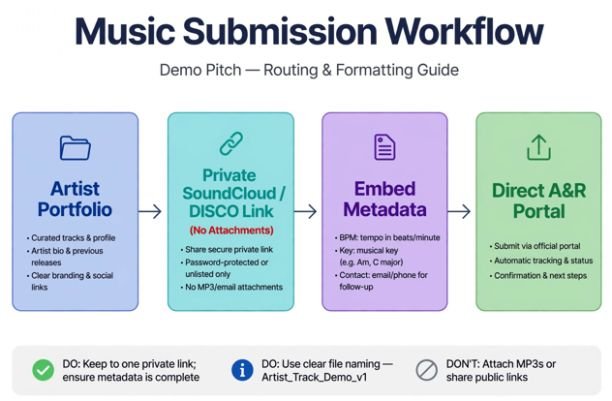
    Pitching a record label requires treating your unreleased catalog like proprietary software. Never mass CC a list of fifty A&Rs on a single email. Personalize each message, specify why your sound belongs on that specific roster, and point them to a streamlined listening hub.

    [Artist Portfolio]

           │

           ▼

    [DISCO / Private SoundCloud Link] ──▶ [No Audio Files Attached]

           │

           ▼

    [Embed Core Metadata] ──────────────▶ [Artist Name, BPM, Key, Contact]

           │

           ▼

    [Direct A&R Portal / Targeted Email]

    Building Your Private Stream Architecture

    Host your unreleased music exclusively on a private, streaming-friendly host. Private SoundCloud links with downloads enabled or secure DISCO playlists are the industry standards. According to reports tracking digital audio rights and licensing protocols from Billboard, A&R managers almost universally prioritize platform streams over email attachments.

    If you are developing your catalog while retaining ownership, mastering your own independent music distribution gives you immediate leverage. Labels want to see that your track can generate momentum before they invest their capital. 

    You can also monitor non-interactive digital performance royalties via SoundExchange to register catalog assets before external deals are executed.

    Frequently Asked Questions About Submitting Demos

    1. How long does an indie label take to review a demo?

    Most independent labels take between four to eight weeks to review incoming material due to backlog volumes.

    2. Should I send MP3 files or streaming links?

    Always send private streaming links like SoundCloud or DISCO with downloads enabled; never send attached audio files.

    3. Can I submit a demo that has already been released?

    Most labels only accept unreleased, exclusive masters unless you are negotiating an upstream distribution or catalog acquisition deal.

    4. Do I need a manager before submitting music to indie labels?

    No, independent labels actively review direct artist submissions as long as the music is high-quality and the pitch is professional.

    Stop Waiting for Permission and Ship Your Sound

    A record deal is a business partnership, not validation of your worth as an artist. Send your submissions to labels whose rosters you genuinely respect, follow their exact delivery instructions, and give them a hard deadline of thirty days. 

    If they pass or fail to respond, do not stall your rollout. Distribute the project independently, cultivate your own audience, and make the labels come searching for you on your next cycle.

  • How Do Independent Record Labels Sign Artists: An Insider Guide

    How Do Independent Record Labels Sign Artists: An Insider Guide

    I spent seven years running A&R for a boutique indie imprint in Brooklyn, and I saw thousands of demos hit our inbox. The romantic myth claims an executive stumbles into a dive bar, hears one chorus, and hands over a check on a cocktail napkin.

    In reality, understanding how do independent record labels sign artists comes down to recognizing a methodical, low-overhead risk assessment. Independent labels operate on tight margins. We sign acts when creative identity aligns with operational leverage.

    The Scouting Phase: How Indie A&R Finds Unsigned Talent

    The Scouting Phase: How Indie A&R Finds Unsigned Talent

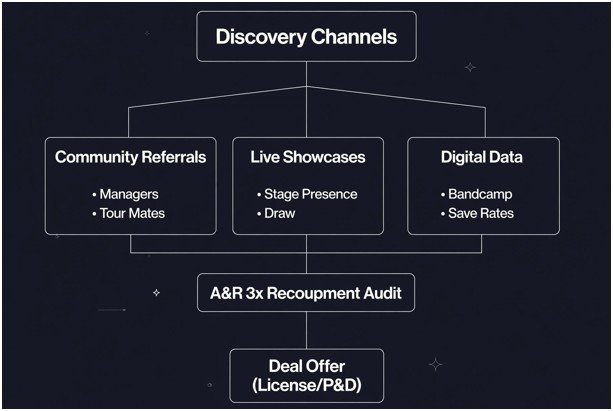
    Indie labels rarely use open calls. We source music through closed loops, personal networks, and targeted digital monitoring.

                        ┌──────────────────────────────┐

                         │     Discovery Channels       │

                         └──────────────┬───────────────┘

                                        │

             ┌──────────────────────────┼──────────────────────────┐

             ▼                          ▼                          ▼

      Community Referrals         Live Showcases             Digital Data

     (Managers, Tour Mates)     (Stage Presence, Draw)    (Bandcamp, Save Rates)

             │                          │                          │

             └──────────────────────────┼──────────────────────────┘

                                        ▼

                         ┌──────────────────────────────┐

                         │   A&R 3x Recoupment Audit    │

                         └──────────────┬───────────────┘

                                        │

                                        ▼

                         ┌──────────────────────────────┐

                         │   Deal Offer (License/P&D)   │

                         └──────────────────────────────┘

    Digital Footprints Over Vanity Metrics

    I never cared about raw follower counts. Viral spikes on short-form video often fail to sell concert tickets or vinyl records. Instead, I analyzed listener retention and community engagement.

    We look for high listener-to-follower ratios on Bandcamp and Spotify. If 3,000 people stream your record weekly and buy physical merch, you possess a viable foundation. For artists deciding between DIY momentum and label infrastructure, reviewing an independent artist revenue split provides vital perspective before taking meetings.

    The Live Show Litmus Test

    A recorded track can be tuned, comped, and polished. A live performance cannot hide behind studio production.

    I scouted local rooms like Baby’s All Right or The Echo to witness how an artist commands silence between tracks. If an act brings 40 dedicated fans who purchase cassette tapes and sing every lyric, that proves cultural resonance. 

    The Worldwide Independent Network (WIN) reports that independent labels account for over 40% of the global recorded music market, fueled primarily by these hyper-engaged local communities.

    The Evaluation Rubric: What We Look for Before Offering a Deal

    The Evaluation Rubric: What We Look for Before Offering a Deal

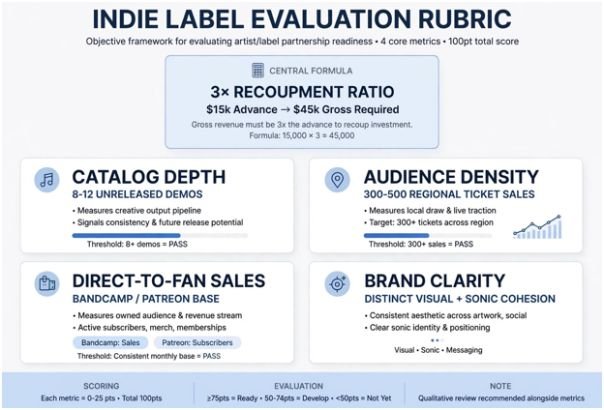
    Before drafting an offer letter, my team ran prospective signings through an internal underwriting process:

    Metric Target Benchmark Why It Matters
    Catalog Depth 8–12 unreleased demos Guarantees release pacing without studio stalling.
    Audience Density 300–500 regional ticket sales Proves fans will travel and spend money on the project.
    Direct-to-Fan Sales Established Bandcamp/Patreon base Confirms recurring audience buy-in beyond passive streaming.
    Brand Clarity Distinct visual and sonic cohesion Reduces marketing costs needed to define the artist narrative.

    We applied a metric I call the 3x Recoupment Ratio. If an artist required a $15,000 advance and press budget, our financial projections needed to show a high probability of generating at least $45,000 in gross master revenue across 24 months. If the projections stalled at breakeven, we passed.

    Deal Architectures: Structuring the Agreement

    Deal Architectures: Structuring the Agreement

    When we chose to sign an artist, our agreements looked fundamentally different from major-label corporate contracts. We prioritized flexible structures over predatory acquisitions.

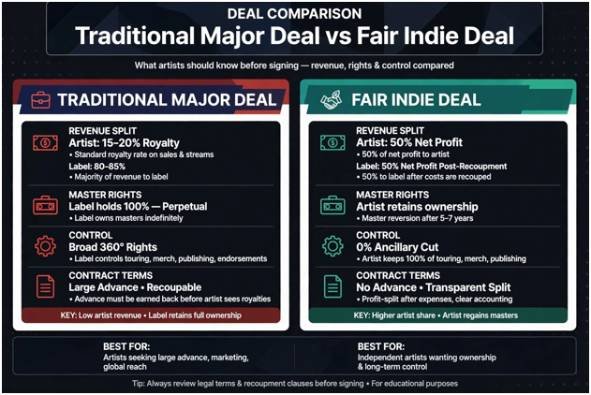
                        Traditional Major Deal vs. Fair Indie Deal


      [ Major Label Deal ]

      Revenue:  Artist: 15-20% Royalty  │  Label: 80-85% + Master Rights (Perpetual)

      Control:  Broad 360 rights (touring, merch, publishing)


      [ Fair Indie Deal ]

      Revenue:  Artist: 50% Net Profit   │  Label: 50% Net Profit (Post-Recoupment)

      Control:  Master reversion after 5-7 years; 0% ancillary cut

    Net Profit Splits (50/50)

    The standard indie contract is a 50/50 net profit split. The label finances mixing, mastering, physical manufacturing, and PR. Once the label recoups those specific, itemized costs, every dollar of net revenue gets divided equally.

    The catch sits inside the accounting definition of “net.” Artists must negotiate strict spending caps. Without mutual expense approval, a label can charge internal operational overhead against the project’s gross income, preventing the artist from receiving royalties.

    Exclusive Licensing vs. Outright Master Assignments

    I advised every musician entering our office to avoid assigning their sound recording copyrights in perpetuity. The U.S. Copyright Office treats sound recordings as distinct intellectual property assets.

    A fair indie deal licenses the master recordings to the label for a defined term—typically five to seven years. After that term expires, commercial rights revert entirely to the artist. If a label insists on owning the master forever, walk away.

    Closing the Deal: Negotiation to Ink

    The contract stage separates casual hobbyists from career professionals. The signing process follows four direct steps:

    1. The Memo of Understanding (MOU): We issued a one-page term sheet outlining the advance, royalty split, territory, and term duration.
    2. Legal Due Diligence: The artist hires an entertainment attorney to redline the long-form contract. Never sign an agreement using the label’s in-house counsel.
    3. Neighboring Rights Registration: Both parties map out metadata collection through SoundExchange to ensure non-interactive digital performance royalties flow smoothly.
    4. Calendar Integration: The project moves to the production schedule. If the artist prefers complete autonomy, consulting a self releasing an album checklist clarifies whether self-distribution beats a label partnership.

    Don’t Sign Away Your Soul: The Final Cadence

    A record deal is not a validation stamp; it is an unsecured business loan paid back with your creativity.

    Independent record labels can amplify your vision, open doors to sync licensing, and place your records into physical shops worldwide. However, they cannot manufacture momentum out of thin air. 

    Build your audience, track your financial metrics, and treat your catalog like equity. When the label calls, ensure you negotiate as an established partner rather than a desperate applicant.

    Frequently Asked Questions

    1. Do indie labels pay advances to new artists?

    Yes, indie labels offer modest advances ranging from $1,000 to $20,000, which are fully recoupable against future streaming and sales royalties.

    2. How do independent record labels find artists?

    Indie labels discover acts through live venue scouting, peer artist referrals, Bandcamp discovery tags, and direct electronic press kit submissions.

    3. Do indie labels own your master recordings?

    Reputable indie labels license masters for a limited term of 5 to 7 years rather than owning the recording copyrights permanently.

    4. Can an artist leave an indie record deal early?

    An artist can exit early only if the label breaches contractual duties or through a negotiated buyout agreement.

  • Independent Artist Revenue Split Streaming Platforms: The 2026 Reality

    Independent Artist Revenue Split Streaming Platforms: The 2026 Reality

    I spent my first three years as a DIY creator believing my distributor gathered every cent my catalog earned. When I audited my catalog statements against my raw stream counts, I realized I had left nearly 20% of my total earnings sitting in collection society escrow accounts.

    Understanding the independent artist revenue split streaming platforms pay out requires looking past aggregate stream counts. A single stream does not pay a flat statutory fee to a single party. Instead, every platform uses a multi-tiered revenue pool split across distinct legal copyrights.

    How the Streaming Revenue Pool Actually Works

    Digital streaming platforms (DSPs) such as Spotify, Apple Music, and TIDAL operate on a pro-rata revenue-share system rather than paying artists a fixed per-stream rate.

    The Platform Cut vs. The Rights-Holder Pool

    Every subscription dollar and ad impression enters a localized pool. DSPs deduct their cut first before disbursing the remainder to copyright owners.

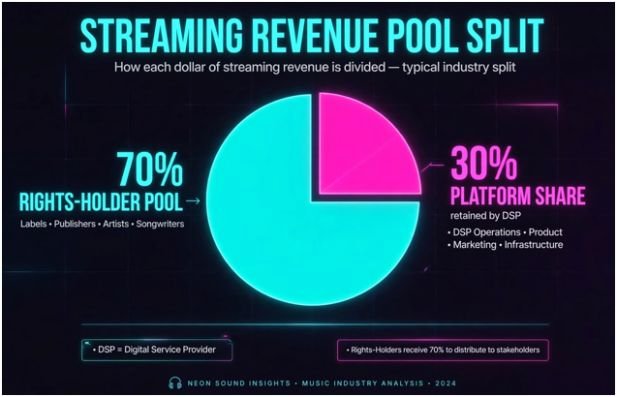
    Allocation Segment Approximate Share Recipient Entity
    Platform Share ~30% Retained by DSP for operational costs, bandwidth, and margin
    Rights-Holder Pool ~70% Disbursed to distributors, labels, publishers, and songwriters

    The 70% pool distributes according to market share: if an artist accounts for 0.01% of all eligible streams in a territory during a billing period, that catalog receives 0.01% of the available pool.

    The Split Breakdown: Master Rights vs. Publishing Rights

    The Split Breakdown: Master Rights vs. Publishing Rights

    When someone streams your track, you trigger two separate intellectual property assets governed by copyright law. The U.S. Copyright Office legally differentiates between the recorded audio and the underlying composition. If you write and record your own songs, you own both sides.

    Royalty Stream Percentage of Pool Collection Channel Required Registration
    Master Royalties ~80–85% DSP $\rightarrow$ Digital Distributor TuneCore, DistroKid, CD Baby
    Mechanical Royalties ~8–10% DSP $\rightarrow$ Mechanical Licensing Body The Mechanical Licensing Collective
    Performance Royalties ~6–8% DSP $\rightarrow$ Performing Rights Org (PRO) ASCAP, BMI, SESAC, PRS
    Non-Interactive Master Statutory (Varies) DSP $\rightarrow$ Statutory Collective SoundExchange

    Master Recording Royalties

    The sound recording (the master) claims roughly 80% to 85% of the rights-holder pool. This payout flows directly to your distributor. If you utilize modern independent music distribution, you keep 85% to 100% of this chunk depending on whether you pay a flat annual subscription or a backend commission.

    Composition and Publishing Royalties

    The remaining 15% to 20% belongs to the composition: the melodies, lyrics, and song arrangements. This bucket divides into two distinct parts:

    1. Mechanical Royalties: Generated when music is reproduced digitally via on-demand streaming.
    2. Performance Royalties: Generated when music is publicly performed, broadcast, or transmitted digitally.

    Distributors rarely collect publishing mechanicals or performance fees by default. Uncollected mechanicals land in the “black box” where unclaimed funds eventually get re-allocated to major publishers based on market share.

    DSP Payout Estimates Across Major Platforms

    DSP Payout Estimates Across Major Platforms

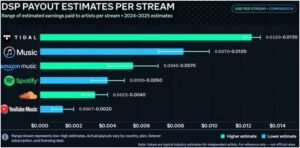
    Payouts fluctuate monthly based on subscriber location, subscription tiers, and local ad markets. Free ad-supported streams pay fractions of what premium family or individual accounts yield.

    Platform Estimated Effective Payout / Stream Primary Revenue Model Key Terms & Requirements
    TIDAL $0.012 – $0.013 Premium subscription only Artist-first model; highest consistent pool rate
    Apple Music $0.007 – $0.010 Premium subscription only No ad tier; consistent international rates
    Amazon Music $0.004 – $0.007 Hybrid (Prime vs Unlimited) Higher payouts tied strictly to Unlimited plans
    Spotify $0.003 – $0.005 Freemium / Ad-supported 1,000 streams minimum annually to generate royalties
    SoundCloud $0.0025 – $0.004 Fan-Powered Royalties Allocates subscription fees based on user listening habits
    YouTube Music $0.0007 – $0.002 Ad-heavy / Video hybrid Content ID monetization heavily affects payouts

    The Leaky Bucket: Where Unclaimed Royalties Vanish

    The Leaky Bucket: Where Unclaimed Royalties Vanish

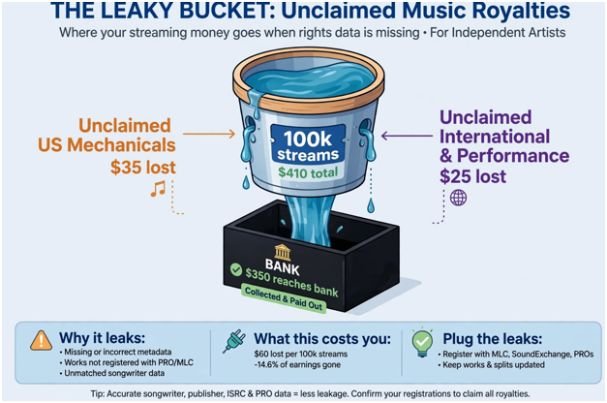
    Here is a live audit of an independent release generating 100,000 streams in the United States on Spotify, assuming a standard average master rate of $0.0035:

    • Gross Stream Payout Generated: ~$410
    • Master Distribution Cut (to your bank via distributor): ~$350
    • Unclaimed US Mechanicals (uncollected at The MLC): ~$35
    • Unclaimed International & Performance Royalties: ~$25
    • Total Value Abandoned: ~$60 per 100k streams

    Scale those numbers to 1,000,000 streams, and an unmonitored catalog surrenders $600 or more in uncollected publishing revenue.

    The Pipeline Fix: How I Set Up Complete Royalty Collection

    Securing your total earnings requires a coordinated release process. Before distributing your next track, complete this administrative checklist:

    1. Upload via Digital Distribution: Use your distributor to push audio to DSPs and assign your ISRC codes.
    2. Register with a PRO: Submit titles and splits to ASCAP or BMI to capture writer and publisher performance income.
    3. Register Works with The MLC: Add track titles, ISWCs, and corresponding audio ISRCs inside the member portal to receive direct mechanical distributions.
    4. Claim Tracks on SoundExchange: Register as both the Featured Artist and the Sound Recording Copyright Owner (SRCO) to capture digital radio performances from Pandora and SiriusXM.
    5. Enlist a Publishing Administrator: Use an admin publisher if you want automated collection of mechanical royalties outside the US without managing local societies yourself.

    Keep this workflow handy inside your self releasing an album checklist before every release date.

    Stop Donating Your Residuals

    Streaming margins remain lean, but abandoning your rights makes them thinner. Stop treating your digital distributor as a one-stop business manager. Claim your publishing registrations, match your ISRC codes, and collect every cent the algorithms generate.

    Frequently Asked Questions

    1. Does DistroKid or TuneCore collect my ASCAP and BMI royalties?

    No, digital distributors only collect master recording royalties, leaving performance collections to your PRO.

    2. What is the 1,000 stream threshold rule?

    Spotify requires tracks to hit at least 1,000 streams within 12 months before disbursing recorded royalties.

    3. How often do digital streaming services distribute payouts?

    DSPs process royalties on a 60- to 90-day delay, sending reports monthly to distributors and quarterly to PROs.

    4. What is the difference between an ISRC and an ISWC code?

    An ISRC identifies the recorded audio file, while an ISWC identifies the underlying musical composition.

  • Self Releasing an Album Checklist for Indie Artists: My 8-Week Roadmap

    Self Releasing an Album Checklist for Indie Artists: My 8-Week Roadmap

    I blew my first album release by uploading raw files directly to a distributor five days before launch. I earned zero playlist placements, neglected mechanical royalties, and burned out my audience with sporadic social posts. After years of producing records and managing releases, I built an organized system. This self releasing an album checklist for indie artists eliminates chaos, secures your revenue streams, and delivers your music to the right listeners.

    Whether you plan a full twelve-track LP or scaled back to release an independent ep, an eight-week runway remains the industry standard for a reason.

    Weeks 8 to 6: Locking Production Assets and Metadata Hygiene

    Weeks 8 to 6 Locking Production Assets and Metadata Hygiene

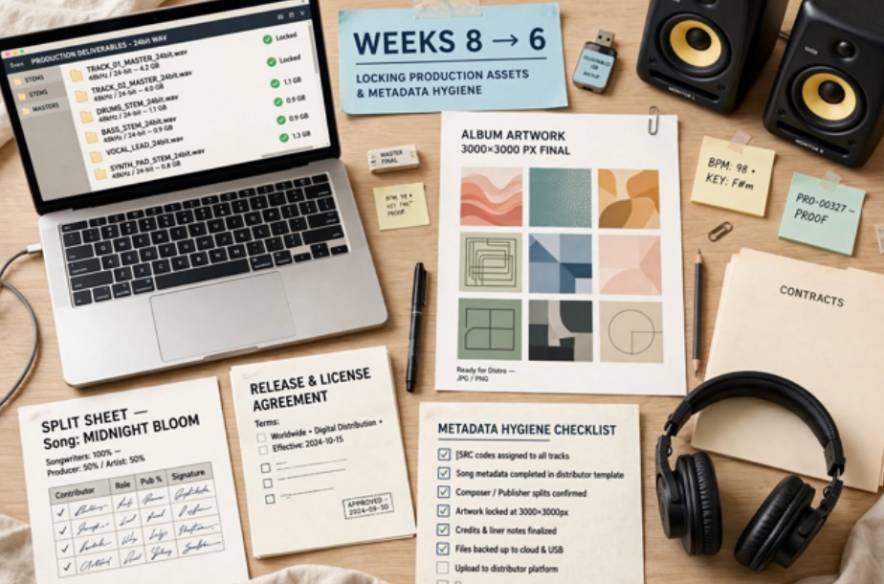
    Rushing production deliverables corrupts your release downstream. Your mixing and mastering engineers must deliver archival-quality files before you sign off on any distribution contracts.

    Clearing Rights, Splits, and Master Files

    Export your master audio as 24-bit, 44.1kHz uncompressed WAV files. Verify your artwork measures exactly 3000 x 3000 pixels at 300 DPI, configured in RGB color space. Streaming services reject artwork displaying social media handles, pricing stickers, or retailer logos.

    Never rely on verbal agreements for songwriting. Draft signed split sheets detailing the precise percentages owed to co-writers, topliners, and session musicians. If you used samples, clear both the master sound recording and underlying composition licenses now. Untangled publishing disputes freeze distribution assets and escrow royalty payouts indefinitely.

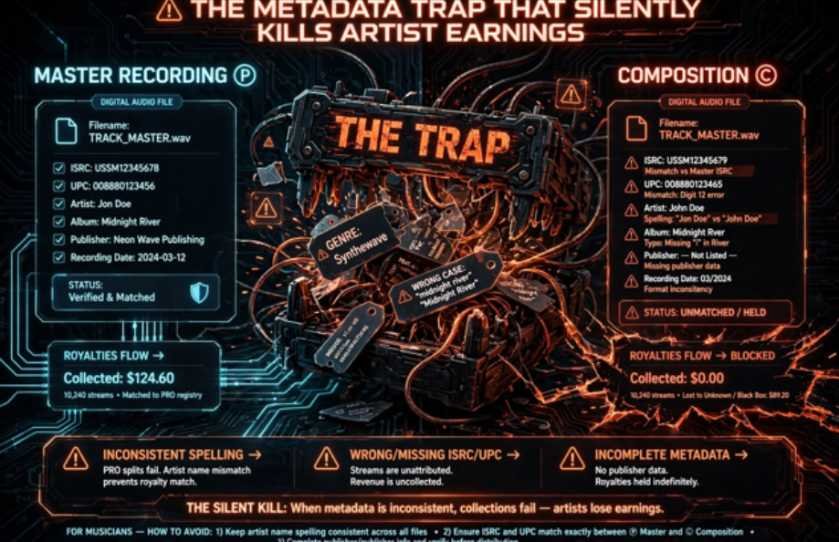
    Compile your metadata into a single offline document. Collect primary artist display names, featured performers, producers, engineers, and explicit content designations. Double-check the legal spelling of every contributor. Fixing spelling mistakes across digital service providers after release often takes weeks.

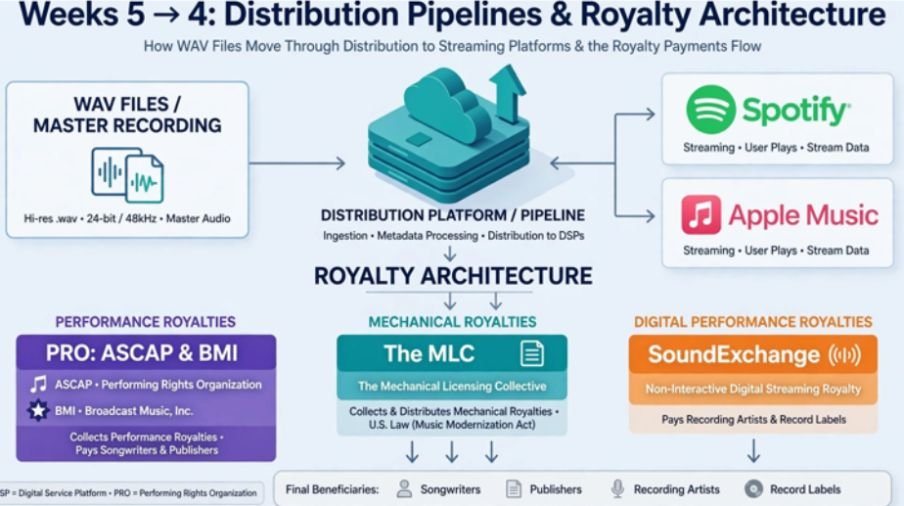
    Weeks 5 to 4: Distribution Pipelines and Royalty Architecture

    Weeks 5 to 4 Distribution Pipelines and Royalty Architecture

    Uploading your album a month in advance ensures you never miss a street date. Modern independent music distribution platforms need sufficient lead time to process, inspect, and ingest multi-track deliverables across global networks.

    Always select a Friday release date to synchronize with standard weekly platform updates and global charting windows.

    Platform / Entity Function Asset / Requirement
    Digital Distributor Ingestion to Spotify, Apple, etc. 24-bit WAVs, 3000x3000px Cover, Metadata
    PRO (ASCAP / BMI) Performance Royalty Collection Work Titles, Writer IPIs, Publisher IPIs
    The MLC Digital Audio Mechanicals Master Song Titles, ISRCs, Writer Splits
    SoundExchange Non-Interactive Digital Audio Royalties Master Recording ISRCs, Featured Artist Info

    Setting Up Mechanical and Digital Performance Pipelines

    Distributors deliver your songs to DSPs, but they do not collect your global songwriting royalties. Register your songs with your local Performing Rights Organization to secure broadcast and live performance revenue.

    Next, submit your catalog data directly to The MLC to collect domestic mechanical royalties generated by on-demand interactive streams. Pair this step with a complete catalog upload to SoundExchange, which recovers non-interactive digital performance royalties from satellite and internet radio broadcasts. Missing these steps leaves roughly 20% to 30% of your earned music revenue sitting in unclaimed black-box pools.

    Finally, build your smart pre-save link through platforms like Feature.fm or Hypeddit. This single page aggregates fan interest across all primary platforms.

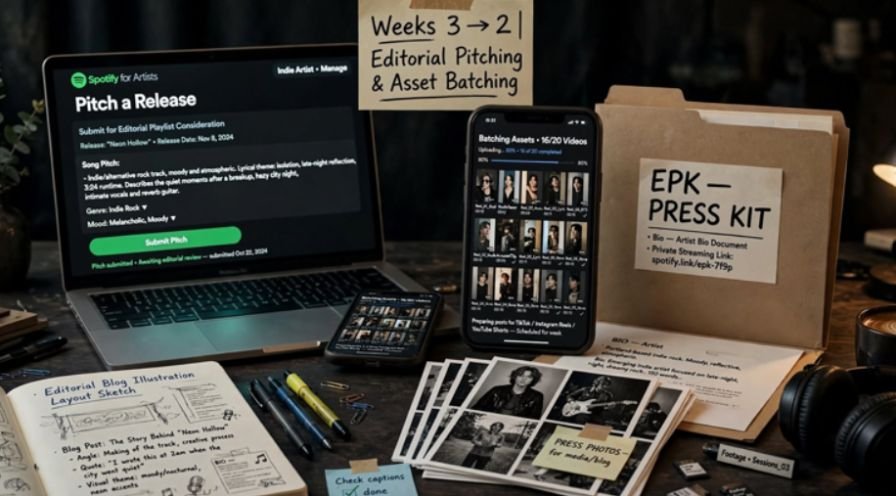
    Weeks 3 to 2: Editorial Pitching and Asset Batching

    Weeks 3 to 2 Editorial Pitching and Asset Batching

    With your release ingested and assigned unique ISRCs and UPCs, your streaming profiles will display the upcoming release in your creator dashboards. This begins your promotional campaign.

    Pitching Spotify Editorial Without Wasting Your Shot

    Log into your dashboard and follow the Spotify for Artists Pitching Best Practices to target human curators. You must pitch your chosen focus track at least 14 days before launch.

    Avoid generic descriptions in your pitch. Detail the musical instrumentation, identify complementary artists, specify your target audience demographic, and describe your external promotional budget.

    Alongside editorial playlist pitching, artists can learn how to get featured on independent music blogs and podcasts to expand their release campaign beyond streaming platforms.

    Pitching on time guarantees your single lands on your existing followers’ personal Release Radar playlists on morning one.

    Simultaneously, craft a lightweight Electronic Press Kit hosted on an unlisted webpage or cloud folder. Include:

    • A concise 250-word narrative bio framing the record’s sonic identity
    • Two high-resolution press photos in both horizontal and vertical crops
    • High-res album artwork files
    • A private, password-protected streaming link for journalists and playlisters

    During this quiet window, batch 15 to 20 vertical videos. Create short-form performance takes, lyric breakdowns, and behind-the-scenes recording footage. Trying to shoot, edit, and post video daily during release week causes immense stress. Bank your assets early.

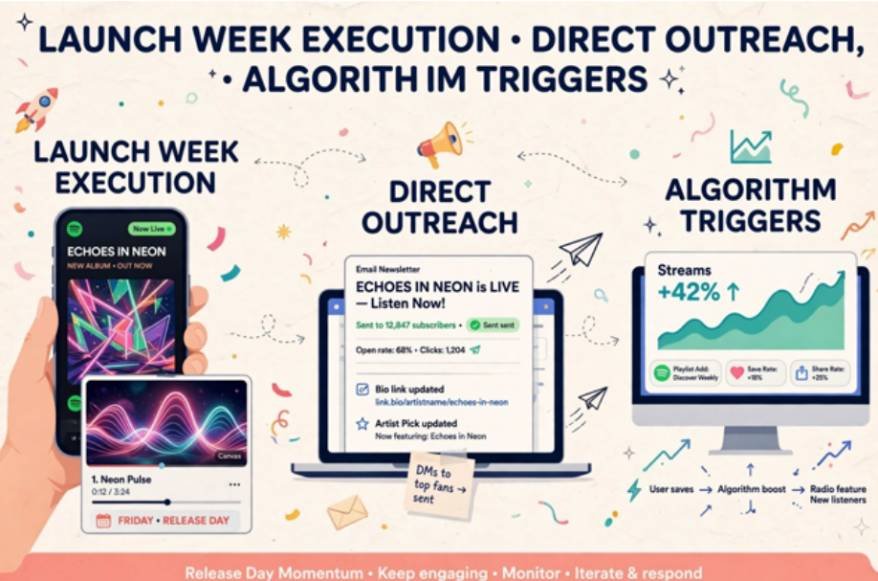
    Launch Week: Execution, Direct Outreach, and Algorithm Triggers

    Launch Week Execution, Direct Outreach, and Algorithm Triggers

    Friday morning brings the official rollout. First, audit every major storefront to ensure the album appears correctly without orphaned tracks, mismatched metadata, or split artist profiles.

    Swap the primary URL in your social bios to direct fans to your live smart link. Update your Artist Pick on your streaming profiles to prioritize the new album, and link your custom vertical Spotify Canvas videos to your focus tracks.

    Send an email newsletter directly to your core subscribers with clickable links to every service. Direct-to-fan email marketing repeatedly yields four times the conversion rate of standard social posting. Thank your engineers, visual artists, and collaborators publicly across your channels, tagging their handles to cross-pollinate reach.

    Post-Launch: The Second Wave and Algorithmic Momentum

    The work continues after the first weekend. Streaming algorithms analyze listening trends, skip rates, and playlist-add ratios during the initial 14-day window.
    Publish your batched social clips on a disciplined schedule. Respond to every user-generated clip, comment, and story mention within an hour of posting to keep platform engagement metrics high.

    Deliver secondary promotional assets during weeks two and three. Release an acoustic performance video, drop a visualizer for track four, or share an in-depth track-by-track interview. Continuous activity tells Spotify’s Discover Weekly algorithm that your release maintains organic interest beyond launch day.

    Frequently Asked Questions 

    1. How far in advance should I upload an album for distribution?

    Upload your album four to six weeks before your target release date to secure editorial pitching access and prevent technical delays.

    2. What is the ideal day of the week to release indie music?

    Friday is ideal for competing for algorithmic playlists, whereas a Tuesday or Wednesday release minimizes competition if you rely strictly on direct-to-consumer sales.

    3. Do I need a record label to collect streaming mechanical royalties?

    No, independent artists can collect their mechanical royalties directly by registering their catalog with The MLC and a publishing administrator.

    4. How much money should indie artists budget for marketing an album?

    Allocate at least 50% of your total project budget strictly toward external marketing, video assets, and targeted playlist pitching campaigns.

    Cut the Ribbon, Keep the Equity

    Self-releasing music requires discipline, careful project management, and patience. Following an established framework shields you from copyright roadblocks, missing royalty checks, and unforced distribution errors. Run through this roadmap, check off your production deliverables early, and focus on building genuine connections with your audience.

  • Independent Music Distribution Without Major Label Backing: My Battle-Tested Blueprint

    Independent Music Distribution Without Major Label Backing: My Battle-Tested Blueprint

    Signing away my master rights to a predatory label was never an option for my projects. Executing independent music distribution without major label backing became my survival strategy. Bypassing the major label machine means you keep your copyright, retain 85% to 100% of your royalty revenue, and reach every global digital storefront within 72 hours.

    Direct uploads do not exist for everyday creators on platforms like Spotify or Apple Music. You must partner with an aggregator. Navigating this ecosystem requires clear math, an understanding of rights collection, and ruthless attention to metadata.

    Choosing Your Aggregator Model: The Real Math Behind the Fees

    Choosing Your Aggregator Model The Real Math Behind the Fees

    Aggregators generally use two models: recurring subscriptions or pay-per-release commission structures. Choosing the wrong setup eats your margins or drops your catalog from streaming stores when life gets busy.

    Artists working with limited release budgets can also explore music grant opportunities for independent artists to help offset distribution, production, and promotional expenses.

    For a closer look at pricing structures, royalty retention, and catalog policies, explore the best digital music distribution for independent musicians.

    I learned this the hard way when a missed billing notification threatened a year of back-catalog singles on an annual flat-fee service. Evaluate your release cadence before entering your card details.

    Flat-Fee vs. Commission Breakdown

    Distributor Model Cost Structure Royalty Retention Catalog Takedown Risk Best For
    Flat Annual Fee (e.g., DistroKid, TuneCore) ~$23–$40/year recurring 100% High (music pulled if subscription lapses unless paid extra) High-volume artists (4+ singles/year)
    Pay-Per-Release (e.g., CD Baby, EmuBands) ~$9.99–$20 one-time fee 91%–100% (CD Baby takes 9%) Zero (catalog remains live perpetually) Evergreen catalog releases & low-frequency drops
    Curated / Tiered (e.g., Symphonic, Too Lost) Revenue share (15%) or bespoke tier 85%–100% Low Artists with existing streaming traction & video needs

    Flat fees win if you upload tracks monthly. If you release sporadically, a permanent one-time fee protects your catalog from disappearing during dry spells.

    The Streaming Payout Reality: The 1,000-Stream Cutoff

    The Streaming Payout Reality The 1,000-Stream Cutoff

    Spotify’s payout rules require tracks to hit at least 1,000 streams within a trailing 12-month period to generate recorded music royalties. Below that threshold, your master streams earn $0.

    When planning your release cadence, direct your promotional energy toward pushing specific priority tracks past that milestone instead of spreading listeners across scattered releases.

    The Rights and Royalties Engine Behind Digital Music Distribution

    The Rights and Royalties Engine Behind Digital Music Distribution

    Distributor royalties only account for half your income. When an aggregator routes your audio through modern digital music distribution networks, you only collect the master interactive streaming payout.

    If you wrote the song, up to 40% of your earnings stay frozen across multiple collection societies unless you claim the composition side.

    Securing your creative assets through the U.S. Copyright Office provides legal foundation, but active pipeline registration drives your ongoing income.

    Master vs. Composition Payout Pathways

    Royalty Type Source Collection Agency Who Keeps It
    Interactive Master Royalty Spotify, Apple Music, Tidal Your Distributor (e.g., DistroKid) Sound recording owner (You)
    Digital Performance Royalty SiriusXM, Pandora, Webcasts SoundExchange Featured artist & master copyright owner
    Performance Royalties Terrestrial radio, venues, streams PROs (ASCAP, BMI, SESAC) Songwriter & Music Publisher
    Mechanical Royalties Interactive stream reproductions The MLC Songwriter & Music Publisher

    Link your metadata with correct International Standard Recording Codes (ISRC) for master tracks and International Standard Musical Work Codes (ISWC) for compositions. Missing these connections guarantees lost revenue.

    How I Release an Independent EP: A Tactical Setup Checklist

    When you prepare to release an independent ep, rush jobs lead to broken credits, lost playlist placements, and delayed streaming releases.

    Production Window Action Item Primary Objective
    4 Weeks Out Final Audio & Asset Export Master to -9 to -11 LUFS for dynamic punch; verify cover art meets 3000x3000px standards.
    3 Weeks Out Distributor Submission Upload track files, populate legal songwriter credits, and generate native ISRC/UPC codes.
    2 Weeks Out Editorial Pitching Access Spotify for Artists to draft your formal editorial pitch with genre tags and mood context.
    1 Week Out Short-Form Campaign Launch Deploy pre-save links, seed original audio on TikTok and IG Reels, and send bandcamp mailers.

    Never leave delivery to the final week. Aggregator review queues can back up, leaving your release date dead on arrival.

    Ditch the Label Handcuffs, Keep the Cash

    The old industry myth claimed you needed major label backing to find an audience. Modern streaming and short-form platforms prove that ownership, smart distribution choices, and systematic publishing collection yield far more leverage.

    Pick the right aggregator, register your performance rights, and build your release runway. Stop waiting for validation from an A&R representative who wants 80% of your work.

    Frequently Asked Questions 

    1. Does my music get removed if I cancel my distributor subscription?

    Yes, subscription platforms remove your music upon account cancellation unless you pay an add-on permanent legacy fee.

    2. What is the main difference between an ISRC and a UPC?

    An ISRC identifies a specific audio recording, while a UPC identifies the complete product release or album package.

    3. Can an independent artist distribute to TikTok and Instagram Reels?

    Yes, modern distributors deliver audio to Meta and TikTok sound libraries alongside traditional streaming platforms.

    4. Do I need a music publisher to collect mechanical streaming royalties?

    No, independent songwriters in the US can register directly with The MLC to claim their mechanical royalties at zero cost.

  • How to Release an Independent EP Step by Step: A Complete Roadmap

    How to Release an Independent EP Step by Step: A Complete Roadmap

    I spent five months recording my first self-produced project, exported the audio, and uploaded it to a distributor forty-eight hours before my chosen Friday release date. The result was radio silence: zero algorithmic playlist traction, no editorial review, and hundreds of dollars in mechanical royalties left completely uncollected.
    Learning how to release an independent ep step by step requires treating your release strategy with the same surgical precision you bring to the mixing console. An Extended Play (EP) is your most potent calling card. It defines your sonic identity without demanding the exhausting promotional runway of a twelve-track LP.
    Follow this practical, timeline-tested framework to protect your royalties, leverage streaming algorithms, and deliver your music to listeners globally.

    Phase 1: Locking Down Production Assets and Technical Metadata

    Phase 1 Locking Down Production Assets and Technical Metadata

    Before uploading a single file to a server, lock your creative and technical assets. Tweaking a master or fixing a typo after distribution initiates ingestion delays that can derail an entire promotional timeline.

    Audio Formatting and Strict Delivery Standards

    Export your final masters from your mastering engineer as uncompressed WAV files at 24-bit / 44.1 kHz or 24-bit / 48 kHz. Avoid delivering MP3s or files with inter-sample peaks that clip during Digital Signal Processing (DSP) encoding. Check that track filenames follow a clean, standardized naming structure:

    TrackNumber_ArtistName_SongTitle_Master_24-44.wav

    Cover Art Specifications and Rejection Traps

    DSP ingestion systems automatically flag artwork that fails standard delivery parameters. Design your graphics to meet these baseline rules:

    • Strictly square aspect ratio (1:1), sized between 3000 × 3000 and 4000 × 4000 pixels.
    • Formatted in RGB color space as high-quality JPG or PNG files.
    • Free from retailer logos, social media handles, website URLs, barcodes, pricing, or pixelated imagery.

    Ensure the artist name and project title on the art match your metadata verbatim. A disparity between “EP” on the cover and “E.P.” in the distribution field can trigger a metadata rejection during ingestion.

    Phase 2: Selecting Distribution and Scheduling the Ingestion Window

    Independent artists cannot upload directly to Spotify, Apple Music, or Tidal. You need a trusted distributor to pipe your music, metadata, and licensing codes into each digital storefront. Choosing the best digital music distribution for independent musicians depends on your release cadence, budget, and how you want to manage your catalog over time.

    Evaluating Distribution Models for Multi-Track Projects

    Navigating digital music distribution for independent musicians comes down to your release cadence:

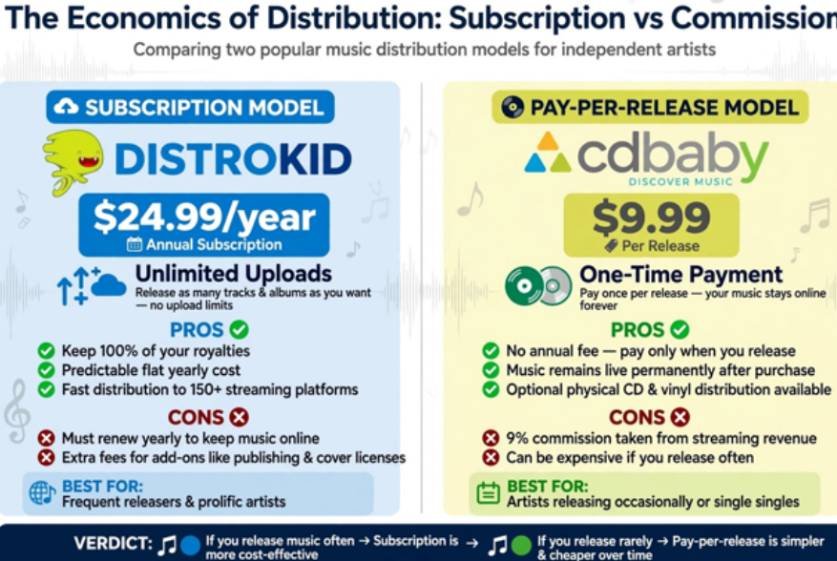
    • Annual Flat-Fee Services (e.g., DistroKid, TuneCore): Ideal if you release music frequently. You pay a predictable annual subscription to keep unlimited tracks live.
    • Pay-Per-Release Platforms (e.g., CD Baby): Ideal for artists who release projects intermittently and do not want to maintain an annual fee to prevent their catalog from being taken down.

    The Strategic Lead Time: Why Six Weeks Is Non-Negotiable

    Upload your assets at least six weeks prior to your official release date. Distributors require three to five business days to inspect and deliver your files to platforms. 

    Furthermore, Spotify requires your tracks to sit inside their backend system for a minimum of seven business days before release to ensure inclusion in your followers’ Release Radar playlists. 

    Six weeks gives you breathing room to troubleshoot metadata errors and execute an editorial pitch without panic.

    Phase 3: The Waterfall Release Strategy That Compounds Streams

    Phase 3 The Waterfall Release Strategy That Compounds Streams

    Dropping all five tracks of an EP simultaneously is an outdated approach for independent acts. When you dump an entire project at once, Spotify’s editorial curators only let you pitch one song, leaving the remaining four without editorial consideration.

    The modern industry standard is the Waterfall Strategy.

    Single 1 Drop:       [Track 1]

    Single 2 Drop:       [Track 2] + [Track 1]

    EP Release Day:      [Track 3] + [Track 4] + [Track 5] + [Track 2] + [Track 1]

    To execute this, release your lead single first. Four weeks later, release your second single as a two-track package that includes the first single. When the full EP lands, it houses the previous singles alongside the unreleased tracks.

    The Golden Rule: Always reuse the exact same International Standard Recording Code (ISRC) for each recurring track. Reusing the ISRC ensures that the play counts, playlist inclusions, and algorithm history from Single 1 seamlessly roll into the full EP release rather than resetting to zero.

    Phase 4: Pitching Editorial Curators and Setting Up Pre-Saves

    Phase 4 Pitching Editorial Curators and Setting Up Pre-Saves

    Once your distributor delivers the files, the project appears in your artist dashboard. Now you can initiate your direct playlisting outreach.

    Crafting the 500-Character Spotify Editorial Pitch

    According to Spotify for Artists pitch guidelines, curators evaluate thousands of submissions daily through a strict 500-character description field.

    Cut the self-praising adjectives and focus exclusively on sound, context, and promotional leverage. Understanding curated user playlists vs editorial pitching can help independent artists decide where to focus their playlist promotion efforts.

    Structure:

    [Sonic Hook & Sub-genre] + [2 Comparable Artists (FFO)] + [Core Theme/Story] + [Target Playlists] + [Concrete Marketing Commitment]

    Tested 480-Character Pitch Example:

    “Static Bloom” is an upbeat indie-rock track driven by chorus-heavy guitars and driving percussion. FFO: Sam Fender, The War on Drugs. Written in a home studio during winter isolation, capturing the friction between creative ambition and creative burnout. 

    Target playlists: ‘Fresh Finds Indie,’ ‘Undercurrents.’ Supported by a $600 Meta conversion campaign targeting indie fans, a four-city regional tour kicking off next month, and high-rotation short-form video previews. (488 characters)

    High-Intent Pre-Save Funnels

    Do not rely on a standard streaming link until the song is live. Build an unreleased smart link using services like Feature.fm or Hypeddit. When fans pre-save your project, they authorize the platform to add the EP directly to their libraries the second it goes live at midnight. A high concentration of first-day saves signals to the algorithm that your release has genuine listener demand.

    Phase 5: Registering the Backend Rights to Collect Every Royalty

    Distributors collect your master recording royalties from streaming services. However, if you wrote the songs, your distributor leaves roughly half your money on the table. You must register your catalog with the organizations designed to capture performance and mechanical income.

    Composition vs. Sound Recording: The Four Royalty Streams

    Royalty Type Source Collection Agency
    Master Streaming Interactive streams (Spotify, Apple) Your Digital Distributor
    Performance (Composition) Terrestrial radio, venues, streaming sync PROs: ASCAP, BMI, or PRS
    Digital Performance (Master) Non-interactive streaming (Pandora, SiriusXM) SoundExchange
    Mechanical Royalties On-demand streaming reproductions The MLC

    Register with a Performing Rights Organization (PRO) like ASCAP or BMI to capture your performance royalties. Next, set up an account with SoundExchange to collect non-interactive digital transmission money. 

    Finally, register your song titles and splits with The Mechanical Licensing Collective (The MLC). The MLC is a congressionally mandated nonprofit that collects and distributes digital audio mechanical royalties in the United States.

    Phase 6: Release Week Execution and Algorithmic Momentum

    Phase 6 Release Week Execution and Algorithmic Momentum

    Release day is the midpoint of your campaign, not the finish line. When Friday arrives:

    • Refresh Digital Storefronts: Update your artist banners, profile pictures, and “Artist Pick” on Spotify and Apple Music to feature the new EP artwork.
    • Direct High-Value Traffic: Point your most dedicated listeners to Bandcamp for digital downloads and physical merch. Direct purchases deliver immediate cash flow that streaming micro-cents cannot match early on. Independent musicians can also explore other ways to make money without touring, including digital sales, licensing, memberships, and other music-related income streams.
    • Deploy Short-Form Video Hooks: Post raw, behind-the-scenes clips, songwriting breakdowns, and performance videos across TikTok, Instagram Reels, and YouTube Shorts. Focus on the core emotional hook of your lead single.

    Frequently Asked Questions

    1. How many tracks should an independent EP have?

    An EP typically contains three to six tracks with a total run time under thirty minutes.

    2. How much does it cost to release an EP independently?

    Distribution and rights registrations run between $20 and $150, excluding production, mixing, and promotional ad budgets.

    3. When should I upload my EP to my distributor?

    Upload your audio and metadata four to six weeks before your target release date to guarantee playlist consideration.

    4. Does copyrighting my EP happen automatically?

    Copyright protection exists upon creation, but registering your work with the U.S. Copyright Office is required before filing an infringement lawsuit.

    Stop Sitting on Your Masters: Your Launch Sequence Starts Today

    The difference between an overlooked release and a sustainable release comes down to organizational discipline. When you protect your metadata, build a sensible runway, and pitch with facts instead of fluff, your music stands the best chance of finding its true audience. Run through your checklist, schedule your upload window, and share your project with the world.

  • Best Digital Music Distribution for Independent Musicians

    Best Digital Music Distribution for Independent Musicians

    I spent years uploading masters through nearly every digital aggregator on the web, watching small royalty percentages vanish into hidden contract clauses. Finding the best digital music distribution for independent musicians comes down to your release velocity, long-term catalog security, and how each distributor treats your publishing data.

    A bad choice leaves your songs trapped behind recurring subscription paywalls or bleeds your streaming profits via perpetual backend commissions.

    How often do you drop music ?

                   +——————————-+

                    | How often do you drop music?  |

                    +—————+—————+

                                    |

                   +—————-+—————-+

                   |                                 |

           1-2 Tracks / Year                 3+ Tracks / Year

                   |                                 |

        [ Pay-Per-Release ]                [ Flat Subscription ]

        CD Baby ($9.99/single)             DistroKid ($24.99/yr)

        – Permanent hosting                – Unlimited drops

        – No renewal anxiety               – 100% streaming payouts

        – 9% commission on DSPs            – Songs drop if plan lapses

    The Economics of Distribution: Subscription vs. Commission

    Aggregators divide into two pricing camps: annual recurring fees and one-off upload charges.

    Flat-Fee Subscriptions: DistroKid and Ditto Music

    If you drop multiple tracks a year, subscription services offer high financial leverage. DistroKid charges $24.99 annually on its baseline Musician plan, allowing unlimited uploads while you keep 100% of your streaming revenue. Its automated split-payment system handles collaborator payouts seamlessly.

    The compromise sits in the fine print. Scheduling custom release dates requires upgrading to the Musician Plus tier ($44.99/year). Essential marketing tools like YouTube Content ID monetization carry recurring annual surcharges ($4.95/track/year plus a 20% cut). 

    Ditto Music operates on a similar unlimited baseline, bundling pre-save smart links, chart registration, and sync licensing opportunities into its middle tiers.

    Pay-Per-Release Stability: CD Baby and Legacy Hosting

    CD Baby bypasses recurring annual bills. You pay a one-time fee of $9.99 for a single or $14.99 for an album, and your discography stays on streaming platforms permanently.

    The trade-off is a 9% commission on all digital streaming and download earnings. If you release music sporadically, this model eliminates the anxiety of having your life’s work pulled down due to a failed credit card renewal.

    Direct-to-Opportunity Networks: UnitedMasters and SoundCloud

    Certain aggregators act as hybrid label partners. UnitedMasters funnels independent tracks directly to brand curation teams at the NBA, ESPN, and Twitch. SoundCloud for Artists merges standard global distribution with direct fan engagement and Fan-Powered Royalties, making it a compelling pipeline for hip-hop and electronic producers who prioritize grassroots community support.

    Independent musicians can further expand their reach by learning how to submit music to independent radio stations and getting their tracks in front of curated audiences.

    Independent musicians can also use independent music PR campaigns to build awareness around new releases and reach audiences beyond streaming platforms.

    Calculating the 5-Year True Cost of 15 Singles

    Calculating the 5-Year True Cost of 15 Singles

    A distributor advertising a cheap sign-up fee can end up costing thousands more down the road. Let us examine what happens when releasing three singles per year over five years (15 tracks total) across different earning scenarios.

                        5-Year Take-Home Earnings

                         (Gross Royalties: $25,000)

       DistroKid  ======================================= ($24,875 net)

       CD Baby    ================================= ($22,600 net)

                  +———-+———-+———-+———-+

                  $0        $7,000    $14,000    $21,000    $28,000

    • Upfront baseline costs: DistroKid costs $124.95 ($24.99 × 5 years). CD Baby costs $149.85 ($9.99 × 15 singles).
    • Low-volume catalog ($500 gross streaming income): DistroKid yields $375.05 net after subscription fees. CD Baby takes its 9% commission ($45) plus the $149.85 setup cost, leaving $305.15 net. DistroKid edges ahead by $69.90.
    • Breakthrough catalog ($25,000 gross streaming income): DistroKid yields $24,875.05 net. CD Baby takes $2,250 in commission, yielding $22,600.15 net. DistroKid yields $2,274.90 more.

    However, if you cancel your DistroKid account after year five without purchasing the $29-per-track “Leave a Legacy” option, your songs face delisting. CD Baby’s releases remain hosted forever with zero ongoing maintenance fees.

    The Metadata Trap That Silently Kills Artist Earnings

    The Metadata Trap That Silently Kills Artist Earnings

    Distribution is only half the battle. If your digital audio files lack sound metadata hygiene, your royalties become untraceable “black box” revenue held by collecting societies.

    1. Verify your ISRC and UPC codes: Ensure your distributor assigns free, unique International Standard Recording Codes to every sound recording.
    2. Standardize spelling across DSPs: Consult the Spotify for Artists Metadata Guidelines. Inconsistent contributor tags split your algorithmic listener profile. Once your release metadata is consistent, promoting the music through independent music blogs and podcasts can also help expand its reach and build exposure beyond streaming platforms.
    3. Separate masters from publishing: Digital distribution handles the master sound recording (the ℗ line). It does not collect mechanical or performance royalties generated by the underlying musical composition (the © line).
    4. Register with primary collection agencies: Secure master rights through the US Copyright Office Circular 56, log composition mechanicals with The MLC, and collect digital non-interactive performance royalties through SoundExchange.

    Direct Comparison: Platform Features and Royalty Retention

    Direct Comparison Platform Features and Royalty Retention

    Platform Pricing Model Royalty Cut Best Use Case Notable Limitations Reference & Documentation
    DistroKid $24.99/year (Unlimited) 0% High-output indie artists Paid add-ons for YouTube Content ID and custom release dates DistroKid Documentation
    CD Baby $9.99/single, $14.99/album 9% Archival or sporadic releases Percentage cut scales poorly on viral hits CD Baby Pricing
    TuneCore From $24.99/year (Unlimited) 0% Career artists needing publishing Basic plans gate select promotional features and new stores TuneCore Plans
    SoundCloud for Artists Tiered subscription 0% external Electronic & hip-hop acts Smaller external streaming network reach than traditional aggregators SoundCloud for Artists
    UnitedMasters Tiered / Free split tiers 0% – 10% Urban acts seeking sync/brand deals Full commercial sync pitching requires higher-tier approval UnitedMasters

    Frequently Asked Questions

    1. Which distributor delivers fastest to Spotify and Apple Music?

    DistroKid consistently pushes tracks to Spotify and Apple Music within 24 to 72 hours, outpacing traditional manual aggregators.

    2. Do independent music distributors own my master recordings?

    Reputable digital distributors act solely as delivery pipelines and claim zero ownership over your underlying master copyrights.

    3. What happens to my songs if I stop paying my annual subscription?

    Unless you paid for permanent legacy protection, subscription-based distributors remove your catalog from streaming platforms once billing lapses.

    4. Can I change digital distributors without losing my stream counts?

    You can migrate distributors without losing stream counts by using the exact same ISRC codes, track lengths, and metadata fields.

    Stop Overthinking the Aggregator and Pick Your Lane

    Do not let analysis paralysis hold your tracks captive on an external hard drive. If you write, mix, and drop music continuously throughout the year, launch a DistroKid or Ditto subscription to maximize your earnings. 

    If you work deliberately on concept projects and value permanent hosting without maintenance fees, upload via CD Baby. Pick the economic structure matching your workflow, lock down your metadata, and release your art into the wild.