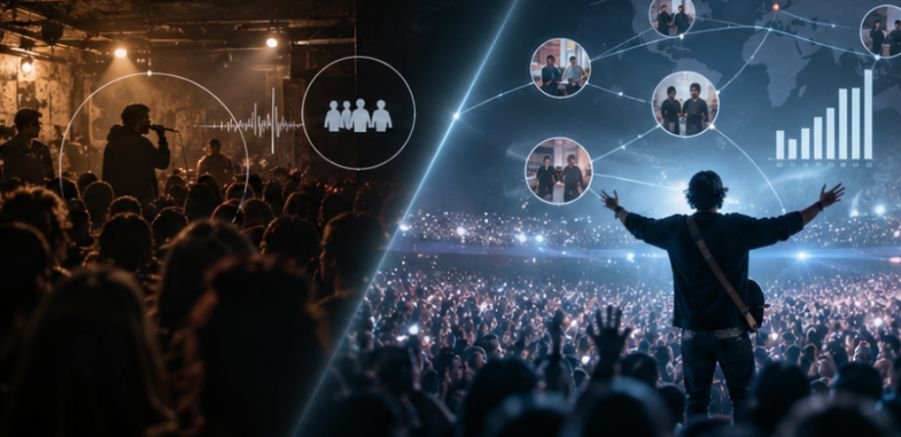
A musician can have millions of listeners and still be independent. Another can have only a few thousand devoted fans, belong firmly to an underground scene, and still work with a record company.
That apparent contradiction explains why underground artist vs independent artist is so often misunderstood. “Independent” primarily describes how an artist’s career, recordings, rights, and business relationships are structured. “Underground” describes something less contractual: an artist’s visibility, audience, cultural position, sound, and relationship with the mainstream. The two frequently overlap, but they are not interchangeable.
The Simplest Difference: Business Structure vs Cultural Position
An independent artist generally operates without being signed to one of the major record-label systems. They may finance recordings themselves, own masters, hire outside companies for distribution, employ managers or publicists, and operate their career like a small business.
An underground artist is identified less by contracts and more by where they exist culturally.
Their audience may be concentrated around a particular subgenre, city, online community, venue network, or DIY scene. Their music may receive little commercial radio exposure or mainstream media coverage despite having deeply committed listeners.
That gives us a useful shortcut:
| Question | Independent Artist | Underground Artist |
| What defines the term? | Career and business structure | Audience and cultural visibility |
| Must the artist be unknown? | No | Usually relatively niche |
| Can they become mainstream? | Yes | Yes, though the label may eventually stop fitting |
| Can they work with companies? | Yes | Yes |
| Does genre determine it? | No | Often influenced by scene or subculture |
| Main concern | Control, ownership, distribution | Community, identity, reach |
The important point is that independence does not automatically mean obscurity.
What Makes an Artist Independent?
Modern independent musicians can perform many functions once handled almost exclusively by record labels.
Berklee College of Music notes that musicians can now record with relatively simple equipment, promote themselves through social platforms, and independently release music through digital services.
Independence therefore has more to do with control than popularity. An artist might independently organize recording sessions, hire producers, commission artwork, arrange distribution, book concerts, run advertising campaigns and negotiate licensing opportunities.
What is an independent artist and how indie musicians actually build careers becomes clearer when these responsibilities are viewed as part of a broader career structure, where artists can combine creative control with professional support across recording, distribution, marketing, touring, and rights management.
Some create their own labels simply to organize releases and intellectual property more professionally.
That does not mean independent musicians literally do everything alone. An independent artist can hire a manager, lawyer, distributor, booking agent, marketing company or publisher and remain independent. The important question is who controls the underlying career and agreements.
Berklee even teaches artist entrepreneurship and DIY music marketing as professional disciplines, covering business planning, revenue streams, marketing and independent career development.
What Makes an Artist Underground?

“Underground” is harder to reduce to paperwork because there is no legal definition or universally accepted audience threshold.
Instead, it describes an artist’s place inside music culture.
An underground performer may build an audience through basement shows, independent venues, college radio, small festivals, local promoters, niche forums, Discord communities, Bandcamp circles, scene-specific playlists or word-of-mouth discovery.
American music history offers many examples of scenes growing this way.
The Smithsonian’s documentation of Washington, D.C.’s DIY music culture describes underground scenes built around local musicians, independent spaces and handmade show posters. It also connects this tradition with D.C.’s go-go and hardcore punk communities.
NYU: The Downtown Music Scene has the archive of Manhattan’s downtown music scene similarly describes creative networks characterized by experimentation, unconventional collaboration and resistance to established commercial and cultural norms.
This is why underground status is partly cultural rather than purely numerical. An artist with 100,000 listeners concentrated within one alternative scene could feel more “underground” than someone with fewer listeners whose music regularly appears in mainstream entertainment media.
Can an Independent Artist Become Mainstream?
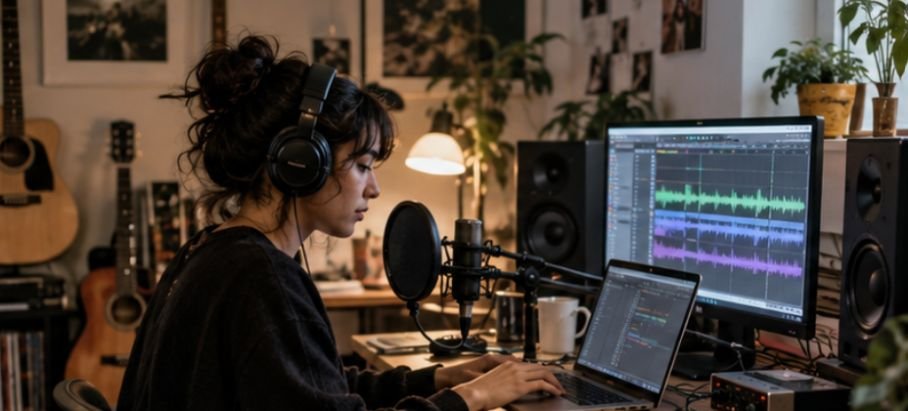
Absolutely. One of the biggest misconceptions surrounding underground artist vs independent artist is that independent musicians must remain small.
Digital distribution changed that equation.
Artists no longer necessarily need a traditional major-label contract simply to make recordings commercially available. Independent musicians can use distributors, direct-to-fan channels, social platforms and touring to reach audiences far beyond their hometown.
Berklee’s historical coverage of independent distribution shows how services such as CD Baby developed specifically to give independent musicians distribution options without requiring conventional label relationships.
An artist could therefore achieve substantial streaming numbers, sell out venues and build an international audience while retaining an independent business structure.
Popularity alone does not turn an independent artist into a major-label artist.
Can an Underground Artist Be Signed to a Label?
Yes, which reveals the opposite side of the distinction.
Suppose an experimental metal, hip-hop or electronic artist signs a recording agreement but continues making highly niche music for a relatively small scene. Listeners may still reasonably describe that artist as underground because the word refers to cultural reach rather than simply contract status.
Likewise, independent labels complicate the terminology.
Being signed to a small independent label does not automatically place an artist within the major-label system. At the same time, being associated with a label does not automatically erase an artist’s underground identity.
Context matters more than the label itself.
The Four-Question Test for Identifying the Difference
Instead of judging artists by follower counts alone, I would use four questions.
1. Who Controls the Recording Career?
Look at who releases the music, who owns or administers the recordings and what type of label agreement exists.
Copyright matters here because musical compositions and sound recordings can have separate owners. The U.S. Copyright Office explains that these are distinct copyrighted works that may be owned and licensed separately.
2. How Broad Is the Audience?
Look beyond raw streaming numbers.
Is the artist known mainly inside one local or online scene, or has recognition spread into mainstream media, major festivals and general entertainment culture?
This question helps determine underground status rather than independence.
3. How Does the Artist Reach Fans?
Grassroots shows, independent promoters, niche communities and direct fan relationships often characterize underground scenes.
However, those methods do not prove an artist is financially or legally independent.
For artists handling their own promotion, independent music PR campaigns on a budget can provide a practical way to build visibility through targeted outreach, niche media, and community-focused promotion without relying entirely on traditional agency support.
4. Where Does the Money and Administration Flow?
Independent artists still operate within formal royalty systems.
For example, SoundExchange manages U.S. digital performance royalties for featured performers and sound-recording copyright owners, illustrating that independent careers can involve sophisticated rights administration rather than purely DIY activity.
The nonprofit Future of Music Coalition also focuses on issues affecting musicians’ compensation, licensing and participation in the modern music economy.
Why the Internet Blurred the Old Definitions

Before inexpensive recording software, global streaming distribution and social media, artists outside the traditional record business faced much greater barriers to reaching listeners.
That made “independent” and “underground” appear much closer together.
Today, distribution and discovery are separate problems.
Today, distribution and discovery are separate problems. For independent musicians, how do independent artists get discovered is increasingly tied to the combination of digital distribution, social platforms, live performances, niche communities, and direct audience relationships rather than relying on a traditional label to create visibility.
A musician can independently distribute a track worldwide within days, but availability does not automatically create mainstream recognition. Meanwhile, a niche artist may deliberately value scene credibility, experimentation or community over mass-market visibility.
The internet therefore separated two ideas that once frequently traveled together: independence from industry gatekeepers and distance from mainstream audiences.
Common Misconceptions
One misconception is that underground automatically means amateur. It does not. Underground performers may have experienced producers, professional touring operations and highly developed artistic identities.
Another is that independent means unsigned and unsupported. Independent artists routinely work with professional distributors, publishers, booking agencies and rights organizations.
Finally, underground is not necessarily a permanent career stage. An artist may emerge from a small scene, attract a wider audience and stop being widely viewed as underground without changing how their business is structured.
Frequently Asked Questions
1. Is an underground artist automatically independent?
No. Many are independent, but underground describes cultural visibility and audience reach. An underground musician can still have a label relationship.
2. Can an independent artist be famous?
Yes. Independence describes business structure rather than fame. An artist can reach a large international audience while independently controlling releases and career decisions.
3. What is the main underground artist vs independent artist difference?
Independent primarily describes how a music career is owned and operated. Underground describes how niche, scene-based or outside mainstream culture an artist remains.
4. Does signing with a distributor mean an artist is no longer independent?
Not necessarily. Distribution services can provide infrastructure without taking the same role or control associated with a traditional major-label recording deal.
What the Labels Really Tell You
The easiest mistake is treating “underground” and “independent” as two levels on the same ladder. They measure different things.
If you want to understand an artist accurately, ask two separate questions: Who controls the career, and where does the artist sit culturally?
The first reveals independence. The second reveals whether “underground” still makes sense.
That distinction has become especially important as musicians can build serious businesses without traditional major-label structures while niche scenes can reach listeners worldwide. An artist can be independent without being underground, underground without being fully independent, both at once—or eventually neither.
Leave a Reply