Blog

  • How Modern Songwriters Use Silence and Space in Lyrics for Greater Impact

    How Modern Songwriters Use Silence and Space in Lyrics for Greater Impact

    I used to think strong lyrics had to keep moving. If there was an empty beat, I wanted another line there, and if a verse felt short, I added more words. Then I started noticing how often my favorite songs did the opposite. A pause before a chorus, a breath after a vulnerable line, or a few seconds with almost nothing happening could make a lyric stay with me longer than a crowded verse.

    I also realized that silence is not empty. When a singer stops, I notice the line before it. When an instrument drops away, I hear the voice differently. That gap can create anticipation or intimacy.

    Why Silence Can Make a Lyric Hit Harder

    Songs communicate through words, melody, rhythm, dynamics, and arrangement. When everything is active, there is little contrast. A placed gap changes that balance.

    Silence can work like a spotlight. If instruments disappear before an important lyric, the vocal suddenly carries more attention. A beat between phrases gives the listener time to register the first thought.

    This connects to prosody, the relationship between lyrics and musical elements. A lyric about hesitation can feel different when sung quickly than when stretched over a sparse setup. Space becomes part of the meaning rather than simply a production trick.

    Space Gives Important Words Room

    Space Gives Important Words Room

    One simple use of silence is placing a pause after a line that deserves attention. Instead of immediately explaining the feeling, the songwriter lets the listener sit with it.

    This works especially well with titles, confessions, or exposed phrases. A short pause can make a sentence feel heavier because the listener is not pushed forward.

    A song does not need another verse just because there is room. A guitar figure, piano phrase, or ambience can carry it forward while giving the lyric a break. Wordless sections can create contrast before a final chorus.

    Silence Creates Tension and Anticipation

    A pause can make listeners wonder what comes next. That uncertainty creates movement.

    Consider the moment before a chorus. If the vocal always enters on the downbeat, the transition can become predictable. Holding it back for a beat or two can make the entrance feel larger. Sometimes the delay creates the drama.

    A singer can break a sentence into fragments, leaving tiny spaces between phrases. Depending on delivery, this can suggest hesitation, urgency, confidence, anxiety, or restraint.

    Let the Song Sound Human

    Real speech is full of pauses. People stop to breathe, search for words, change direction, or let an emotional statement settle. Lyrics that leave space can capture some of that natural behavior.

    This is one reason sparse phrasing works well in alternative and indie music. The vocal does not have to fill every measure. A delayed entrance or uneven pause can make a performance feel closer and more conversational.

    The goal is to give the singer room to communicate the emotional shape of the lyric. Modern songwriting techniques for alternative and indie artists can include this restraint because the space around a phrase can become part of the artist’s identity.

    Use Contrast Instead of Constant Density

    Use Contrast Instead of Constant Density

    Space becomes most noticeable when it contrasts with fullness. A quiet verse can make a dense chorus feel bigger, while a busy passage can make one short line feel important.

    During revision, ask where the listener could use a change of pace. If every section has the same density, removing one element may create more impact.

    Try these three experiments:

    • Leave one or two beats between important phrases.
    • Remove an instrument before a key lyric or chorus entrance.
    • Replace an unnecessary lyrical section with a short instrumental passage.

    Begin with a simple question: does this line need to be here, or am I afraid of the silence that follows it?

    Silence Can Strengthen the Listener’s Role

    Overwriting often tells listeners exactly what to feel. Space can do something different. It leaves room for interpretation.

    A lyric that stops short can invite listeners to connect it with their own experiences. A pause can make them complete an unresolved thought. Personal interpretation can make an emotional song feel more intimate.

    Repetition works similarly. A repeated phrase does not need new words every time. Changing the space around it can shift its emotional meaning. One delivery might feel uncertain; another might sound resigned or confident.

    How to Edit More Space Into Your Lyrics

    Start with the lyric sheet. Read the song aloud and mark where you naturally breathe. Those moments can reveal where the phrasing wants room.

    Then look for lines that explain what the previous line already communicates. Cutting one sentence can create a stronger opening. Try different pauses and entrances, then listen back without watching the screen.

    If the song feels crowded, do not automatically change the words. Try removing an instrument, shortening a phrase, delaying the vocal, or leaving a section wordless. The aim is contrast.

    That approach also connects to the future of songwriting in an AI-saturated music industry. As polished musical material becomes easier to generate, deliberate choices about pacing, restraint, phrasing, and emotional timing can stand out. A songwriter’s voice is shaped by what they create and what they leave unfilled.

    FAQs: How Modern Songwriters Use Silence and Space in Lyrics for Greater Impact

    1. Why is silence useful in songwriting?

    Silence creates contrast, gives lyrics room to land, and can build anticipation before an important moment.

    2. What is negative space in music?

    Negative space refers to intentional gaps or reduced activity, including pauses, rests, sparse arrangements, and sections with fewer instruments or words.

    3. How can I add more space to my lyrics?

    Read your lyrics aloud, mark natural breaths, remove repeated explanations, and experiment with delayed phrases or instrumental passages.

    4. Can silence work in any genre?

    Yes. Silence and space can work in pop, rock, rap, electronic music, alternative, indie, and other styles. The timing needs to suit the song.

    Why Leaving Something Out Can Make a Song Stronger

    Good songwriting is often associated with finding the perfect line, melody, or hook. Yet strong moments can come from choices that barely appear on the page. A pause can expose a voice. A missing beat can create tension. An instrumental passage can let an emotional idea settle. A song is experienced through time, not just read as text.

    When a lyric feels crowded, resist adding another clever line. Take something away and listen to what the silence does. Sometimes the space is where the meaning finally arrives.
  • Major Record Deal vs Independent Music Contract Pros and Cons

    Major Record Deal vs Independent Music Contract Pros and Cons

    When I received my first recording offer ten years ago, I thought a six-figure advance meant instant wealth. It took an entertainment attorney five minutes to show me I was essentially taking out a high-interest mortgage on my own creative voice. Weighing a major record deal vs independent music contract pros and cons comes down to one fundamental trade-off: trading equity and creative control for institutional leverage, or keeping your masters and building long-term enterprise value.

    Both paths build viable careers. However, signing the wrong agreement without understanding how royalties, master ownership, and marketing budgets function will derail your momentum for years.

    The Core Trade-Off: Global Clout vs. Master Ownership

    The three major record conglomerates—Universal Music Group, Sony Music Entertainment, and Warner Music Group—control roughly 70% of the global recorded music market. They operate massive marketing machines capable of commanding commercial radio, securing billboard campaigns, and pitching worldwide DSP (Digital Service Provider) playlists.

    Independent music companies, ranging from boutique imprints to powerhouse operations like Beggars Group or EMPIRE, operate on artist-first revenue splits. Knowing how do independent record labels sign artists reveals their emphasis on data, organic audience engagement, and sustainable catalog growth over mass-market churn.

    Side-by-Side Comparison

    Contract Feature Major Record Deal Independent Contract DIY / Distribution Deal
    Typical Advance $100,000 to $2,000,000+ $5,000 to $100,000 $0 (Self-funded)
    Royalty Share 14% to 20% (Standard) 50% profit-share (Common) 85% to 100% net receipts
    Master Ownership Label owns in perpetuity Artist retains (or 5–10 yr license) Artist owns 100%
    Scope of Contract 360 Deal (Touring, Merch, Sync) Recording rights only (Standard) Digital pipeline only
    Release Control Label decides release dates & singles Mutual agreement with artist Full artist discretion
    Recoupment Scope Video, marketing, tour support, advance Direct manufacturing & release costs Distribution fees only

    Inside the Major Label Machine

    Inside the Major Label Machine

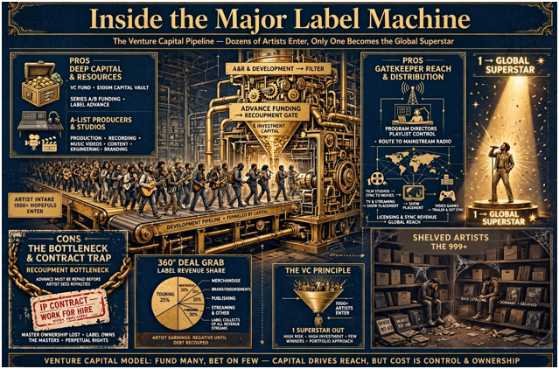
    Major record labels run on venture capital principles. They sign dozens of acts knowing that one global smash funds the losses of twenty failed releases.

    Major Record Deal Pros

    • Access to Deep Capital: A major label provides liquidity. You receive upfront funds to hire A-list producers, book world-class mixing engineers, and execute cinematic video productions that indie budgets cannot touch.
    • Commercial Gatekeeper Influence: Independent publicists work hard, but major radio promotion departments maintain decades-long relationships with commercial PDs (program directors), corporate brand executives, and festival talent buyers.
    • Global Sync Teams: Major publishers and sync divisions place tracks directly with film studios, television networks, and video game franchises at volumes independent teams struggle to match.

    Major Record Deal Cons

    • The Recoupment Bottleneck: Advances are non-reciprocal corporate loans. The label withholds 100% of your 15% royalty share until every dollar spent on recording, music videos, independent radio promotion, and personal advances gets recovered.
    • Loss of Intellectual Property: In almost every standard major contract, you deliver your tracks as “works made for hire.” The label owns the copyright to the master recordings permanently. Under the U.S. Copyright Office regulations, statutory termination rights under Section 203 do not effortlessly reclaim “work for hire” recordings.
    • 360-Degree Ancillary Grabs: Modern majors rarely sign pure recording contracts. Their “multiple rights” clauses capture 10% to 30% of your gross earnings across touring, live appearances, merchandise, VIP ticketing, and third-party sponsorships.
    • Shelving Risks: If an A&R executive departs or your debut single underperforms, corporate leadership can freeze your project. Because you are bound by an exclusivity clause, you cannot legally self-release that music elsewhere.

    The Independent Music Contract Reality

    The Independent Music Contract Reality

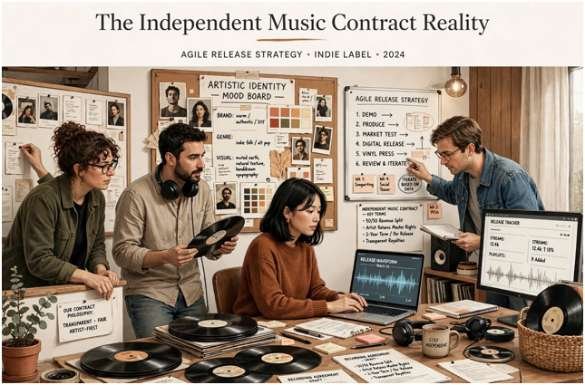
    Independent labels operate with leaner teams and agile release strategies. Many curate distinct artistic identities, making them regular targets for artists seeking out independent music labels accepting demo submissions.

    Independent Deal Pros

    • Retaining Master Equity: Most independent agreements rely on fixed-term licensing contracts lasting five to ten years. Once the term ends or the costs clear, full exploitation rights revert to you.
    • Favorable Splits: Indie labels typically split net profits 50/50 after hard manufacturing and promotional expenses. If you distribute via companies like DistroKid, TuneCore, or Symphonic, you retain up to 100% of net royalties.
    • Direct Digital Royalties: Artists with master ownership collect both the featured artist and master owner shares directly through organizations like SoundExchange, keeping third-party administrative cuts to a minimum.
    • Creative Sovereignty: Indie partners offer creative counsel without dictating your creative output. You maintain ultimate approval over mix versions, artwork, tracklists, and collaborators.

    Independent Deal Cons

    Independent Deal Cons

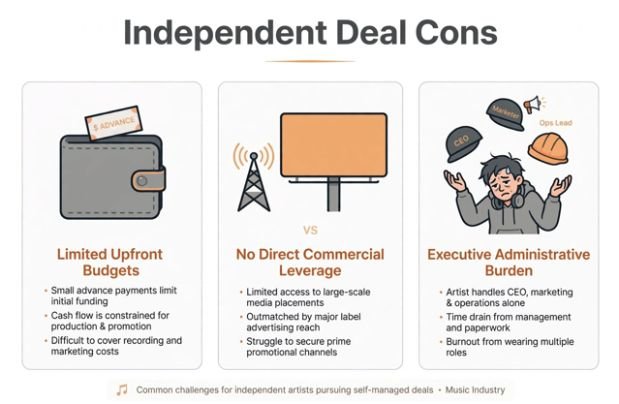
    • Limited Upfront Budgets: Indie labels rarely issue massive advances. You fund your living expenses and often supply creative capital out of your own pocket.
    • No Direct Commercial Leverage: Cracking Top 40 terrestrial radio or landing widespread billboard placement without major label infrastructure remains an uphill, expensive battle.
    • Executive Administrative Burden: Operating as an independent artist means acting as the CEO, marketer, and operational lead of your own record company, increasing potential for creative fatigue.

    The Real Recoupment Math: Major Advance vs. Indie Streaming

    The Real Recoupment Math: Major Advance vs. Indie Streaming

    Most artists view an advance as earnings. In truth, your royalty rate determines how quickly you earn a single dollar beyond that check. Industry data documented by the Future of Music Coalition demonstrates that catalog ownership creates far more reliable lifetime revenue than large initial payouts.

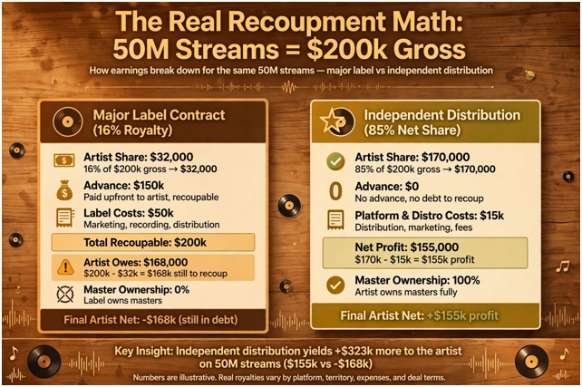
    Consider a project that generates 50,000,000 streams on Spotify and Apple Music, generating roughly $200,000 in gross master royalties (assuming an average payout of $0.004 per stream):

    Metric Major Label Contract (16% Royalty) Independent Distribution (85% Net Share)
    Gross Master Revenue $200,000 $200,000
    Artist Royalty Share 16% ($32,000) 85% ($170,000)
    Initial Cash Advance $150,000 $0
    Direct Recoupable Costs $50,000 (Videos/Marketing) $15,000 (Self-funded PR/Ads)
    Total Recoupable Balance $200,000 $15,000
    Artist Pipeline Royalties Paid $0 (Still owes $168,000 to recoup) $155,000 (Net profit earned)
    Master Rights Retained? No (Owned by Label) Yes (100% Artist)

    Under the major deal, the label collected $168,000 in gross profit from your music while your account remains deep in the red. Under the indie model, you pocketed $155,000 and retain ownership of the master recording forever.

    How to Protect Your Catalog Before Signing

    If you decide to sign a contract, negotiate these four baseline safeguards into the deal:

    1. Master Reversion Period: Require that ownership of your sound recordings reverts back to you within 7 to 10 years following initial commercial release.
    2. Release Commitment Clause: Mandate that if the label fails to commercially release your delivered project within 120 days, you can terminate the deal and buy back the masters at cost.
    3. Net Profit 360 Limits: Never surrender a cut of gross touring or merch income. Cap ancillary cuts strictly to net earnings from opportunities the company directly procures.
    4. Independent Accounting and Auditing: Secure audit rights with provisions requiring the company to pay audit fees if an examination discovers a royalty discrepancy greater than 5%.

    Slay the Hype: Own Your Masters or Rent the Machine

    Major record labels run high-stakes venture capital bets on pop culture, while independent agreements give you the keys to building a lasting, profitable small business. If your dream requires private jets, stadium tours, and global

    Top 40 saturation, partnering with a major might be the right engine. If you want to own your work, secure high-margin streaming royalties, and protect your creative freedom, build your leverage independently first.

    Never sign a contract under pressure. Retain a qualified entertainment attorney, analyze your recoupment math, and choose the business framework that serves your long-term independence.

    Frequently Asked Questions

    1. Do independent artists make more money than signed artists?

    Per stream and sale, independent artists earn significantly higher margins because they retain 50% to 100% of royalties rather than a major label’s 15% to 20% cut.

    2. What is a 360 deal in music?

    A 360 deal allows a record label to collect percentages from non-record revenue streams, including touring, merchandise sales, publishing, and brand sponsorships.

    3. Can a major record label drop you if you do not recoup?

    Yes, labels exercise unilateral options between album cycles and regularly drop artists with unrecouped debt without forgiving the master rights.

    4. How do I legally get my masters back from a label?

    You can secure masters through a negotiated contract reversion clause, a direct catalog buyout, or statutory copyright termination under Section 203.

  • How Changing Music Discovery Affects the Way Lyrics Are Written in the Streaming Era

    How Changing Music Discovery Affects the Way Lyrics Are Written in the Streaming Era

    I have noticed that I rarely discover a new song by deliberately searching for an artist anymore. A playlist, recommendation, social clip, or autoplay queue usually gets there first. When a song catches me, I often remember one line before I know the artist’s name. That small change has made me think differently about what a lyric needs to do when it enters my listening life.

    I have also noticed how quickly I decide whether a new track deserves another listen. An opening, an emotional idea, or one memorable phrase can pull me in before I know the whole story. That does not mean every songwriter follows the same formula, but the environment around songwriting has changed. Music discovery now happens through systems that reward attention, recognition, repetition, and sharing.

    Discovery Happens Before the Whole Song Does

    Streaming has changed the first meeting between a listener and a song. Instead of choosing an album and hearing tracks in sequence, people encounter songs through personalized playlists, autoplay, recommendations, social feeds, and shared clips. Recommendation systems use listening behavior and other signals to suggest music, making discovery more personalized and automated. Government research describes these systems as cultural intermediaries because they influence which music reaches audiences.

    That changes the context in which lyrics have to work. A listener may meet a song halfway through a playlist, hear a short social clip, or encounter a track beside dozens of alternatives. The lyric may need to create recognition during a first encounter.

    The Opening Carries More Weight

    The Opening Carries More Weight

    Long instrumental openings can still work, but songs competing for attention have a reason to reveal their identity quickly. That can mean opening with a vocal line or phrase.

    Streaming payment rules vary by service, so 30 seconds should not be treated as a universal songwriting law. Listeners can leave quickly, so the first moments matter.

    Simpler Lyrics Can Travel Faster

    There is stronger evidence for a broader lyrical shift than for any single streaming-era formula. A 2024 study of more than 350,000 English-language songs found that lyrics have generally become simpler and more repetitive across several genres over five decades. Researchers observed declining vocabulary richness in some genres, more repeated lines, and a greater presence of choruses relative to other sections.

    That does not prove Spotify or TikTok caused these changes. The researchers point to several explanations, including changes in music consumption and technology.

    Repetition makes phrases familiar quickly. Simplicity is not automatically shallow writing. Ordinary words can carry emotional weight when melody, delivery, and context do the rest.

    Lyrics Have Become Shareable Moments

    Short-form video adds another layer. A song can become known through a fragment before anyone hears its full arrangement. A lyric that fits a joke, relationship story, personal confession, or visual trend can travel independently of the original song.

    A lyric can advance a narrative while also providing a self-contained emotional or visual idea. It needs enough personality to stand alone while remaining connected to the song around it.

    Yet virality should not be confused with lasting discovery. Recent research involving 10,000 global consumers found that social exposure does not always lead people to stream more of an artist’s music or explore the catalog.

    Emotional Clarity Matters, Too

    Emotional Clarity Matters, Too

    Personalized discovery can encourage clearer emotional signals. Songs are encountered through moods, activities, genres, and listening patterns.

    Direct language, recognizable situations, and specific details can help a listener understand a song without several verses of setup.

    But clarity has a limit. If every lyric explains itself immediately, music loses mystery. Ambiguous writing can invite interpretation, while an unusual image can make a song memorable.

    Recommendation research shows that algorithmic discovery can personalize listening, but human curation, platform design, listener behavior, and commercial priorities also interact.

    The Human Detail Still Makes a Lyric Stick

    This is where songwriting can push back against pure optimization. A perfectly engineered hook may get noticed, but a strange pause, imperfect phrase, specific memory, or unexpected image can make a listener feel that someone is actually speaking to them.

    The principle applies to how modern songwriters use silence and space in lyrics. Leaving room around a line can create tension and give a simple phrase more emotional weight. In a discovery environment built around speed, restraint can become a form of distinction.

    Writing for Discovery Without Writing Only for Discovery

    The streaming era has changed songwriting conditions, but it has not created one mandatory style. Some artists lead with a hook; others build slowly or favor detailed storytelling.

    A lyric may arrive through a playlist, search result, friend’s post, short video, or recommendation, making its first context less predictable. Songwriters are therefore working in an environment where the listener’s entry point can change.

    That can encourage stronger openings, memorable refrains, concise language, and emotionally recognizable lines. Distinctive writing can matter too: one detail may be more memorable than a perfectly familiar phrase.

    Likewise, why imperfect lyrics can make a song feel more authentic matters because listeners do not always want polished language. A slightly awkward phrase can sound personal, spontaneous, or emotionally exposed. Those qualities are difficult to reduce to a recommendation signal, yet they can make someone replay a song or share it with a friend.

    FAQs: How Changing Music Discovery Affects the Way Lyrics Are Written in the Streaming Era

    1. Does streaming make song lyrics shorter?

    Not necessarily. Streaming can encourage quicker openings, but lyric length still varies by genre and artist.

    2. Why are repetitive lyrics common in modern music?

    Repetition makes phrases easier to recognize and remember, and research shows it has increased across several genres.

    3. Does TikTok directly determine how songs are written?

    It can influence songwriting choices, but social virality does not always create deeper listening.

    4. Do algorithms reward simple lyrics?

    Algorithms do not simply rank lyrics by simplicity. Recommendation systems use multiple signals shaped by platform design, listener behavior, metadata, and human decisions.

    Why the Song Still Has to Outlast the Scroll

    Changing music discovery has altered the conditions in which lyrics are heard. A song may need to introduce its emotional world quickly and work outside the recording. Those pressures can encourage simpler language, repetition, stronger openings, and memorable lines. But none guarantees a meaningful song. Strong writing can still leave room for ambiguity, surprise, silence, and details that reveal their value after several listens.

    Discovery gets someone to the song. The lyric gives them a reason to return.

  • How to Make Kick and Bass Not Clash for a Cleaner Mix

    How to Make Kick and Bass Not Clash for a Cleaner Mix

    A powerful low end should feel controlled, not crowded. When the kick hits and the bass enters, I want both elements to sound bigger together, not weaker, muddier, or harder to distinguish. That is why learning how to make kick and bass not clash is less about piling on plugins and more about managing space, timing, phase, and frequency with purpose.

    In many mixes, the problem starts before EQ or compression ever enters the picture. The kick may be too long, the bass may occupy the same fundamental range, or both sounds may hit with competing energy at the same moment. I prefer to solve those issues at the source first, then use EQ, sidechain compression, dynamic EQ, and phase adjustments only where they genuinely improve the mix.

    For US producers working in hip-hop, trap, EDM, pop, and related styles, this approach can help create a low end that stays punchy on studio monitors while still translating well to headphones, cars, earbuds, and everyday consumer speakers.

    Why Do Kick and Bass Clash in the First Place?

    Kick and bass usually clash because both contain strong energy in the same low-frequency range.

    A kick may have its fundamental punch somewhere around 60 to 90 Hz, while a bass or 808 may also carry heavy energy in that area. When both sounds dominate the same frequencies at the same time, frequency masking makes the mix feel muddy, weak, or undefined.

    Timing also matters. A long kick tail can continue underneath a sustained bass note. Even if the EQ looks acceptable, excessive overlap can still create low-end buildup.

    Phase cancellation creates another problem. If the kick and bass waveforms move against each other, parts of the low end can weaken instead of becoming more powerful.

    That is why I treat low-end mixing as a combination of frequency, timing, phase, and dynamics.

    Should You High-Pass Kick and Bass Below 20 Hz?

    Should You High-Pass Kick and Bass Below 20 Hz?

    Ultra-low frequencies below roughly 20 Hz are usually more felt than heard, yet they can still consume valuable headroom.

    I often check both the kick and bass with a spectrum analyzer and remove unnecessary sub-rumble using a gentle high-pass filter when needed. Tools such as Ableton EQ Eight can handle this easily.

    However, I do not automatically cut everything below 20 Hz just because a tutorial recommends it. Some sounds contain useful energy near that region, and overly aggressive filtering can weaken the weight of the mix.

    The goal is to remove unnecessary information, not strip away the character of the low end.

    How Do You EQ Kick and Bass So They Have Separate Space?

    Complementary EQ is one of the most effective methods for reducing frequency masking.

    If the kick has its strongest punch around 70 Hz, for example, I may slightly emphasize that area on the kick while making a small reduction around the same frequency in the bass.

    The reverse can also work.

    If the bass needs to dominate the deepest sub frequencies, I may reduce some low-end weight from the kick and allow more of its character to come from the upper bass or attack frequencies. This kind of separation can also help fix beats that sound empty by making the low end feel more intentional and balanced instead of simply adding more layers.

    This does not mean every mix needs dramatic boosts and cuts. Small EQ adjustments often work better because extreme carving can make both sounds feel unnatural.

    I always identify the actual kick fundamental frequency before making changes instead of blindly copying fixed EQ settings.

    Should the Kick or Bass Own the Sub Frequencies?

    Either can control the deepest frequencies.

    What matters is creating a low-end hierarchy.

    In some trap and hip-hop mixes, the 808 carries most of the sub-bass energy while the kick provides more transient punch. In other productions, the kick sits deeper while the bass occupies a slightly higher range.

    Problems usually appear when both elements try to dominate the same area.

    I decide which sound should feel deeper based on the genre, arrangement, and character of the track.

    Can Shortening the Kick Stop It From Clashing With Bass?

    Absolutely.

    One of the simplest fixes is reducing the kick length.

    If a kick continues playing long after the initial transient, its low-frequency tail can overlap with the bass. I may trim the kick sample or shorten its decay so it ends before the bass reaches full strength.

    Some producers use an eighth-note kick length as a rough starting point, but I do not treat that as a strict rule. Tempo and arrangement matter.

    The correct kick length is simply one that provides enough weight without unnecessarily covering the bass.

    Should You Change Bass MIDI Notes Before Using Plugins?

    Should You Change Bass MIDI Notes Before Using Plugins?

    Yes, especially when the clash comes from timing.

    I often inspect the MIDI arrangement before touching another EQ or compressor.

    If the bass note begins at the same instant as every kick, I may move selected notes slightly later, shorten their duration, or let them finish before the next kick lands.

    Changing the octave of a bass note can also help if a specific note creates excessive low-frequency buildup.

    These small arrangement changes allow the kick and bass to move around each other naturally.

    In many cases, fixing note placement sounds more transparent than forcing separation with aggressive compression.

    How Do You Check Phase Between Kick and Bass?

    If the kick sounds strong in solo but suddenly loses power when the bass plays, phase should be one of the first things you inspect.

    I compare the two sounds together, flip polarity, and experiment with tiny timing adjustments.

    If the low end becomes noticeably stronger after a small timing change, phase interaction was probably contributing to the problem.

    I also listen in mono because phase problems often become easier to detect without stereo distractions.

    Visual waveform alignment can help, but I trust what I hear more than what the waveform looks like.

    How Much Sidechain Compression Should You Use?

    Sidechain compression creates temporary space for the kick by reducing the bass volume whenever the kick hits.

    I place a compressor on the bass and use the kick as the sidechain trigger.

    A relatively fast attack can move the bass out of the way when the kick transient arrives. The release should then allow the bass to return naturally with the groove.

    I avoid making the bass pump dramatically unless that sound fits the genre.

    The objective is not to make the compression obvious. It is to create enough room for the kick to remain clear.

    This is one of the most reliable techniques when learning how to make kick and bass not clash, but it should not replace good sound selection and arrangement.

    Is Dynamic EQ Better Than Regular Sidechain Compression?

    Dynamic EQ can be more transparent because it targets only the frequencies that are actually colliding.

    Traditional sidechain compression lowers the entire bass signal when the kick hits.

    A sidechained dynamic EQ can instead reduce only a narrow area, such as 60 or 70 Hz, while leaving the rest of the bass almost untouched.

    Plugins such as iZotope Neutron and frequency-selective tools like Fuser can accomplish this type of bass ducking.

    This technique works particularly well when full-band sidechain compression makes the bass feel too weak.

    How Do You Make Kick and Bass Translate to Cars and Small Speakers?

    How Do You Make Kick and Bass Translate to Cars and Small Speakers?

    I never finish low-end decisions using only one playback system.

    A mix that sounds clean on studio monitors may become overwhelming in a car because the cabin emphasizes certain bass frequencies.

    Small speakers create the opposite challenge because they cannot reproduce deep sub-bass effectively.

    I check the track on headphones, consumer earbuds, small speakers, and a car system whenever possible.

    If the bass disappears on smaller devices, adding controlled harmonic content can help listeners perceive it without increasing the sub frequencies.

    If the kick disappears at low volume, it may need more upper-frequency attack rather than more bass.

    Frequently Asked Questions (FAQs)

    1. What frequency should I cut from bass for kick?

    There is no universal frequency. Find the kick’s main fundamental area and reduce the bass slightly there only when audible frequency masking occurs.

    2. Should kick and bass hit at the same time?

    Yes. They can hit simultaneously as long as their frequency content, phase, sustain, and dynamics allow them to work together.

    3. Is EQ or sidechain better for kick and bass?

    EQ works well for constant frequency overlap, while sidechain compression works better for short timing conflicts. Many mixes benefit from subtle amounts of both.

    4. Why does my kick disappear when the bass enters?

    Frequency masking, phase cancellation, and excessive bass sustain are the most common causes. Test each one before adding more processing.

    5. Should sub-bass be mono?

    Keeping the deepest low frequencies relatively centered usually improves stability and translation, although higher bass harmonics can still contain stereo width.

    Final Takeaway

    When I work on how to make kick and bass not clash, I start with the simplest fixes first.

    I choose complementary sounds, control unnecessary sub-rumble, decide which element owns the deepest frequencies, shorten kick and bass tails, adjust MIDI timing, and check phase. Only then do I use complementary EQ, sidechain compression, or dynamic EQ.

    The goal is not to process the low end as heavily as possible. It is to create enough separation that the kick feels punchy while the bass remains full, controlled, and musical.

    When those two elements stop competing and begin supporting each other, the entire mix sounds bigger.

  • Top Independent Music Labels Accepting Demo Submissions: The Definitive Pitch Guide

    Top Independent Music Labels Accepting Demo Submissions: The Definitive Pitch Guide

    I spent years sending cold MP3 attachments into dead inboxes before learning the hard truth about modern music discovery. If you want to get signed, you must target the top independent music labels accepting demo submissions using the exact technological workflows their A&R teams prioritize. 

    A cold pitch is an engineering problem as much as an artistic one. Labels filter through hundreds of tracks daily, discarding files that violate submission guidelines before listening to a single note.

    Navigating the landscape requires knowing where to look, how to pitch, and how to protect your career equity.

    What Top Indie Record Labels Actually Look for in a Demo

    Independent labels operate on lean teams and focused budgets. Unlike majors, they rarely sign unproven artists based on vague potential or incomplete rough takes. They sign turnkey assets that integrate seamlessly into their release rosters.

    The 20-Second Drop Rule

    The 20-Second Drop Rule

    When I track listening metrics on A&R links via private streaming dashboards, one behavioral trend stands out: an A&R rep spends an average of 18 to 25 seconds on a submission before making a decision. If your track opens with a 45-second ambient drone before reaching the core motif, you have wasted your window.

    Your best hook, main groove, or defining vocal line must land upfront. Give the scout an immediate reason to keep listening rather than skipping to the next submission in their queue.

    Rights Clearance and Metadata Hygiene

    Independent teams cannot afford legal battles over uncleared splice loops or obscure vinyl samples. Every track you pitch must be 100% royalty-free or fully cleared. In fact, organizations like the American Association of Independent Music (A2IM) frequently emphasize that clear master rights and publishing splits are the single biggest factor separating amateur submissions from viable commercial releases.

    Ensure your files have embedded ID3 metadata including:

    • Artist name and primary contact email
    • Track title, BPM, and musical key
    • Clear ownership status (e.g., “100% Master & Publishing pre-cleared”)

    Electronic and Dance Labels Actively Scouting Talent

    Electronic and Dance Labels Actively Scouting Talent

    Dance music relies on dynamic club testing, making electronic imprints the most systematized demo evaluators in the music business.

    Armada Music and Defected Records

    Armada Music, co-founded by Armin van Buuren, accepts regular submissions across trance, deep house, and melodic techno. They process entries via designated online portals and platform aggregators like LabelRadar. Expect a structured turnaround window of roughly six to eight weeks.

    Defected Records remains the gold standard for pure house music, disco edits, and soulful grooves. Defected routes submissions for its primary roster and eleven sister labels—including Glitterbox and DFTD—directly through automated portal pipelines. Do not send attachments; submit your clean, uncompressed streaming links through their established channels.

    Monstercat and Spinnin’ Talent Pool

    Monstercat built an empire by signing emerging bass music, glitch, and gaming soundtrack producers out of obscurity. They maintain an always-open submission system on direct evaluation platforms. They prioritize distinct sonic branding over existing social followings.

    Spinnin’ Records relies on their dedicated “Talent Pool” platform. This public-facing ecosystem allows creators to upload club cuts, climb community charts, and catch the direct attention of Spinnin’s internal A&R board.

    Alternative, Punk, and Indie Rock Powerhouses

    Alternative, Punk, and Indie Rock Powerhouses

    Guitar music and alternative songwriting still prioritize raw, unvarnished identity over hyper-quantized production.

    Sub Pop Records

    Seattle’s Sub Pop remains one of the most culturally revered record labels on the planet. From pioneering grunge to breaking world-class indie acts, they maintain a remarkably accessible intake policy. Sub Pop accepts unsolicited submissions through a dedicated demo review inbox.

    Their rules are non-negotiable: send streaming links only. Never attach raw WAVs or MP3s to an email sent to Sub Pop, as their servers will flag or reject files over standard size thresholds. Their team reviews unreleased material on rolling monthly cycles.

    Epitaph Records and Glassnote

    Founded by Bad Religion’s Brett Gurewitz, Epitaph champions punk, pop-punk, post-hardcore, and left-leaning indie folk. They seek completed arrangements that deliver a tangible counter-culture edge.

    Glassnote Records is legendary for breaking alternative giants like Phoenix and Mumford & Sons. They maintain private digital portals for unsolicited work. When pitching Glassnote, emphasize your live performance history or regional audience traction alongside the audio.

    Hip-Hop, Beats, and Global Grooves

    Urban music scouting moves quickly, relying on distinctive sample work, lyricism, and cross-genre fusion.

    Stones Throw Records and Chinese Man Records

    Stones Throw Records, founded by Peanut Butter Wolf, is the definitive home for lo-fi hip-hop, underground beatmakers, psych-funk, and boundary-pushing soul. They reject derivative radio rap; their catalog celebrates idiosyncratic, analog-tinged textures.

    Overseas, Chinese Man Records curates an international catalog of trip-hop, dub, afro-funk, and experimental hip-hop. They actively evaluate emerging worldwide beatmakers through indie discovery aggregators such as Groover.

    By diversifying your streaming, physical, and performance royalties, you build steady independent artist revenue that proves your project is commercially viable from day one. 

    How to Route and Format Your Pitch

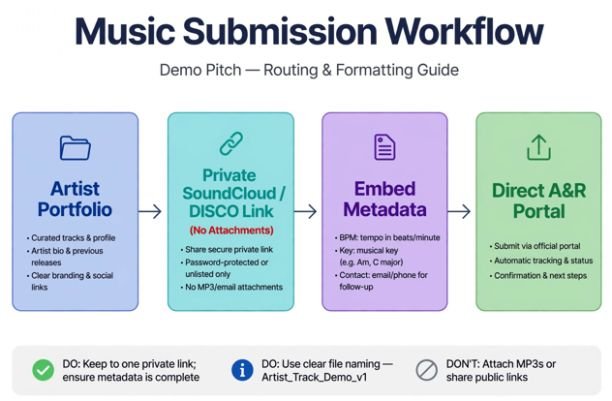
    Pitching a record label requires treating your unreleased catalog like proprietary software. Never mass CC a list of fifty A&Rs on a single email. Personalize each message, specify why your sound belongs on that specific roster, and point them to a streamlined listening hub.

    [Artist Portfolio]

           │

           ▼

    [DISCO / Private SoundCloud Link] ──▶ [No Audio Files Attached]

           │

           ▼

    [Embed Core Metadata] ──────────────▶ [Artist Name, BPM, Key, Contact]

           │

           ▼

    [Direct A&R Portal / Targeted Email]

    Building Your Private Stream Architecture

    Host your unreleased music exclusively on a private, streaming-friendly host. Private SoundCloud links with downloads enabled or secure DISCO playlists are the industry standards. According to reports tracking digital audio rights and licensing protocols from Billboard, A&R managers almost universally prioritize platform streams over email attachments.

    If you are developing your catalog while retaining ownership, mastering your own independent music distribution gives you immediate leverage. Labels want to see that your track can generate momentum before they invest their capital. 

    You can also monitor non-interactive digital performance royalties via SoundExchange to register catalog assets before external deals are executed.

    Frequently Asked Questions About Submitting Demos

    1. How long does an indie label take to review a demo?

    Most independent labels take between four to eight weeks to review incoming material due to backlog volumes.

    2. Should I send MP3 files or streaming links?

    Always send private streaming links like SoundCloud or DISCO with downloads enabled; never send attached audio files.

    3. Can I submit a demo that has already been released?

    Most labels only accept unreleased, exclusive masters unless you are negotiating an upstream distribution or catalog acquisition deal.

    4. Do I need a manager before submitting music to indie labels?

    No, independent labels actively review direct artist submissions as long as the music is high-quality and the pitch is professional.

    Stop Waiting for Permission and Ship Your Sound

    A record deal is a business partnership, not validation of your worth as an artist. Send your submissions to labels whose rosters you genuinely respect, follow their exact delivery instructions, and give them a hard deadline of thirty days. 

    If they pass or fail to respond, do not stall your rollout. Distribute the project independently, cultivate your own audience, and make the labels come searching for you on your next cycle.

  • Why Emotionally Specific Lyrics Connect With Modern Listeners

    Why Emotionally Specific Lyrics Connect With Modern Listeners

    I have noticed that the songs I return to are rarely the ones that describe heartbreak, happiness, or loneliness in the broadest possible terms. What stays with me is usually a small detail: a room, an awkward silence, a message left unanswered, or a routine that suddenly feels different. Those details make an emotion easier to recognize because they give it a shape.

    I have also found that specific lyrics can make a song feel personal, even when the songwriter is describing a life completely different from mine. A line about one moment can bring back my own memories, relationships, or places. That is part of the appeal of emotionally specific songwriting: the story belongs to the artist, but the feeling can become the listener’s.

    Specific Details Give Emotions a Shape

    Broad emotional statements are easy to understand, but they can be difficult to feel deeply. Saying that someone is lonely tells the listener what the character feels. Showing the empty passenger seat, an untouched coffee, or a phone that never lights up gives that loneliness somewhere to live.

    Songwriting resources often encourage writers to build lyrics around small, sensory moments. Details involving sight, sound, touch, smell, taste, and movement can place listeners inside a scene rather than leaving them outside the story. That specificity can make an emotion feel immediate and memorable.

    The trick is not to fill every line with decoration. One precise detail can do more work than several abstract descriptions.

    This is also where behind the song stories from independent songwriters can become useful. A small object or moment can reveal a much larger emotional experience.

    Specificity Can Make a Personal Story Feel Universal

    Specificity Can Make a Personal Story Feel Universal

    There is a useful paradox in songwriting: the more particular a scene becomes, the more room a listener may have to recognize themselves in it.

    A songwriter does not need to describe everyone’s experience of grief, jealousy, desire, or regret. A sharply observed moment can provide an emotional doorway for the listener’s own memories.

    Music has a strong relationship with autobiographical memory. Research has found that songs can evoke memories of personal experiences, with emotional responses linked to how strongly those memories are remembered. More recent research comparing song cues with spoken lyrics found that musical cues were more likely to evoke autobiographical memories and could create a stronger sense of reliving. That evidence does not mean every detailed lyric will trigger a memory, but it helps explain why emotionally meaningful songs can become attached to periods of someone’s life.

    Conversation Creates Emotional Intimacy

    Specific details become even more powerful when the lyric sounds like something a real person might say.

    Direct address, especially the use of “I” and “you,” can make a song feel like an ongoing conversation. Instead of describing a relationship from a distance, the songwriter places the listener inside an exchange. Questions, confessions, arguments, and unfinished thoughts can create a sense that something personal is happening in real time. Berklee describes direct address as a way of creating intimacy, emotional immediacy, and conversational authenticity.

    Polished language is not always the same as believable language. A lyric can be poetic without sounding formal. Plain words can carry considerable emotional weight when attached to a precise situation. A conversational line can establish intimacy, while a concrete image adds depth.

    Vulnerability Works Better When It Has Boundaries

    Emotionally specific songwriting does not require a songwriter to reveal every private detail.

    If every emotion is explained, the listener has less work to do. Specific images create clues, while subtext creates participation. A changed routine, familiar address, old photograph, or empty side of the bed can communicate loss without announcing it.

    That restraint can keep a lyric from becoming overly literal. Personal songwriting works best when the audience can understand the emotional situation while still having room to interpret it. Specificity should create connection, not simply provide a diary entry set to music.

    Emotion and Memory Strengthen the Connection

    Emotion and Memory Strengthen the Connection

    Research into music-evoked autobiographical memories shows that music can bring back personally meaningful experiences. More recent findings suggest that songs can provide temporal and emotional context for autobiographical memories, helping explain why a familiar track can transport someone to a period.

    A specific lyric can become more powerful when its emotional meaning changes across the song. A place might shift from representing comfort to representing absence, giving that emotional change something tangible.

    Let the Verse Show, Then Let the Chorus Open Out

    One effective songwriting approach is to let verses carry the scene while the chorus communicates the larger emotional idea.

    A verse might stay close to a room, conversation, drive, or memory. The chorus can then widen the meaning so listeners understand what the moment represents. This balance keeps a song grounded without trapping it inside one person’s biography.

    It also creates a useful relationship between lyrical depth and memorability. Writing memorable choruses without sacrificing lyrical depth becomes easier when the chorus does not have to carry every detail. The verse can provide texture, while the chorus distills the emotional truth. Berklee similarly describes verses as places for specific imagery and choruses as spaces for the broader message.

    Not every detail deserves a place in the final lyric. The songwriter can choose images that reveal character, advance the story, or sharpen emotional tension.

    Why Specific Lyrics Stay With People

    Emotional connection does not necessarily come from making a lyric bigger or louder. Often, it comes from making the moment clearer. A memorable detail gives listeners something to picture, while vulnerability gives it emotional stakes. Conversation makes it feel close, and music can attach it to memory.

    Together, these elements create conditions in which a listener can move from simply hearing a story to recognizing something of their own life inside it.

    FAQs: Why Emotionally Specific Lyrics Connect With Modern Listeners

    1. Why do specific lyrics feel more relatable?

    Specific details give abstract emotions a concrete setting. Listeners can picture the moment and connect it with experiences from their own lives.

    2. Do lyrics need to be based on real experiences?

    No. Authenticity can come from believable emotional observation and specific storytelling, even when a song combines fictional or imagined elements.

    3. How can songwriters make lyrics more emotionally specific?

    Focus on observable details, sensory language, small moments, natural dialogue, and meaningful changes in everyday behavior instead of repeatedly naming the emotion.

    4. Can highly personal lyrics still appeal to a broad audience?

    Yes. A story can express a widely understood feeling. The listener does not need to share the exact experience to recognize its emotional meaning.

    The Details That Give a Song a Life

    Emotionally specific lyrics work because they leave something tangible behind. A broad statement can communicate an emotion, but a precise image can make that emotion easier to see, remember, and reinterpret. When songwriting combines specificity with restraint, conversational intimacy, and a strong musical setting, personal experience can become a space where listeners recognize their own memories.

    The smallest detail may be the part that makes someone stop, listen again, and think, “I know that feeling.”

  • How Emerging Songwriters Develop Their Own Lyrical Voice Through Practice

    How Emerging Songwriters Develop Their Own Lyrical Voice Through Practice

    I used to think a songwriter’s voice would arrive as a sudden feeling, usually after one perfect line appeared on the page. Over time, I noticed something more useful: writers whose lyrics felt unmistakably theirs were usually writing, revising, testing, and rewriting long before anyone called their work distinctive.

    I also realized that practice does more than improve technique. It leaves fingerprints. Certain images return, certain rhythms feel natural, and certain subjects become easier to express. Those patterns can become a lyrical identity when a songwriter pays attention to them instead of trying to sound like everyone else.

    What a lyrical voice actually sounds like

    A lyrical voice is the combination of choices that makes a songwriter recognizable. It can appear in subject matter, vocabulary, imagery, sentence length, humor, emotional openness, rhythm, rhyme, and the way a writer observes ordinary life.

    A songwriter can change subjects while keeping a recognizable perspective. The connection often comes from perspective. Two people can describe the same rainy drive home, but their details and emotional reactions may reveal completely different writers.

    Technical songwriting tools matter, but they are not the voice itself. Berklee professor Pat Pattison describes those tools as serving the ideas and emotions a songwriter wants to communicate. His teaching also uses object writing to help writers discover what they uniquely have to say.

    Practice gives your voice somewhere to appear

    Practice gives your voice somewhere to appear

    The easiest way to develop a songwriting voice is to create enough material for patterns to become visible. Frequent low-pressure writing creates a larger sample of your instincts.

    Try a ten-minute writing session with one physical object. Describe its texture, temperature, smell, sound, color, and associations without worrying about making a song. Sensory writing can pull lyrics away from broad statements and toward details that feel lived-in. Berklee songwriting instruction similarly recommends short daily sensory exercises to generate imagery and encourage self-discovery.

    Write the detail only you would notice

    Generic emotions are easy to write because everyone understands them. The problem is that they can make songs sound interchangeable. Instead of writing that someone is heartbroken, show what heartbreak looks like in a particular room, on a particular afternoon, through a particular person’s habits.

    Small moments are especially useful. A forgotten receipt in a coat pocket, a half-empty refrigerator, a text typed and deleted three times, or keys landing on a kitchen counter can carry more personality than a broad declaration of sadness. Specific imagery gives listeners something to see while giving the songwriter room to sound individual.

    Study influences without becoming an imitation

    Pay attention to how a favorite writer handles an opening line, builds a verse, uses repetition, shifts perspective, or lands an unexpected image. Then put the technique away and write about something from your own world.

    A useful test is simple: if a line sounds impressive but would never come out of your mouth, reconsider it. Your natural vocabulary is valuable, including your odd expressions, regional references, sense of humor, and recurring subjects.

    Let revision make the lyrics more natural

    Let revision make the lyrics more natural

    First drafts are where ideas arrive; revision is where voice becomes clearer. Read the lyric aloud without singing it. Notice where your mouth hesitates, where a phrase feels overly formal, and where a rhyme exists only because you needed something to rhyme.

    Then test the words against the melody. Natural speech has its own rhythm and emphasis, and awkward phrasing can become obvious once you hear it. One songwriting approach recommends reading lyrics to rhythm and experimenting with spontaneously invented rhythms because changing accents can reveal new possibilities.

    Revision does not mean sanding every unusual phrase smooth. Sometimes the strange line is the most personal one. The goal is to remove accidental awkwardness while protecting intentional character.

    Keep technology in the supporting role

    AI can help with brainstorming themes, exploring structures, generating prompts, or challenging a familiar approach. The risk begins when convenience replaces the decisions that make a lyric personal.

    That makes an important question for emerging writers. Treat generated material as raw material rather than a finished answer. Keep ideas that genuinely fit your experience, rewrite generic language, and add details a tool could not know about your life or perspective.

    The same principle applies when considering AI songwriting tools versus human lyric writing. Technology can assist with possibilities, but voice depends on selection, judgment, memory, taste, and lived observation. The songwriter still needs to decide what deserves to stay.

    Build a practice that leaves evidence

    A simple weekly routine can make progress easier to see:

    • Write freely for ten minutes several times a week.
    • Finish at least one lyric without judging the first draft too early.
    • Review older lyrics and mark recurring images, phrases, and subjects.
    • Rewrite one lyric for stronger detail and more natural speech.

    After a month or two, compare newer work with older material. You may notice how to keep lyrics authentic when using AI music tools notice recurring images or more confident phrasing. Voice is often easier to recognize retrospectively than while writing songs.

    FAQs: How Emerging Songwriters Develop Their Own Lyrical Voice Through Practice

    1. How long does it take to develop a lyrical voice?

    There is no fixed timeline. Regular writing, revision, listening, and reflection can make your patterns easier to recognize over time.

    2. Should new songwriters avoid their influences?

    No. Influences can teach structure, phrasing, imagery, and storytelling. The goal is to transform those lessons through your own experiences and perspective.

    3. What exercise helps develop lyrical voice?

    Object writing is useful. Choose an object and spend ten minutes describing it through your senses without worrying about rhyme or song structure. Berklee uses this approach in lyric-writing education.

    4. Can AI help songwriters find their voice?

    AI can provide prompts, possibilities, or structural ideas, but the songwriter should make the creative decisions. Personal details, judgment, revision, and perspective keep the final lyric individual.

  • When Should You Use Reverb on Vocals? Avoid These Mistakes

    When Should You Use Reverb on Vocals? Avoid These Mistakes

    A vocal can be perfectly recorded and still feel strangely disconnected from the rest of a song. I usually notice this when the singer sounds too dry, too close, or almost pasted on top of the instrumental instead of sitting naturally inside it. That is when reverb becomes one of my most useful mixing tools.

    So, when should you use reverb on vocals? I use it when I want to create believable physical space, blend a dry vocal with the surrounding instruments, control how close or distant the singer feels, or create a specific emotional atmosphere. The goal is not simply to make a vocal sound bigger. Good vocal reverb should support the performance without making the lyrics harder to understand.

    Most studio vocals are recorded relatively dry, especially in treated recording spaces. That gives me more control later because I can decide exactly how much ambience, depth, and character the vocal needs during mixing.

    Why Does Reverb Make Vocals Sound More Natural?

    In real life, we rarely hear a voice without reflections from walls, ceilings, floors, or nearby surfaces. A completely dry recording can therefore sound unnaturally close or almost uncomfortable when placed against a full instrumental.

    Reverb recreates some of those reflections.

    I use subtle ambience when I want a vocal to feel more natural and dimensional. Even a short room reverb can make a close-miked recording feel like it exists in a believable space without making the reverb itself obvious.

    Reverb can also act like a sonic bridge. When several instruments and vocals share similar ambience, they often feel more connected instead of sounding like separate recordings stacked together.

    When Should You Keep Vocals Mostly Dry?

    When Should You Keep Vocals Mostly Dry?

    More reverb is not always better.

    Fast rap verses, intricate vocal flows, dense pop arrangements, and lyric-heavy performances often need maximum clarity. Long reverb tails can overlap syllables and make important words harder to understand.

    I also keep vocals relatively dry when I want an intimate, in-your-face sound. Modern hip-hop, indie productions, acoustic recordings, and some pop mixes benefit from vocals that feel extremely close to the listener.

    A dry vocal does not necessarily mean zero ambience. I may still use a very short room, subtle slap delay, or an almost inaudible reverb send. The effect simply remains supportive instead of becoming part of the foreground.

    If the instrumental is already crowded or muddy, I may use delay instead of a long reverb. Delay can provide width and depth while leaving more open space between repetitions.

    Which Type of Reverb Works Best on Vocals?

    Different reverbs create different perceptions of space, so I choose the type based on what the song needs.

    When Should You Use Plate Reverb on Vocals?

    Plate reverb is one of my favorite choices for lead vocals because it can add smoothness, sustain, and richness without necessarily creating the impression of a real room.

    I often use plate reverb when a vocal needs polish while remaining relatively forward. It works particularly well in pop, rock, R&B, and other modern productions where vocal presence matters.

    When Does Room Reverb Work Better?

    Room reverb is useful when I want natural ambience.

    A short room can help a dry vocal blend with acoustic instruments or make separate recordings feel as though they occupy the same environment. Because the decay is usually shorter, room reverb can also work well in faster or busier arrangements.

    When Should You Choose Hall Reverb?

    Hall reverb creates a much larger sense of distance and atmosphere.

    I tend to use it for emotional ballads, atmospheric pop, dream pop, cinematic sections, or sparse arrangements where there is enough room for a longer tail.

    A large hall can sound beautiful, but too much decay can quickly push the lead vocal backward in the mix.

    How Much Reverb Should You Add to Vocals?

    How Much Reverb Should You Add to Vocals?

    There is no universal vocal reverb setting.

    I usually increase the send until I clearly hear the effect and then pull it back slightly. This helps me retain the sense of depth without letting the ambience overpower the singer.

    I also judge reverb while the full instrumental is playing. A vocal can sound impressive when soloed but become cloudy as soon as guitars, keyboards, drums, and background vocals return.

    This is especially important when deciding when you should use reverb on vocals, because the correct amount depends heavily on arrangement density, tempo, vocal delivery, and genre.

    How Does Pre-Delay Keep Vocals Clear?

    Pre-delay determines how long the dry vocal plays before the reverb reflections begin.

    I often use roughly 20 to 50 milliseconds as an initial starting range. A little separation allows the original vocal to remain clear and upfront before the reverb blooms behind it.

    However, I never treat those numbers as strict rules. Faster songs, slower ballads, aggressive vocals, and spacious productions may all need different settings.

    The right pre-delay should help preserve consonants and vocal definition while still creating depth.

    What Reverb Decay Time Should You Use?

    Decay controls how long the reverb tail remains audible.

    Shorter decay times generally work better in busy or fast-moving tracks because the reflections disappear before they interfere with the next phrase. I also pay attention to the decay transient, since the way the reverb fades after the initial vocal can affect how clean or crowded the next phrase feels. Longer tails can create emotion, drama, and atmosphere in slower or more spacious music.

    I often listen to the gaps between vocal lines. If the previous line is still washing over the next phrase, I usually shorten the decay before reducing the entire reverb level.

    Should Vocal Reverb Be on an Aux Send?

    In most cases, I prefer using an auxiliary or bus send instead of placing the reverb directly on the vocal track.

    I set the reverb bus to 100% wet and control how much vocal enters it with the send level. This lets me process the dry vocal and wet signal separately.

    I can then EQ, compress, automate, or de-ess the reverb without affecting the original recording.

    An insert can still work for creative effects, but sends usually give me greater control in a conventional vocal mix.

    How Do You Stop Reverb From Making Vocals Muddy?

    How Do You Stop Reverb From Making Vocals Muddy?

    Reverb can easily create low-frequency and low-mid buildup.

    I often use EQ to remove unnecessary low-end information from the reverb return. Instead of automatically choosing one fixed cutoff, I adjust it by ear because different voices and arrangements require different treatment.

    I also pay attention to harsh high frequencies and sibilance. Strong S and T sounds can create bright, distracting reverb tails, so EQ or de-essing the signal entering the effect can help.

    The objective is to let the ambience surround the vocal without competing with it.

    Should You Automate Vocal Reverb?

    Yes, and this is one of the easiest ways to make a mix feel more dynamic.

    I may keep verses relatively dry and increase the reverb slightly when the chorus arrives. That makes the chorus feel larger without forcing the entire song to stay heavily reverberant.

    Reverb throws are another useful technique. I can send only the final word or phrase of a section into a long reverb, creating drama while keeping most of the vocal clear.

    Background vocals can also handle more reverb than the lead because the additional ambience helps push them farther back in the soundstage.

    Frequently Asked Questions (FAQs)

    1. Should every vocal have reverb?

    No. Some vocals sound better almost completely dry, especially when maximum lyric clarity or intimacy is important. Reverb should solve a specific mixing or creative problem rather than being added automatically.

    2. Is reverb or delay better for vocals?

    Neither is always better. Reverb creates continuous ambience, while delay produces distinct repetitions. I often use delay when I want depth without filling the mix with a long reverb tail.

    3. What is a good pre-delay for vocals?

    Around 20 to 50 milliseconds is a practical starting range, but the best setting depends on tempo, vocal phrasing, arrangement density, and the desired sense of distance.

    4. Should I put reverb before or after compression?

    I generally compress the main vocal first and then send the controlled signal to the reverb. However, different processing orders can create useful creative effects.

    5. Can too much reverb ruin vocal clarity?

    Yes. Excessive decay, poor EQ, or too much wet signal can blur words, create low-mid buildup, and push the singer too far behind the instrumental.

    How Do You Know When There Is Too Much Reverb?

    I know I have gone too far when lyrics become difficult to understand, the singer feels too distant, or several reverb tails start overlapping and making the mix cloudy.

    If commercial reference tracks remain clear while my mix sounds washed out, I check the reverb level, decay time, pre-delay, and EQ before changing the entire vocal balance. Reverb can also help when a beat sounds empty and makes the vocal feel too exposed, but I still avoid using ambience as a substitute for better arrangement or frequency balance.

    Ultimately, learning when you should use reverb on vocals is more useful than memorizing a preset. I decide what role the vocal needs to play first, then use reverb to create the right depth, emotion, and sense of space.

  • How Digital Life Is Influencing Contemporary Songwriting and Creativity

    How Digital Life Is Influencing Contemporary Songwriting and Creativity

    I started noticing that songs reached me differently once streaming, short videos, and social feeds became part of everyday listening. A chorus could appear in a clip before I ever heard the full track, while a playlist could make a song feel familiar within seconds. It made me realize that digital life influences not only how music is distributed, but also the creative choices made before a song reaches a listener.

    I also noticed how songwriting now connects to a much larger digital routine. A songwriter can record an idea at home, collaborate with someone across the world, test a hook online, watch audience reactions, and adjust a release strategy without entering a traditional studio. Creativity still begins with human experiences, but the environment surrounding those experiences has changed dramatically.

    Digital Tools Have Changed Where Songs Begin

    Songwriting can start almost anywhere. A melody can be recorded on a phone, a beat built in a Digital Audio Workstation, and virtual instruments used without expensive hardware. Software such as Ableton Live, FL Studio, and Logic Pro lets creators move between songwriting, production, and mixing.

    Instead of separating composition from production, many creators can shape both together. Loops, samples, pitch correction, automation, and digital effects are not simply technical fixes. They can become part of a song’s creative language. Ideas can be tested quickly, discarded, and rebuilt without starting over.

    Cloud storage and shared project files allow songwriters, producers, vocalists, and instrumentalists to work across cities and countries. Different musical backgrounds can therefore enter one composition, making genre boundaries easier to cross.

    Streaming Has Changed What a Song Needs to Do

    Streaming Has Changed What a Song Needs to Do

    A song now enters an environment where listeners have enormous choice. Streaming services place millions of tracks within reach, while recommendation systems continually determine what appears next. Research on platform-optimized music suggests that artists and industry professionals increasingly consider how songs will behave within algorithmic systems, not simply how they sound as isolated compositions.

    That can affect creative decisions. A long instrumental opening may feel risky when listeners can skip instantly. A memorable vocal line may arrive earlier. This does not mean every songwriter follows one formula, but rapid skipping creates a different creative environment.

    The pressure is especially visible around short-form video. TikTok and Luminate reported that 84% of songs entering the Billboard Global 200 in 2024 had gone viral on TikTok first, although the finding comes from research commissioned by TikTok and should be understood in that context. A song can now gain attention through a small, reusable moment before listeners seek out the complete recording.

    For independent artists, understanding curated user playlists vs editorial pitching for indie music can also help clarify how different playlist pathways influence music discovery and audience reach.

    Creativity Is Becoming More Visible

    Digital life has blurred the line between making music and promoting it. A songwriter may share a chorus in progress, post a recording session, explain a lyric, or perform an unfinished idea before the final release. This creates opportunities for direct audience interaction, but creative work can also become content.

    Visibility can bring quick feedback and community, but it can also create pressure to produce material that performs online.

    For independent artists, independent music PR campaigns on a budget can provide another way to build visibility without relying entirely on paid promotion or major industry support.

    This is where the role of personal journals in modern songwriting can become meaningful. Private writing offers a space where ideas do not need to be optimized for views, shares, or reactions. A songwriter can explore an awkward memory or complicated feeling before deciding whether it belongs in a public song. Digital culture may reward speed and constant output, but private reflection can preserve a slower form of creativity.

    AI Adds Another Layer to Songwriting

    Generative AI has introduced another change. Tools can help with brainstorming, generate musical ideas, manipulate recordings, and create synthetic performances. Berklee’s 2026 research describes a music and video environment increasingly shaped by AI, platform algorithms, rights concerns, compensation questions, and creative control.

    For songwriters, the question is how creators choose to use AI. An AI system might help overcome a blank page or suggest an unexpected direction, while the songwriter decides what feels authentic. At the same time, synthetic music can add enormous volume to an already crowded environment, making originality and human identity harder to communicate.

    Digital Discovery Is Expanding Musical Possibilities

    Digital Discovery Is Expanding Musical Possibilities

    Online listening exposes songwriters to more sounds than a traditional local music scene might provide. A listener can move from country to Afrobeats, K-pop, electronic music, hip-hop, or indie rock within minutes. Those encounters can influence rhythm, production, language, arrangement, and lyrical perspective.

    That wider musical palette encourages experimentation. A songwriter who regularly encounters different genres does not have to treat them as separate boxes. writing lyrics for songs that blend multiple genres can become a natural response to a listening environment where musical boundaries constantly cross.

    Digital communities make collaboration easier. Artists can find producers, instrumentalists, and audiences through networks that would have been difficult to access geographically.

    Why Human Experience Still Shapes the Song

    Digital tools can accelerate songwriting, expand collaboration, and change music discovery, but they do not remove the need for something worth expressing. A platform can recommend a track, software can shape its sound, and an audience can turn one section into a trend, yet none automatically supplies a meaningful personal experience. The challenge is using digital possibilities without letting platform habits dictate every artistic decision.

    That balance matters because technology changes quickly, while human experiences remain familiar. People still write about love, loss, identity, uncertainty, memory, and change. Digital life may alter the route a song takes to reach us, but the reason we connect with it can still begin with something deeply human.

    Frequently Asked Questions 

    1. How has technology changed songwriting?

    Digital tools let songwriters record, arrange, edit, and produce music from accessible setups. They can also collaborate remotely and experiment with sounds faster.

    2. Does streaming influence song structure?

    It can. The abundance of available music and instant skipping may encourage earlier hooks, tighter arrangements, and sections designed to capture attention quickly.

    3. How does social media affect songwriting?

    Social platforms can influence which musical moments receive attention. Artists may consider how a chorus, lyric, or instrumental section could work within short-form video while developing the complete song.

    4. Will AI replace songwriters?

    AI can generate musical material, but songwriting still involves human judgment, lived experience, taste, interpretation, and creative intent. Its role continues to develop.

    Why Human Experience Still Shapes the Song

    Digital tools can accelerate songwriting, expand collaboration, and change music discovery, but they do not remove the need for something worth expressing. A platform can recommend a track, software can shape its sound, and an audience can turn one section into a trend, yet none automatically supplies a meaningful personal experience. The challenge is using digital possibilities without letting platform habits dictate every artistic decision.

    That balance matters because technology changes quickly, while human experiences remain familiar. People still write about love, loss, identity, uncertainty, memory, and change. Digital life may alter the route a song takes to reach us, but the reason we connect with it can still begin with something deeply human.

  • How to Keep Lyrics Authentic When Using AI Music Tools for Songwriting

    How to Keep Lyrics Authentic When Using AI Music Tools for Songwriting

    I started using AI music tools for practical reasons: getting unstuck, testing a rhyme, or hearing how an idea might work over a beat. What surprised me was how quickly a polished line could feel strangely empty. It sounded like a song, but it did not sound like something I would actually say.

    I realized that authenticity does not come from avoiding AI altogether. It comes from deciding which parts of songwriting belong to me. When I bring the story, emotion, details, and final judgment, AI can help with mechanics without taking over the identity of the song.

    Start With Your Own Story

    AI lyrics often feel generic when the starting point is generic and vague. A vague prompt gives the system little personal material, so familiar images can fill the gaps.

    Start with an emotional blueprint. Write down the specific moment behind the song, what changed, and the detail you still remember. It could be a coffee cup left beside the sink, a voicemail you never deleted, or the street where an argument ended. Those details give the lyric a point of view.

    Give AI a Smaller Job

    Give AI a Smaller Job

    AI songwriting becomes more useful when its task is narrow. Instead of asking it to write an entire song, ask for five rhymes for one line, alternative ways to express a feeling, or different syllable patterns for a chorus.

    That approach keeps creative decisions in human hands. If one option works, keep it. If another contains an interesting word but feels unnatural, borrow the idea and rewrite the line yourself.

    A useful workflow is simple: create a human brief, generate options, test the rhythm, then rewrite. Treat the first output as raw material, not a finished lyric.

    Protect the Lines That Sound Like You

    Your strongest lyric may not be the cleverest. It may be the sentence that could only have come from your experience.

    Keep unusual observations, personal phrases, specific images, and emotional contradictions that reflect your perspective. If an AI suggestion is technically stronger but removes that personality, it may not belong in the final version.

    Sing them over the melody. Some lines look impressive on a screen but become awkward when you breathe or emphasize a beat.

    This also helps catch “AI-isms”: polished but familiar language, perfect rhymes, predictable metaphors, and lines that communicate an emotion without showing anything specific. A lyric can be grammatically flawless and still feel lifeless.

    Rewrite Until the Lyrics Feel Lived-In

    Revision is where much of the authenticity happens. AI can offer a starting point, but your rewrite gives the material context and character.

    Look for broad emotional statements and replace some with physical details. Instead of simply saying someone feels lonely, show what loneliness looks like in that person’s life. Instead of reaching automatically for a perfect rhyme, consider a slant rhyme or a phrase that sounds more like everyday speech.

    You can also change the rhythm. A slightly uneven line can feel more human than a perfectly symmetrical verse. Natural vocal phrasing depends on pauses, breaths, tension, and moments that do not fit neatly into a template.

    Read every line and ask: would I actually say this? If the answer is no, rewrite it.

    Keep the Human Behind the Hook

    Keep the Human Behind the Hook

    Thinking about how songwriters create hooks that work beyond TikTok can help because a hook should not depend only on repetition or short-form visibility. It should carry the central emotional idea of the song.

    AI can suggest catchy phrases quickly, but it cannot decide which phrase captures your story best. A strong hook often becomes more distinctive when it contains a specific image, tension, or phrase that means something within the wider song.

    Know Where AI Helps and Where It Should Step Back

    AI can help with brainstorming, rhyme alternatives, structure, syllable checks, and variations. Human writers remain responsible for perspective, emotional context, cultural nuance, vocal delivery, and the final decision about what the song means.

    The important part is staying involved throughout the process rather than approving whatever sounds polished first.

    Keep Your Creative Process Documented

    There is also a practical reason to keep drafts, notes, and revisions. In the United States, the Copyright Office says AI assistance does not automatically prevent copyright protection. The key issue is whether a human contributed sufficient expressive authorship. The Office also states that prompts alone generally do not establish authorship of the resulting expressive output.

    For songwriters thinking about AI songwriting tools versus human lyric writing, that distinction matters: technology can support technical tasks, while creative judgment still shapes the finished work.

    For songwriters, the distinction between writing lyrics yourself and simply requesting a finished song is particularly relevant. Original drafts, edits, arrangements, and creative decisions can help show what you contributed.

    FAQs: How to Keep Lyrics Authentic When Using AI Music Tools for Songwriting

    1. Can AI write authentic lyrics?

    AI can help develop lyrics, but authenticity usually depends on the songwriter’s personal perspective, details, revisions, and final creative choices.

    2. How can I make AI lyrics sound less generic?

    Give the tool specific story details, then replace clichés with personal images, natural phrasing, unusual observations, and language you would actually use.

    3. Should I let AI write the whole song?

    You can experiment with full generations, but narrower AI tasks often give you more creative control. Use it for options, structure, rhyme, or rhythm, then make the final decisions yourself.

    4. Can I copyright a song made with AI?

    In the United States, copyright depends on the human contribution. The Copyright Office says AI-assisted works can qualify where sufficient human expressive authorship is present, while AI-generated material itself may not receive the same protection.

    Let the Technology Serve the Song

    The most useful way to approach AI music tools is as another instrument inside the process. The technology can throw possibilities onto the page, test patterns, and help when the blank screen becomes frustrating. What it cannot supply is the particular memory behind your lyric, the private meaning of a phrase, or the instinct that tells you a technically good line is still wrong for the song. Those decisions are where a songwriter’s identity remains visible.

    A song does not become authentic because AI stayed out of it. It becomes authentic when the person behind it still has something real to say.