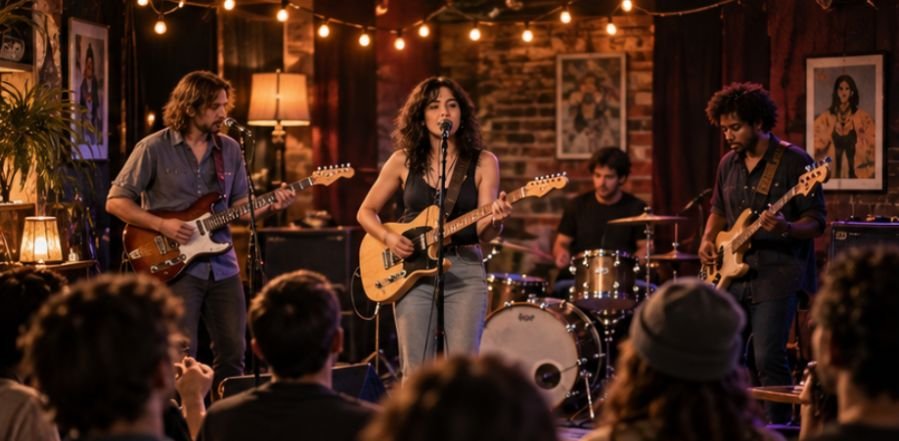
Some of the most interesting music in your city may never appear on a major playlist. It is happening in a neighborhood bar on Thursday night, a college venue on Friday, or a community festival where the opening act has fewer than 2,000 followers.
Learning how to find local bands near you is therefore less about searching for individual musicians and more about finding the places, people, and calendars that connect a local music scene.
That matters because live music extends far beyond major concert halls. National Endowment for the Arts research has historically found performances taking place across parks, restaurants, bars, coffee shops, schools, campuses, community centers, and other spaces. More recent NEA data also shows meaningful differences in live arts participation from state to state.
Start With Venues, Not Band Names
Searching “bands near me” often produces established acts, wedding bands, tribute groups, or outdated directories.
Reverse the process.
Search for small venues first. Try phrases such as “live music tonight,” “independent music venue,” “all ages concerts,” “local rock shows,” or “live jazz this weekend” plus your city or neighborhood.
Then open the venue’s upcoming-event calendar.
A 150-capacity club may feature four different bands on one bill. A coffeehouse may schedule acoustic performers every weekend. Breweries, restaurants, art spaces, bookstores, community centers, and outdoor markets can also host musicians who rarely appear in mainstream concert searches.
Independent venues are particularly useful. The National Independent Venue Association describes independent stages as part of a nationwide ecosystem that includes music clubs, festivals, performing arts centers, and promoters.
Once you discover one useful venue, don’t stop there. Look at where the musicians appearing there played previously and where they are playing next. That frequently reveals another layer of the local scene.
Use Event Platforms as Discovery Engines
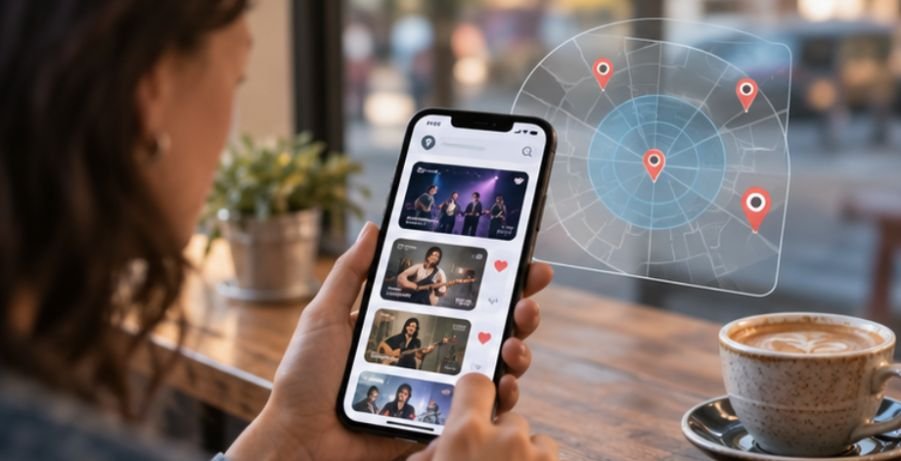
Bandsintown and Songkick are useful for more than tracking artists you already know. Set your location, reduce the distance radius, and browse events rather than searching only for particular musicians. Smaller shows appearing between arena concerts are often where the discoveries happen.
Spotify’s concert and venue features can provide another path. In 2026, the National Independent Venue Association noted that Spotify was increasing visibility for independent venues through features including venue pages and its Live Events Feed.
The useful habit is simple: whenever you recognize one band on a multi-artist bill, research the other two or three. Opening acts are one of the easiest gateways into a regional music network.
For listeners who want to broaden that discovery process beyond algorithmic recommendations, how to find music outside the algorithm can offer a more intentional approach to uncovering independent artists, overlooked releases, and emerging local acts.
Build a 15-Minute Local Music Scan
You do not need to spend hours searching every week. Use the same short routine once or twice a week.
| Minutes | What to check | What you may uncover |
| 0–3 | Small venue calendars | Upcoming local bills |
| 3–6 | Bandsintown or Songkick | Shows within your radius |
| 6–9 | Instagram venue tags | Recently performing bands |
| 9–12 | College/community radio | Artists receiving local airplay |
| 12–15 | Festival and arts calendars | Free and unusual performances |
Save promising bands into one playlist called something simple such as “Local Finds.”
Within a month, you will have your own miniature map of the area’s music community rather than depending entirely on recommendation algorithms.
Search Instagram by Place, Not Only Hashtag
Social media becomes much more useful when you search geographically.
Check location tags for independent clubs, record stores, rehearsal spaces, bars, university venues, neighborhood festivals, and music-oriented cafes.
A musician may not rank for a broad search such as “Chicago indie bands,” but photos and clips from Saturday night’s local show may already be attached to the venue’s location.
Next, inspect who the venue follows.
Small venues often follow performers, photographers, promoters, sound engineers, record stores, and other businesses within the same music ecosystem. Those connections can reveal dozens of acts surprisingly quickly.
Follow Promoters and Bookers
The person choosing the lineup can sometimes be more useful to follow than the performers themselves.
Promoters frequently book multiple venues and recurring showcases. Finding one promoter whose taste matches yours can provide a steady pipeline of emerging musicians.
For listeners interested in discovering artists before they gain wider visibility, understanding how do indie bands get discovered can reveal the role that live performances, promoters, local networks, and audience engagement play in bringing independent acts to new listeners.
Understanding emerging artist meaning can also help listeners recognize where these performers may be in their professional development, particularly when an artist is beginning to build a public profile through local performances, collaborations, and recurring bookings.
Pay particular attention to recurring events: songwriter nights, jazz sessions, punk showcases, battle-of-the-bands events, open mics, DIY concerts, and monthly indie nights.
These recurring programs give unfamiliar musicians opportunities to perform before they can consistently headline venues.
The National Independent Venue Association’s 2026 Live List illustrates the importance of people working behind the scenes. Its list draws on recommendations from venue professionals and other members who regularly encounter developing live performers.
Check Your Local Arts Infrastructure
One overlooked answer to how to find local bands near you is your local arts organization. Search for your city’s arts council, cultural affairs department, downtown association, state arts agency, or nonprofit arts organization.
These organizations may publish calendars covering festivals, public performances, grant-supported concerts, cultural districts, and community events that commercial concert websites miss.
The National Assembly of State Arts Agencies documents extensive state support for artists, arts organizations, communities, and local arts agencies. Americans for the Arts similarly describes local arts agencies as organizations embedded in their communities’ broader cultural networks.
This approach becomes particularly valuable for music promotion for independent artists, smaller cities and rural communities where independent performers may appear at public festivals rather than dedicated music clubs.
Do Not Ignore College and Community Radio
Radio can still be an excellent discovery tool—especially when the station has local programming.
Look for college, university, nonprofit, community, and low-power FM stations in your region. Find specialty shows focused on punk, folk, hip-hop, Americana, jazz, metal, electronic music, or regional artists.
Federal Communications Commission records discussing local radio have noted both local-music programming and the role community radio can play in music diversity.
More importantly, human DJs can make connections algorithms miss. A DJ may place an unknown local band next to a recognizable national artist because the music actually fits.
Search the station’s playlists afterward and follow unfamiliar artists.
Explore Festivals Before the Headliners
Festival posters contain surprisingly efficient discovery lists.
Ignore the largest names temporarily and investigate performers listed near the bottom.
Community festivals, university events, neighborhood celebrations, cultural festivals, outdoor concert series, and municipal summer programs frequently combine established performers with regional acts.
The NEA’s state-level arts participation report found that roughly one in five U.S. adults surveyed in 2022 reported attending an outdoor festival featuring performing artists during the prior year, although participation varied significantly between states.
Free events are especially useful because you can sample several performers without committing to multiple ticket purchases.
Learn to Recognize a Real Local Scene
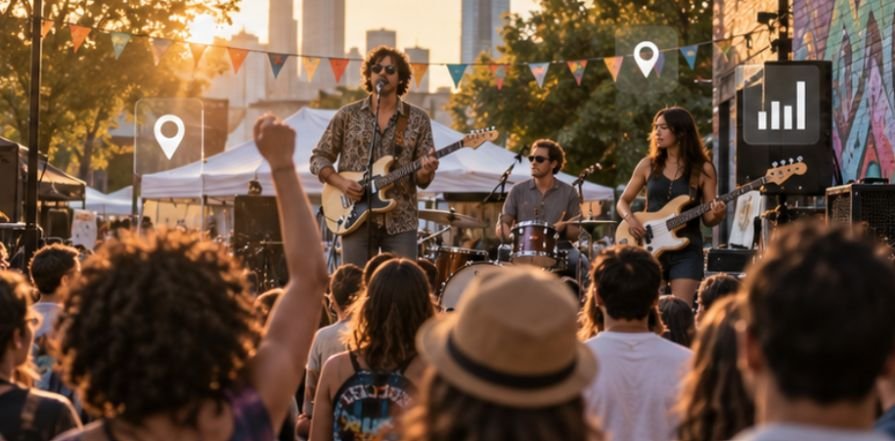
Finding one nearby musician is easy. Finding a scene means identifying connections. Look for repeated names.
If Band A regularly plays with Band B, both appear at Venue C, a local DJ plays them, and the same photographer covers their shows, you have found part of an active network.
Follow those connections outward. The Smithsonian has documented how distinctive local musical cultures can grow from interconnected performers, traditions, families, venues, and communities. That network effect is why local music discovery becomes easier after your first few finds.
Frequently Asked Questions
1. What is the fastest way to find bands playing near me?
Check several nearby independent venue calendars, then compare their upcoming performers with Bandsintown, Songkick, Instagram location tags, and local event calendars.
2. How do I discover small bands that are not on Spotify?
Explore open mics, DIY venues, college radio, Bandcamp, community festivals, record stores, local promoters, and social profiles attached to neighborhood venues.
3. How often should I search for local shows?
Once or twice each week is usually enough. Smaller venues frequently announce concerts gradually, so a short recurring search works better than checking only once a month.
4. Is social media reliable for finding local bands?
Yes, but verify events through the venue. Location tags, promoter accounts, artist profiles, and venue posts can reveal performers that broader search engines overlook.
Where Your Next Favorite Band Is Probably Hiding
Once you understand how to find local bands near you, music discovery starts looking less like searching a database and more like following a trail.
Find one small venue. Check its calendar. Research its opening acts. Follow the promoter. Listen to the local radio show. Explore the festival’s smallest names. Then repeat.
The surprising part is that you do not need thousands of recommendations. You need three or four reliable gateways into your city’s music community. Once those connections start overlapping, the bands that previously seemed invisible become remarkably easy to find.