Blog

  • Where to Find New Independent Music Beyond the Algorithm

    Where to Find New Independent Music Beyond the Algorithm

    Music discovery has never been easier—and that is partly why finding something genuinely unexpected can feel harder. Streaming services can place millions of songs within reach, but recommendations often grow from music you already play. If you are wondering where to find new independent music, the better strategy is to deliberately step outside that familiar recommendation loop. 

    Independent radio DJs, small music publications, artist-run platforms, college stations, local venues, record labels, and curated archives can expose you to musicians you would never think to search for.

    That matters in the United States, where streaming remains the dominant way people consume recorded music. RIAA data shows streaming generated about $9.47 billion in U.S. wholesale recorded-music revenue in 2025. Convenience is extraordinary, but discovery does not have to begin and end with the biggest streaming apps.

    Why Independent Music Can Be Surprisingly Hard to Discover

    Independent does not describe one sound. An independent artist might make punk, folk, electronic music, jazz, experimental hip-hop, bedroom pop, Americana, metal, ambient music, or something that does not fit neatly into any genre. The real discovery problem is visibility.

    A small artist may release an excellent record without having the promotional budget, playlist relationships, press coverage, touring reach, or existing audience enjoyed by established acts. Searching only for popular playlists can therefore create a distorted picture of what new music actually exists.

    The solution is to use several discovery channels because each reveals a different layer of music.

    Follow Human Curators Who Still Listen for a Living

    One of the easiest ways to escape repetitive recommendations is to replace part of your algorithmic discovery with human judgment.

    Indie Shuffle, for example, publishes curated tracks covering independent pop, rock, electronic music, hip-hop, folk, and adjacent sounds.

    Music publications can take you further. Stereogum covers releases, songs, albums, interviews, and emerging scenes, while BrooklynVegan combines new music with touring and live-music coverage. Its recent coverage continues to include regular new-song and release roundups.

    Aquarium Drunkard takes a different approach. The independent Los Angeles-based publication explores contemporary music alongside psychedelia, jazz, folk, post-punk, dub, avant-garde music, and older recordings.

    These sources are valuable precisely because they are different. Do not find one publication that matches your taste perfectly. Find several whose tastes overlap only partially.

    Independent and Public Radio Can Break the Recommendation Loop

    Radio sounds old-fashioned until you realize what a skilled DJ can do that a recommendation system often cannot: explain why two seemingly unrelated records belong next to each other.

    Seattle’s nonprofit independent station KEXP describes music discovery as part of a tradition spanning more than 50 years. Its Live on KEXP archive also contains thousands of performances, giving listeners a way to discover artists through complete sessions instead of isolated singles.

    Another fascinating option is WFMU, a listener-supported, noncommercial freeform station serving the New York-New Jersey region and streaming online. WFMU identifies itself as the longest-running freeform radio station in the United States and maintains an extensive online archive.

    For editorial discovery, NPR Music’s All Songs Considered has been devoted to music discovery since 2000 and regularly brings public-radio programmers and critics into its new-release conversations.

    Use Music Blogs to Discover Scenes, Not Just Songs
    Use Music Blogs to Discover Scenes, Not Just Songs

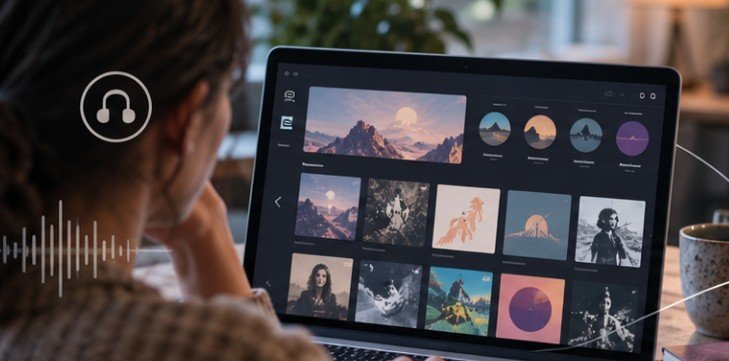
    If you are figuring out where to find new independent music, searching for individual tracks is only half the job. Search for scenes.

    Suppose you discover a post-punk group from Chicago. Instead of simply playing its most popular song, investigate:

    the label releasing the album, bands opening its shows, producers credited on the record, venues where it performs, artists appearing on the same festival bills, and musicians it follows or collaborates with.

    This approach converts one discovery into a branching map. A new independent artist rarely exists completely alone. Musicians usually belong to overlapping communities of venues, promoters, labels, producers, writers, photographers, DJs, and other artists.

    A Simple 20-Minute Independent Music Discovery Routine

    Instead of scrolling endlessly, use a repeatable system.

    Time Action Goal
    5 minutes Browse Bandcamp by genre or location Find three unfamiliar artists
    5 minutes Check a music publication Add two editorial recommendations
    5 minutes Listen to independent/public radio Find something outside your usual genre
    5 minutes Follow labels, collaborators and venues Turn one artist into a discovery trail

    Save only tracks you genuinely want to hear again. After several weeks, patterns will emerge: particular labels, cities, DJs, publications, producers, or venues may consistently lead you toward music you like. Those patterns become your personal discovery network.

    Look Beyond New Releases
    Look Beyond New Releases

    “New music” does not necessarily mean music released this month. An album from 1983 can be completely new to you, and exploring archival recordings can reveal the influences behind today’s independent scenes.

    The Library of Congress holds millions of sound recordings covering music, radio, spoken word, traditional recordings, and other material extending back to the late nineteenth century. Its National Jukebox also offers public access to thousands of historical recordings.

    For folk, traditional, regional, and culturally rooted music, Smithsonian Folkways Recordings offers another remarkable path. Smithsonian Folkways is the Smithsonian Institution’s nonprofit record label and maintains recordings intended to document musical and cultural diversity. Its catalog includes more than 4,000 titles and 65,000 tracks across its family of labels.

    Do Not Ignore Local Shows and College Radio

    Some artists become interesting online only after a scene has already embraced them locally.
    Do Not Ignore Local Shows and College Radio

    Check independent venues, record stores, university radio schedules , community festivals, small promoters, opening acts, and local music calendars. If you like a headliner, arrive early enough to hear the support bands.

    College and community radio can be especially effective because DJs may have greater freedom to explore regional musicians, experimental releases, small labels, and records outside commercial programming formats.

    The artist you discover opening a 150-capacity club tonight may be the artist appearing across everyone’s recommendation feed two years later.

    Frequently Asked Questions

    1. What is the easiest place to discover independent artists?

    Bandcamp is a strong starting point because you can browse genres, labels, locations, new releases, and related artists instead of depending only on personalized recommendations.

    2. How can I discover indie music without Spotify?

    Try Bandcamp, independent radio, college stations, music blogs, local venues, record stores, artist newsletters, independent labels, and curated resources such as KEXP or NPR Music.

    3. Where can I find underground artists before they become popular?

    Follow small labels, local venues, opening acts, Bandcamp releases, independent radio DJs, regional music publications, promoters, and artists who regularly collaborate with musicians you already enjoy.

    4. Is independent music the same as indie rock?

    No. Independent music describes how music is created, released, financed, or distributed rather than one specific genre. Independent musicians work across rock, hip-hop, jazz, folk, electronic music, metal, pop, and many other styles.

    Build a Discovery Habit, Not Another Feed

    The most interesting answer to where to find new independent music is not one website. It is a network of people and places that repeatedly expose you to something unfamiliar.

    Spend one week browsing Bandcamp. Listen to a KEXP session the next. Follow an independent label, read a critic whose taste challenges yours, check who is opening at a neighborhood venue, or explore an obscure Smithsonian recording.

    Streaming made almost everything available. The remaining skill is knowing how to wander through that abundance deliberately. The best discoveries often begin when you stop asking an algorithm for more of what you already know.
  • Independent Music PR Campaigns on a Budget: My Blueprint

    Independent Music PR Campaigns on a Budget: My Blueprint

    I blew $2,500 on my first indie record push hiring a traditional boutique agency. The result? Two obscure write-ups, zero Spotify algorithmic movement, and an inbox full of form-letter apologies from my account manager.

    That expensive mistake taught me how modern media consumption actually works. Running successful independent music PR campaigns on a budget does not require a deep-pocketed investor. It requires an organized strategy that values writer relationships, sharp visual positioning, and audience conversion over empty prestige.

    The Myth of the $3,000 Music PR Retainer

    The Myth of the $3,000 Music PR Retainer

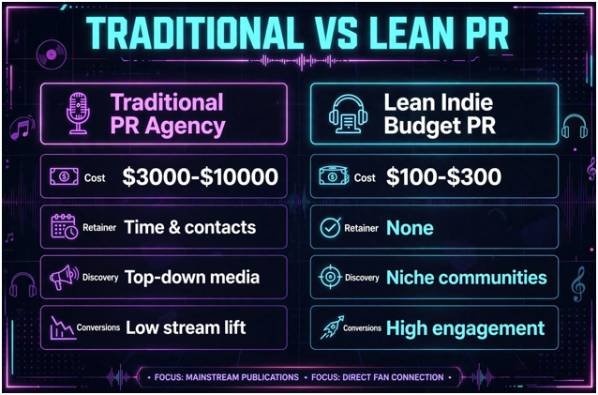
    Most publicists charge between $1,500 and $4,000 monthly, demanding a three-month non-refundable commitment. That financial model made sense when gatekeepers at print magazines and terrestrial radio controlled discovery.

    ┌─────────────────────────────────────────────────────────────┐

    │                 TRADITIONAL VS. LEAN PR                     │

    ├──────────────────────────────┬──────────────────────────────┤

    │ Traditional PR Agency        │ Lean Indie Budget PR         │

    ├──────────────────────────────┼──────────────────────────────┤

    │ Cost: $3,000 – $10,000       │ Cost: $100 – $300 total      │

    │ Retainer: Time & contacts    │ Retainer: None               │

    │ Discovery: Top-down media    │ Discovery: Niche communities │

    │ Conversions: Low stream lift │ Conversions: High engagement │

    └──────────────────────────────┴──────────────────────────────┘

    Where Major Label PR Money Actually Goes

    Retainers fund hours and access, not guaranteed headlines. A publicist cannot force an editor at Pitchfork or Rolling Stone to review an unproven record. When major labels invest five figures into campaign publicity, they are buying persistent relationship maintenance across broad multi-artist rosters.

    The Lean PR Conversion Reality

    Music coverage rarely delivers immediate direct streams on its own. Modern listeners do not jump from a dense text review straight to Apple Music to stream a full discography. Instead, press provides authoritative social proof. Securing reviews validates your art so industry bookers, playlist curators, and skeptical listeners take your music seriously.

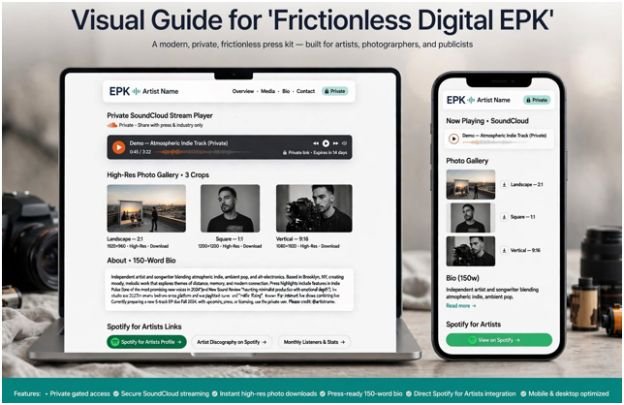
    Phase 1: Assembling a Frictionless Digital EPK

    Assembling a Frictionless Digital EPK

    Before sending cold outreach emails, you need an Electronic Press Kit (EPK) that respects an editor’s limited attention span. Never attach MP3 files, ZIP archives, or heavy PDF documents directly to an email.

    Visuals and Aesthetic Framing

    Your photos dictate whether a curator reads your pitch or clicks delete. Book a local photographer who understands current subculture aesthetics. Deliver three distinct orientation crops: wide landscape, standard square, and 9:16 vertical portraits. Keep your visual palette aligned with your sound so writers immediately identify your creative world.

    Unreleased Streams and Editorial Assets

    Host your EPK on a dedicated, unlisted web link using simple tools or Bandzoogle. Ensure it contains:

    1. A private, streamable SoundCloud or Dropbox link that plays smoothly on mobile devices.
    2. A single downloadable folder housing high-resolution images and clear credit metadata.
    3. A concise 150-word bio highlighting your artistic lineage, unique background hook, and release dates.
    4. Active, claimed links to your profiles on Spotify for Artists and social media platforms.

    Phase 2: The Direct DIY Media Pitching Engine

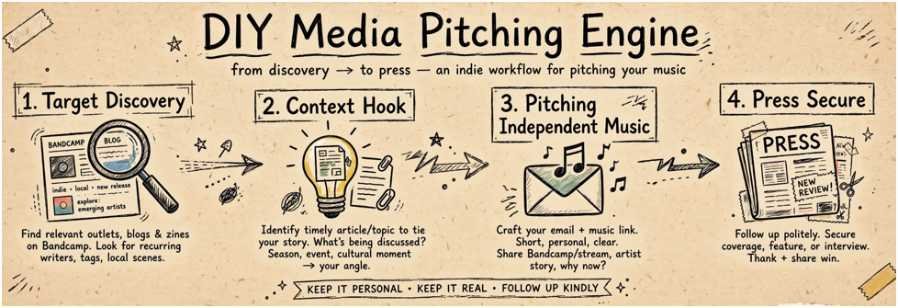
    The Direct DIY Media Pitching Engine

    Landing organic reviews requires consistent personal communication rather than mass BCC mailings. Editors want to know why you belong in their publication right now.

    Target Discovery ──► Context Hook ──► Pitching Independent Music ──► Press Secure

    Finding Hungry Mid-Tier Journalists

    Skip national consumer publications during early campaigns and target grassroots outlets instead. Scan platforms like Bandcamp Daily to find writers who consistently champion regional talent and sub-genre releases. 

    Read recent articles from independent blogs, look up who covers emerging releases, and log their direct contact information inside a simple spreadsheet.

    Writing a Cold Pitch That Secures Replies

    When pitching independent music, brevity outperforms self-indulgent essays. Follow this tested cold outreach framework:

    Subject: Private Stream: [Artist Name] – “[Track Title]” (RIYL: [Notable Reference 1], [Notable Reference 2])

    Hey [Writer Name],

    Loved your recent analysis on [Specific Article they wrote]. Your breakdown of that record’s production style caught my attention.

    I am releasing my new single “[Track Title]” on [Date]. It blends [Micro-Genre] with [Distinct Narrative Hook/Theme]. Given your focus on [Writer’s Niche], I wanted to share this early private stream: [Direct Stream Link].

    The full digital EPK with press photos and release details is available here: [EPK Link]. Happy to coordinate an early track premiere or short Q&A if it fits your editorial calendar.

    Thanks for your time and ears,

    [Your Name]

    Always send outreach at least four to six weeks prior to your official release date. Editors finalize calendars far in advance, and reaching out days before release guarantees missed coverage.

    Phase 3: Deploying Micro-PR and Curator Aggregators

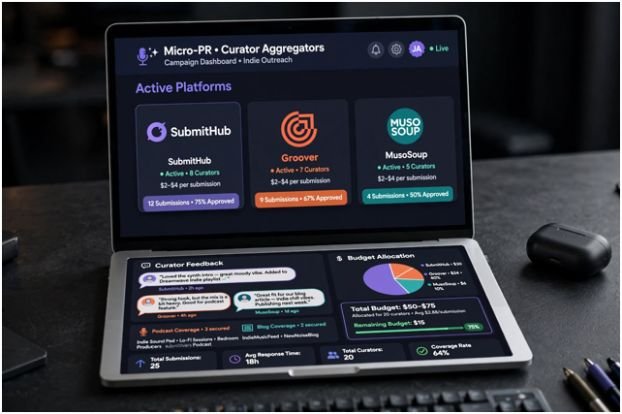
    Deploying Micro-PR and Curator Aggregators

    When you have a modest promotional budget between $100 and $300, crowd-sourced pitching networks offer reliable paths to get featured on independent music blogs and podcasts without long-term retainers.

    Groover and SubmitHub Budget Allocation

    Services like SubmitHub and Groover let you pitch individual bloggers, playlisters, and micro-tastemakers for $2 to $4 per submission. Curators must listen to your track and provide actionable feedback within a strict multi-day deadline.

    Allocate $50 to $75 across 20 carefully vetted curators in your exact sub-genre. Review each curator’s past approval rates and check whether their blog embeds yield genuine community discussion rather than bot activity.

    Crowd-Sourced Editorial Coverage via MusoSoup

    MusoSoup shifts the pitching dynamic by operating as an open marketplace. You pay an upfront campaign fee (around $40 to $60) to submit your press-ready single to their platform. 

    Curators, indie radio hosts, and zine writers browse active submissions and offer coverage options directly to you. This approach frequently unlocks podcast appearances, playlist additions, and regional blog reviews for minimal capital.

    The Amplifier Effect: Turning Small Press Into Major Fan Conversions

    The primary value of independent press is not direct traffic; it is third-party credibility. According to consumer trust frameworks explored in the Harvard Business Review, third-party editorial validation dramatically reduces consumer purchase and streaming hesitation.

    [Secured Niche Blog Review]

              │

              ▼

    [Pull Quote: “Essential dark-pop single”]

              │

              ▼

    [Overlay on 9:16 Meta/TikTok Ad]

              │

              ▼

    [35% Reduction in Cost-Per-Click]

    Extract the single most compelling quote from your blog coverage and overlay it across 9:16 vertical video assets running on Meta ads. When prospective listeners see an authentic pull-quote from a music outlet, your ad click-through rates rise while your cost-per-stream drops. A $50 micro-PR review turns into the creative fuel for a highly profitable paid discovery campaign.

    Frequently Asked Questions About Indie PR

    1. How far in advance should I start an independent music PR campaign?

    Begin pitching press outlets four to six weeks before release to accommodate editorial lead times.

    2. How much money do I need for a DIY music PR push?

    You can execute an effective campaign for $100 to $300 using curated pitching tools and direct outreach.

    3. Do music blogs still help you gain Spotify streams?

    Blogs build vital industry credibility that lowers your digital ad acquisition costs, though they rarely generate massive raw streams alone.

    4. Can I run a PR campaign after my single is already released?

    Post-release PR is much harder to pitch, as most editors only consider unreleased music for premiere features.

    Ditch the Checkbook and Own Your Rollout

    Stop treating press coverage like a lottery ticket you must buy from an expensive middleman. Treat PR as an iterative direct-response system. Build a clean EPK, pitch writers who genuinely love your genre, and use your press clippings to supercharge your social ads. Put the money you saved on a publicist directly into your studio production or digital ad spend, and control your own musical momentum.

  • What Is a Music Collective? How Creative Crews Really Work

    What Is a Music Collective? How Creative Crews Really Work

    Some of the most influential music organizations do not function like bands at all. Their members may release solo records, produce for one another, organize events, design merchandise, run radio shows, or disappear into separate projects for months before collaborating again.

    That flexibility is the simplest answer to what is a music collective: it is a community of musicians and other creative people who collaborate, share resources, audiences, skills, or opportunities while usually retaining separate artistic identities.

    A collective can look informal from the outside, but the strongest ones often operate with surprisingly clear relationships behind the scenes.

    A Music Collective Is More Network Than Band

    A traditional band is normally built around a recognizable lineup. The same musicians rehearse together, perform under one name, and contribute to a shared body of work.

    A music collective is looser. A rapper might release a solo album while another member produces it. A DJ could organize events for the group. A photographer may shape its visual identity, while several singers appear only on selected tracks. Members can collaborate intensely without appearing on every project.

    That distinction matters because collaboration has become increasingly central to independent music careers. Berklee songwriter Andrea Stolpe argues that working with other musicians can expose creators to perspectives and creative territory they may struggle to reach alone. 

    Berklee also encourages musicians to build relationships through local scenes, songwriting groups, workshops, and existing creative networks. Berklee’s advice on finding music collaborators A collective essentially turns that idea into an ongoing ecosystem.

    How Music Collectives Actually Operate

    There is no universal organizational chart. Some collectives begin with a handful of friends making music in a bedroom. Others develop into recognizable creative brands with record releases, touring operations, merchandise, radio programs, festivals, or independent labels. Most successful collectives share several characteristics.

    Members Bring Different Skills

    The group does not have to consist entirely of performers. Producers, engineers, DJs, visual artists, photographers, videographers, managers, designers, promoters, and songwriters may all participate.

    That diversity can create a powerful exchange: one member gains production help, another reaches a new audience, and someone else gains material for a portfolio.

    The Smithsonian has documented similar cross-disciplinary and cross-cultural creative collaboration. Its coverage of the Aga Khan Master Musicians, for example, describes artists from different musical traditions combining instruments, influences, and individual approaches into a shared contemporary project. 

    Resources Are Shared

    Resources Are Shared

    Collectives can reduce the isolation and expense of independent careers. Members may share rehearsal rooms, recording equipment, studio knowledge, contacts, transportation, show bills, promotional networks, or creative labor.

    The principle extends beyond informal collectives. The American Federation of Musicians notes that self-contained recording groups whose members share ownership can use joint-venture arrangements for recording projects, illustrating how collaborative musical projects may involve shared economic interests as well as creative ones. 

    Individual Identity Usually Remains

    A collective does not necessarily erase the individual artist. Members may have completely separate careers, sounds, audiences, contracts, and release schedules. The collective becomes the connective tissue rather than the sole artistic identity.

    Music Collective vs Band vs Record Label

    The easiest way to understand the structure is to compare what each organization is primarily designed to do.

    Structure Main Purpose Membership Typical Releases Creative Control
    Band Perform and record as one act Usually stable Primarily under one band name Shared within the band
    Music collective Collaborate and share creative resources Often flexible Group, solo, and collaborative projects Usually remains with individual artists
    Record label Finance, distribute, market, or administer releases Contract-based roster Releases from signed artists Depends on contracts

    The lines can blur. A collective might eventually create a record label. A band may launch side projects that resemble a collective. A collective can also become a commercial organization while continuing to describe itself as a creative community. That is why the name alone tells you very little about the legal or financial structure.

    Famous Music Collectives Show How Flexible the Model Can Be

    The Los Angeles collective brought together rappers, singers, producers, skaters, and other creatives, including Tyler, the Creator, Earl Sweatshirt and Frank Ocean. The Los Angeles Times has described how the group’s internet-driven approach helped its members develop distinct careers while emerging from the same creative network.

    Soulection demonstrates another version. Rather than functioning simply as a performing group, it has grown around music discovery, DJs, radio, records, events, and a global creative community. Its official site describes 15 years of connecting listeners through sound.

    Elephant 6 represents an earlier indie-rock model. The interconnected musicians and bands associated with the Elephant 6 Recording Company developed overlapping projects and a recognizable creative community rather than operating as one conventional band. Its organization remains active around releases connected with that musical family.

    Different genres, different decades, same underlying principle: relationships are often more important than a fixed lineup.

    The Business Side Is Where Collectives Can Get Complicated

    Business Side Is Where Collectives Can Get Complicated

    The U.S. Copyright Office explains that musical compositions and sound recordings are separate works. It also states that joint authors can become co-owners of copyright, while ownership of separate contributions can depend on how the work was created and whether rights were transferred. 

    This is also where the phrase “collective work” can cause confusion.

    Under U.S. copyright law, a “collective work” is a specific legal concept involving separate contributions assembled into a larger work. That copyright definition is not the same thing as calling Odd Future or another creative network a music collective. 

    Artists forming a collective should therefore document songwriting splits, master ownership, expenses, revenue divisions, trademarks, merchandise rights, and decisions about who can use the collective name. Friendship is useful. Written expectations are safer.

    Why Artists Form Collectives Instead of Working Alone

    The obvious attraction is access. A singer who knows a producer, designer, photographer, promoter, and videographer already has the beginning of an independent creative infrastructure.

    Collectives can also create discovery loops. Fans who arrive for one artist may encounter several others through collaborations, events, playlists, shared social channels, or compilation releases. Community can strengthen experimentation too.

    The Library of Congress’s American Folklife Center has repeatedly used collaborative programs such as its Archive Challenge to connect musicians with archival material and encourage new arrangements and interpretations. The program shows how shared resources and creative exchange can produce work that might not emerge from isolated creation.

    Where Music Collectives Can Go Wrong

    Where Music Collectives Can Go Wrong

    Not every collective becomes a creative success story. Informal organizations can struggle when nobody knows who makes decisions, pays bills, owns recordings, controls passwords, schedules releases, or receives revenue.

    Unequal effort becomes another problem. One independent artist prep for a live show may generate most of the audience while another contributes primarily behind the scenes. Without clear expectations, resentment can replace collaboration.

    Collectives also need enough flexibility to let members grow independently. If every solo opportunity is treated as disloyalty, the organization has effectively stopped behaving like the open creative network that made it valuable in the first place.

    FAQ

    1. What is a music collective in simple terms?

    A music collective is a flexible community of musicians and other creatives who collaborate, share resources, and support one another while often maintaining separate artistic careers.

    2. Does a music collective need a record label?

    No. A collective can release music independently, work with outside labels, or eventually create its own label or distribution operation.

    3. Do members of a music collective have to make music together?

    Not always. Members may collaborate selectively while working on solo projects, visual art, production, events, promotion, radio, or other creative activities.

    4. Can a music collective make money?

    Yes. Revenue can come from recordings, performances, merchandise, events, production services, licensing, subscriptions, or other activities. Ownership and payment terms should be documented clearly.

    More Than a Group Name

    The most useful way to understand a music collective is not to count its members but to examine how they work together. A band generally asks musicians to build one identity; a collective allows several identities to strengthen one another.

    That openness explains why collectives can produce such unusual creative networks. Artists gain collaborators, resources, audiences, and opportunities without necessarily surrendering their independence. But flexibility works best when creative freedom is matched by clear agreements about money and ownership. The strongest collective is not simply a circle of talented people. It is a system in which collaboration makes each member capable of doing more than they could alone.

  • The Role of Street Performers in Urban Music Culture: Why the Sidewalk Matters

    The Role of Street Performers in Urban Music Culture: Why the Sidewalk Matters

    I have walked past music spilling out of a station entrance and stopped even when I had somewhere to be. For a few minutes, the familiar route felt different. Other people paused, too, and a passing crowd became an audience. That small change captures the role of street performers in urban music culture: they bring live music into daily life, give artists a place to be heard, and help people experience a city together.

    Street performance, often called busking, is music performed in public places such as sidewalks, squares, parks, and transit stations. Some musicians play for tips; others use the space to practice, share original work, or meet listeners. Whatever brings them there, their performance becomes part of the city around them.

    They Make Live Music Part of Everyday Life

    A concert usually asks listeners to choose a time, find a venue, and pay for admission. Street music can reach someone who made none of those plans. A person buying groceries might hear a brass player; a commuter might discover a singer whose music they would never have searched for online.

    That accessibility matters. It gives people with different ages, incomes, and musical tastes a chance to encounter live performance in the same place. Listeners can stay for a song, talk to the artist, leave a tip, or keep walking. Even a brief encounter can introduce an unfamiliar style or make a routine journey memorable.

    The street is also an unusually demanding stage. Performers have to hold attention amid conversations, traffic, and people in a hurry. That immediacy can make a familiar song feel fresh: the musician responds to the setting, while the audience responds in real time.

    They Help Give a City Its Sound

    They Help Give a City Its Sound

    Buildings and landmarks help people recognize a place, but sound contributes to its identity as well. The music heard on a street may reflect traditions passed through local families, styles brought by newer residents, or artists experimenting with several influences at once. In these shared spaces, live sessions help independent artists grow as passersby discover their music and return to hear them again.

    A performer’s choice of songs can reveal what a neighborhood celebrates, remembers, or enjoys today. Just as important, the performance changes with its surroundings. A quiet passageway may suit an intimate solo act, while a busy square may invite a louder, more rhythmic set. The city shapes the music, and the music changes how the space feels.

    Street performers also keep culture visible outside formal venues. When music appears where people already gather, local creativity becomes something they can encounter firsthand rather than something they only hear described.

    They Turn Passersby Into a Community

    A street performance creates a temporary meeting place. Strangers may stop at different moments, but they listen to the same musician and react to the same song. Someone smiles at a child dancing; another person asks the performer about an instrument. These exchanges are small, yet they can make a public space feel more welcoming.

    Audiences influence what happens next. A musician might extend a song when a crowd gathers, change the pace when people begin dancing, or explain the story behind an original piece. These moments help performers connect with your audience in a way that makes each street set unique.

    For travelers and residents alike, these moments offer a way to connect with the people who make a place. Listening does not require knowing the artist or understanding every musical reference. Curiosity is enough to begin.

    They Give Emerging Musicians a Place to Grow

    They Give Emerging Musicians a Place to Grow

    For an artist without regular bookings, a public performance can be a chance to test material and learn quickly. A busker can see which songs make people stop, practice speaking to an audience, and grow comfortable performing through distractions.

    It can also lead to conversations that would be less likely in a large venue. A listener might follow the artist online, return for another set, or ask about a future show. That does not mean every street musician is trying to reach a conventional stage. For some, performing in public is a lasting artistic choice and a source of income in its own right.

    The digital world can extend these encounters. A video lets someone revisit a performance and share it with friends, while an online profile helps a listener find the musician again. Still, the recording begins with something specific: an artist, an audience, and a particular moment in a particular place.

    Their Place in the City Is Sometimes Contested

    Public space belongs to many people at once. The sound that delights one listener may disrupt a nearby worker or resident. A crowd can bring energy to a square while making it harder for others to pass. Performers may also face uncertain income, competition for suitable locations, and rules that differ between spaces.

    Those tensions deserve attention because the role of street performers in urban music culture includes more than entertainment. It raises questions about who gets to use public space and how a city balances expression, access, movement, and quiet. Fair arrangements work best when performers’ needs are considered alongside those of the people sharing the area.

    Frequently Asked Questions

    1. What is the role of street performers in urban music culture?

    Street performers make live music accessible in everyday places. They can express local identity, bring strangers together, introduce audiences to new sounds, and give musicians direct experience performing for the public.

    2. Is busking only for new musicians?

    No. Artists perform on the street for many reasons, including income, creative freedom, practice, and the direct connection with listeners. Experience alone does not determine whether someone chooses to busk.

    3. How can listeners support street musicians?

    Listeners can give performers room to work, offer a tip when they can, follow their work, and share it with proper credit. Paying attention to the music is valuable, too.

    The Sound That Stays With Me

    When I think back on a city, I remember more than its streets and buildings. I remember the unexpected song that made people slow down together. Street musicians can offer that experience without an invitation or a ticket. By giving artists room to perform and listeners a reason to pause, they make urban culture something people can hear and share as it happens.

  • How Live Sessions Help Independent Artists Grow Beyond One Performance

    How Live Sessions Help Independent Artists Grow Beyond One Performance

    I used to think a live session mattered only while people were watching. But a performance can do much more than fill an evening. It can introduce a song to someone new, show what makes an artist distinctive, and give listeners a reason to return. That is how live sessions help independent artists grow: one performance creates several chances to build a lasting relationship.

    A live session might be an online broadcast, a small in-person set, or a recorded performance shared afterward. Each format offers something different. The most effective approach is to choose a format that suits the music, invite the right audience, and make it easy for interested listeners to take the next step.

    Live Performances Make Music Easier to Discover

    A released track shows listeners the finished song. A live performance gives them another way into it. They can see how an artist delivers a lyric, responds to a bandmate, or changes a familiar arrangement. A short clip of that moment may catch the attention of someone who would never have searched for the original track.

    Discovery works better when viewers can identify the artist immediately. A clearly titled video, a visible artist name, and a simple link to the song or artist profile help people find more music after the clip ends. Without that path, even an exciting performance can become a moment viewers enjoy and then forget.

    Collaborating with an artist whose music fits the same audience can also introduce both acts to new listeners. The connection is more useful when the performers create something together, such as a shared song or conversation, than when they simply appear in each other’s posts.

    Real-Time Interaction Turns Viewers Into Familiar Faces

    Real-Time Interaction Turns Viewers Into Familiar Faces

    An online session gives fans a chance to ask about a song, request a favorite, or react as it happens. At a small venue, that exchange may occur between songs or after the set. These moments help listeners connect the music with the person making it.

    Give the Audience a Role

    Interaction does not have to interrupt the performance. As part of the evolution of live music culture, artists have found more ways to bring listeners into the moment. An artist might ask which unreleased song they want to hear, explain the story behind a lyric, or invite a question before the final track. When the response feels natural, people have a reason to stay and participate.

    The size of the audience is only part of the picture. Ten viewers who ask questions, return next month, and share a song may be more valuable to an emerging artist than a much larger group that leaves after a few seconds. Remembering familiar viewers and following up on earlier conversations can make a recurring session feel like a community.

    Live Sessions Show What an Artist Can Really Do

    Recorded music often benefits from careful editing and production. A live set reveals other strengths: vocal delivery, musicianship, chemistry, stage presence, and the ability to hold attention. For an independent artist, a strong performance video can also help a potential collaborator or event organizer understand the act quickly.

    That does not mean every session needs an expensive production. Clear sound matters more than an elaborate backdrop. Listeners need to hear the song, see the performer, and understand why this version is worth watching. Testing audio before a broadcast or choosing a quiet place to film can make a modest setup far more effective.

    A live arrangement can also reveal which songs connect. If listeners repeatedly ask about one track or react strongly to a particular section, the artist has useful feedback for future performances and releases. One enthusiastic room is a clue, though, rather than proof that a song will succeed everywhere.

    One Session Can Keep Working After It Ends

    One Session Can Keep Working After It Ends

    The full performance is only one piece of content. A memorable chorus, a brief explanation of a song, or a lively exchange with the crowd can become a short video. A complete, well-recorded performance can give new listeners a deeper introduction than a few seconds of audio.

    The strongest clips make sense on their own. Viewers should be able to tell who is performing and what they are hearing without needing to watch the entire session first. Spacing clips out over the following days also gives the performance a longer life while reminding interested listeners where to find the full song.

    Recording requires some planning. Before an in-person set, an artist should check whether filming is permitted and arrange a camera position that captures usable sound. Paying attention to basic music production and engineering can make the recording clearer and more useful. That preparation can turn one performance into material for future releases, event announcements, and booking conversations.

    Growth Depends on What Happens Next

    A listener who enjoys a session needs a clear next step. The artist could point them toward a released song, an upcoming show, or an email signup for future sessions. One relevant invitation is usually easier to act on than several competing requests.

    To see whether sessions are helping, artists can look beyond total views. Returning viewers, thoughtful comments, song saves, signups, and attendance at the next performance reveal more about continued interest. Comparing those signals across several sessions helps an artist decide which songs, formats, and times are worth repeating.

    Consistency helps, but a schedule should be realistic. A monthly acoustic set that people anticipate can be more useful than frequent broadcasts an artist cannot sustain. The goal is to give listeners a recognizable experience they want to revisit.

    Frequently Asked Questions

    1. Can a small live session help an independent artist grow?

    Yes. A small session can help an artist practice performing, learn which songs connect, gather usable footage, and build relationships with listeners. Its value depends on what the artist learns and how they follow up, not just the number of people present.

    2. Do artists need professional equipment to start?

    No. They need a setup that lets the audience hear the performance clearly. Testing sound, lighting, and the recording before the session is a practical starting point.

    3. How do live sessions help independent artists grow over time?

    They give new listeners a way to discover the music, create direct contact with fans, and produce performances people can revisit or share. Repeated sessions work best when interested viewers can easily find the next song or event.

    The Last Note Is a Beginning

    I would judge a live session by what happens after the final song. Did someone look up the artist, return for another performance, share a clip, or ask when they can hear more? Those actions show a connection beginning to take shape. When artists make room for discovery, conversation, and a clear next step, even a modest session can contribute to steady growth.

  • How to Discover New Indie Artists Before Everyone Else Does

    How to Discover New Indie Artists Before Everyone Else Does

    Music discovery has a paradox: the easier it becomes to access millions of songs, the easier it can be to keep hearing variations of what you already know. Recommendation systems learn from past behavior, while popularity can influence what gets surfaced. Research presented through the Association for Computing Machinery has examined popularity bias in music recommenders, including how niche listeners may receive different recommendation experiences. 
    That is why learning how to discover new indie artists is less about finding one perfect app and more about creating several routes into unfamiliar music. The strongest discovery system mixes algorithms with DJs, labels, local scenes, music writers, live performances, and deliberate exploration.

    Why Your Recommendations Can Start Feeling Predictable

    Personalized streaming is excellent at answering, “What might I enjoy next?” It is not always designed to answer, “What exists far outside what I already hear?”

    Music recommendation technology commonly uses listening behavior, similarities among tracks, popularity signals, metadata, and other information. Stanford’s Center for Computer Research in Music and Acoustics explains how music-information-retrieval systems can analyze characteristics such as tempo, musical structure, key, and other audio features to organize and recommend recordings. 

    That technology is useful, but discovery becomes narrower when every listening session begins from the same familiar artists.

    One study of music recommendation data found that popular artists can be disproportionately represented by some recommendation methods. The research is older and should not be treated as proof that every modern streaming service behaves identically, but it illustrates why active exploration remains valuable. 

    The solution is not abandoning algorithms. It is feeding yourself music through several independent channels.

    Start Where Artists Can Appear Before They Become Famous

    Search Bandcamp by sound, not artist name

    Bandcamp remains particularly useful for intentional digging because its discovery system supports genre, location and descriptive tags. Its current Discover tools also allow multiple tags to be combined, letting listeners narrow large categories into much smaller scenes. 

    Instead of searching “indie rock,” try combinations such as:

    dream pop + lo-fi
    post-punk + Chicago
    experimental + folk
    shoegaze + Texas

    Then explore new releases rather than only best sellers.

    This reverses the usual discovery process. You are starting with a musical characteristic and investigating whoever appears, rather than asking a platform for artists similar to somebody you already know.
    Use SoundCloud as a scene map

    Use SoundCloud as a scene map

    SoundCloud can work differently. Its search system indexes tracks, artists, playlists and DJ sets, while its discovery features use listening behavior and song similarity to make recommendations. Its Following feed also exposes uploads and reposts from accounts you deliberately choose. 

    The useful trick is following producers, DJs, small labels and artists—not simply individual songs.

    When an unknown artist reposts another unknown artist, follow that connection. Repeated connections can reveal a tiny electronic, hip-hop or alternative scene long before its members reach large editorial playlists.

    Put Human Curators Back Into the Process

    One of the simplest ways to expand your musical world is allowing another person to interrupt your taste profile.

    KEXP’s independent music programming is a strong example. Its programming states that DJs hand-select music and mix established acts with emerging performers across rock, electronic, hip-hop, jazz, roots music and other genres. KEXP also says its DJs retain freedom over what they play rather than following a single centralized playlist. 

    College music communities are another productive route. Berklee College of Music’s emerging-artist events, for example, include its Fresh Prospects series, which highlights emerging performers selected by student curators. In September 2026, the series was promoting developing indie artists from the Boston and Northeast music scenes. 

    Search your own area for university radio stations, community stations, independent record stores and small venues. A local DJ who hears 50 regional submissions may expose you to music that national recommendation systems have little data about.

    Follow the People Who Find Artists for a Living

    Music blogs still matter because good writers explain why something deserves attention.

    Follow the People Who Find Artists for a Living

    Hype Machine aggregates music being discussed by independent sites, making it useful for spotting an artist repeatedly appearing across different publications. 

    Indie Shuffle takes another approach: individual songs receive short editorial notes and “sounds like” references, allowing readers to jump between stylistically related artists without depending entirely on automated similarity. 

    Labels are equally useful discovery filters.

    If one small label releases three records you love, subscribe to its mailing list and investigate its entire roster. Sub Pop, Merge, Ninja Tune and smaller regional labels often provide stronger taste signals than browsing an enormous genre category.

    The same principle applies to producers, booking agents, supporting acts and festival lineups.

    Use a Four-Lane Discovery System

    A practical answer to how to discover new indie artists is to deliberately divide discovery across four channels.

    Discovery lane Where to look What it reveals
    Direct artist platforms Bandcamp, SoundCloud Early releases and niche scenes
    Human curation Independent and college radio Artists selected by knowledgeable listeners
    Editorial discovery Music blogs, Hype Machine Context and emerging critical attention
    Scene discovery Venues, labels, opening acts Local artists and real-world networks

    Spend roughly equal time in each lane for a month. The objective is not collecting hundreds of songs. Save only artists you genuinely want to revisit.

    That small constraint improves discovery because it separates “interesting for 30 seconds” from “I actually want another record from this artist.”

    Follow Connections Instead of Rankings

    One of the most effective techniques requires no specialized platform.

    Take one relatively unknown artist you already enjoy and investigate:

    their record label,
    the producer of the recording,
    artists they have toured with,
    opening acts from past shows,
    featured musicians,
    artists they publicly recommend.

    Then repeat the process with the most interesting discovery. This creates a human network rather than a popularity chart.

    Smithsonian Folkways offers a historical example of how productive this approach can be. Its archive documents thousands of recordings, regional traditions and musicians, including material from independent labels that preserved less-commercial musical communities. 

    It is especially valuable if your definition of “indie” extends beyond contemporary guitar bands into folk, roots, experimental and regional American music.

    Don’t Confuse Obscurity With Quality

    Dont Confuse Obscurity With Quality

    There is an easy mistake in underground music discovery: assuming an artist is more interesting simply because almost nobody knows them.

    Popularity does not determine quality, but neither does obscurity. Give each discovery three tests. Listen to one song that initially caught your attention, another track from the same release, and something older or live. If your interest survives all three, save the artist rather than merely the song.

    Live material is particularly revealing. Berklee’s student-produced performance projects have intentionally showcased emerging musicians in intimate environments, illustrating how universities and small performance spaces can function as discovery networks as well as venues. 

    Create a Weekly Discovery Habit

    You do not need hours of daily digging. Try 30 minutes once a week:

    Spend ten minutes exploring unfamiliar tags on Bandcamp or SoundCloud. Spend another ten with a DJ-curated station or program. Use the final ten to investigate one artist’s label, collaborators, supporting acts or local scene.

    Keep a playlist titled by month rather than genre. Add no more than five artists each week. At the end of the month, remove anything you no longer care about. The artists who survive become starting points for the next month’s search.

    That process gradually produces something no default playlist can perfectly recreate: your own independent discovery network.

    Frequently Asked Questions

    1. What is the easiest way to find unknown indie musicians?

    Start with Bandcamp’s niche tags, independent radio playlists and small-label rosters. These sources let you browse beyond artists already dominating major recommendation feeds.

    2. Where can I discover indie artists before they become popular?

    Bandcamp, SoundCloud, college radio, independent stations, small venues, local festival lineups and emerging-artist showcases are particularly useful for finding developing musicians.

    3. Does Spotify or another streaming service work for indie discovery?

    Yes. Algorithmic recommendations can uncover excellent music. For broader discovery, combine them with human-curated radio, independent blogs, labels and local scenes rather than relying on one recommendation system.

    4. How often should I search for new artists?

    A focused 30-minute session once a week is enough. Consistency matters more than endless browsing because following labels, collaborators and scenes compounds your discoveries over time.

    The Artists Worth Finding Usually Have a Trail

    Understanding how to discover new indie artists ultimately means changing what you follow. Instead of waiting for another personalized playlist, follow scenes, labels, DJs, producers, venues, writers and musicians themselves.

    Algorithms are useful shortcuts, but curiosity is still a better exploration tool. Begin with one unfamiliar record this week, find out who released it, see who played alongside that artist, and follow whichever connection looks interesting. The point is not being able to say you heard somebody “first.” It is building a music library that feels discovered rather than delivered.

  • The Evolution of Live Music Culture: How Audiences Changed the Show

    The Evolution of Live Music Culture: How Audiences Changed the Show

    The first thing I notice at a concert is rarely the stage. It is the crowd: strangers singing the same line, friends finding each other near the back, and someone discovering a new favorite artist before the headliner appears. Those moments make me curious about how we arrived at today’s concert experience. 

    The evolution of live music culture is a story about more than bigger venues and brighter lights. It is also about who gets to participate, how audiences behave, and what it means to share music with other people.

    Before the Modern Concert, Music Was Part of Everyday Life

    Live performance existed long before tickets, setlists, or purpose-built venues. Music accompanied ceremonies, celebrations, storytelling, work, and dancing in different cultures. Often, the line between performer and audience was less rigid than it is at a formal concert. People could respond, move, sing, or take part directly.

    That history matters because there is no single path from an ancient gathering to a modern festival. Musical traditions developed differently across communities. The ticketed concert is one way of organizing live music, rather than the starting point for every kind of performance.

    How Concert Halls Changed Audience Expectations

    How Concert Halls Changed Audience Expectations

    As dedicated performance spaces became more common, the setting changed the relationship between musicians and listeners. A raised stage made the performer easier to see while creating a physical boundary. Scheduled start times, admission fees, and programs gave events a more defined shape.

    In many formal concert settings, audiences were expected to sit quietly and applaud at particular moments. That behavior can feel natural now, but it is a learned convention. Compare it with a dance floor, a street performance, or a community celebration, where movement and audible participation may be central to the music.

    The Venue Helped Define the Experience

    A hall invites focused listening. A small club lets the crowd respond immediately. An outdoor field gives people space to wander, meet others, and discover several acts. Venue size affects more than capacity: it influences sound, sightlines, social interaction, and the freedom an audience feels to participate.

    Local Scenes Made Live Music a Community

    Clubs and other small venues gave performers room to experiment and audiences a place to return. Regular shows helped people recognize one another, follow emerging acts, and develop tastes together. Those shared experiences help explain why fans feel emotionally connected at concerts. Over time, a venue could become part of a neighborhood’s identity.

    These spaces also shaped musical styles. A performer can hear a room react and change a song, a set, or an entire approach. For fans, the appeal is often proximity: they can see the work behind a performance and feel that they witnessed something before it reached a much larger audience.

    Amplification Opened the Door to Bigger Crowds

    Microphones, electric instruments, and improved sound systems made it possible to reach audiences in increasingly large spaces. Performances could move beyond rooms built primarily for natural acoustics. As crowds grew, lighting, screens, and stage design helped people farther away follow what was happening.

    Scale brought a different kind of excitement. Thousands of people could sing together, making the audience’s response part of the event. It also created a challenge that remains today: how does an artist make a distant seat feel connected to the stage?

    Festivals Turned a Performance Into a Shared Journey

    Festivals Turned a Performance Into a Shared Journey

    A festival asks more of its audience than a single concert. People travel, spend hours or days together, choose between performances, and discover music they might never have sought out on their own. Food, art, fashion, and the setting become part of the memory.

    Festivals also show how culture and business can grow together. A gathering may express the values of a particular scene while relying on ticket sales, production crews, sponsors, and infrastructure. Looking at both sides gives a fuller picture than treating a famous festival as a single defining moment.

    Stadium Shows Made Participation Visible

    At a stadium concert, fans may be far from the performer, yet their collective actions can be impossible to miss. Singing, coordinated lights, and call-and-response moments connect separate sections of a huge venue. Elaborate visuals help tell the story from the back row, while the crowd supplies an energy no screen can create.

    Digital Fandom Changed What Happens Before the Show

    For many fans, a concert now begins months before the doors open. They meet online, discuss setlists, share clips, plan outfits, and arrange travel. Afterward, recordings and conversations keep the event alive.

    Livestreams offer another way to watch, particularly when someone cannot attend in person. They broaden access to a performance, although watching through a screen creates a different relationship with the artist and fellow listeners. Today’s live music culture includes both the event in the venue and the communities that form around it.

    Frequently Asked Questions

    1. What is the evolution of live music culture?

    The evolution of live music culture describes changes in where music is performed, how audiences participate, and how technology and social customs shape the experience. It includes shifts from communal and local performances to formal concerts, festivals, stadium shows, and digitally connected fandom.

    2. Why do small venues still matter?

    Small venues give artists opportunities to develop and let audiences experience performances up close. They also help sustain local music communities between major tours and festivals.

    3. Has technology made concerts less personal?

    Technology can help performers reach large crowds and fans connect before and after a show. Whether a concert feels personal still depends greatly on the performance, the venue, and the people sharing the moment.

    What I Take Away From Live Music’s Story

    When I look back across these changes, I keep coming to the same thought: audiences helped shape the show at every stage. They learned when to sit quietly, built local scenes, traveled to festivals, filled stadiums, and found one another online. 

    For me, the evolution of live music culture is most compelling when I remember the smaller human exchanges inside those big shifts. Venues and technology keep changing, but each generation finds its own way to make a performance feel shared.

  • The Art of Writing Memorable Choruses Without Sacrificing Lyrical Depth

    The Art of Writing Memorable Choruses Without Sacrificing Lyrical Depth

    I have always noticed that the choruses I remember most are not necessarily the ones with the simplest lyrics. Some stay with me because a short line captures a complicated feeling, while the melody gives it enough space to sink in. That made me realize that memorability and lyrical depth do not have to compete.

    I also found that the strongest choruses often become clearer after hearing the whole song. A line can sound straightforward on its own, then take on a completely different weight after the verses reveal the story behind it. For a songwriter, that is a useful reminder: a chorus does not have to explain everything to mean something. That balance lets a chorus feel immediate on first listen while rewarding attention.

    Start With One Emotional Idea

    A memorable chorus usually has a clear center. That does not mean the emotion needs to be basic. Love, regret, freedom, jealousy, grief, or hope can contain contradictions, but the chorus still needs one dominant feeling or thought that listeners can recognize.

    Instead of trying to summarize an entire story, choose the sentence underneath it. What is the character really trying to say? That answer can become the foundation of the chorus.

    Specific imagery can make that foundation stronger. A physical object, place, gesture, or detail can carry more emotional weight than a broad statement. A locked bedroom door, an empty passenger seat, or a coffee cup left untouched can suggest a larger story without spelling it out. Real experiences often contain small details that can give a chorus its own identity, especially when the songwriter builds around something concrete rather than a broad statement.

    Build a Hook That Has Something to Say

    Build a Hook That Has Something to Say

    A hook is not simply a catchy phrase. It can be a lyric, melody, rhythm, vocal pattern, or combination of elements that gives a song its recognizable fingerprint. Strong hooks often become more meaningful through repetition because listeners hear them in changing contexts.

    The trick is to make the language concise without making it generic. Remove unnecessary explanation, but protect unusual images and phrases that sound personal. A shorter line can create more depth when it leaves room for interpretation.

    Ask whether the central phrase could belong to thousands of other songs. If it could, find a more precise angle through an unexpected image, contradiction, or detail.

    Let the Verses Change the Chorus

    One of the most useful songwriting techniques is to give the chorus a meaning that can shift as the story develops. The words may stay the same while the listener’s understanding changes.

    A hopeful chorus might feel painful after a later verse reveals what happened. A declaration of confidence might become ironic when the final verse exposes doubt. This recontextualization lets a simple chorus carry narrative depth without adding words.

    Use Repetition With Purpose

    Repetition is essential to memorability, but repeating words does not automatically create a strong chorus. The repeated material needs to feel intentional.

    A useful pattern is to establish a phrase, reinforce it, then introduce a small change that creates movement. The final line might answer a question, reverse an expectation, reveal a new detail, or sharpen the emotional point. That variation gives the listener both familiarity and discovery.

    Rhythm can also make repetition more effective. A phrase with a distinctive cadence may become memorable before every word is fully understood. These choices can make a line feel musical even before production is added.

    That matters especially when the subject is complicated. Deep lyrics do not have to rely on complicated vocabulary. Sometimes a carefully chosen, easy-to-sing phrase carries more emotional force than an elaborate sentence.

    Let Melody and Arrangement Carry Some Weight

    Let Melody and Arrangement Carry Some Weight

    Lyrics do not have to perform every emotional job. Melody can communicate tension, release, vulnerability, or urgency through pitch, rhythm, phrasing, and space. A simple lyric can feel enormous when the melody rises at the right moment.

    Contrast is useful here. If the verse stays restrained, the chorus can open up through a wider melodic range, longer notes, stronger rhythm, layered vocals, or a change in instrumentation. The opposite can work too. A sudden reduction in sound can make one quiet lyric feel exposed.

    This becomes especially useful when writing lyrics for genre blending and alternative pop, where a songwriter may want accessibility without losing unusual textures or lyrical character.

    Edit Until Every Line Earns Its Place

    The final stage is often less glamorous than finding the original idea, but it can determine whether the chorus actually works. Sing every line aloud. Notice where your mouth naturally wants to slow down, where a phrase feels crowded, and which words are easy to remember after the music stops.

    Try removing a word without removing the meaning. Replace abstract language with something more concrete when possible. Test different endings.

    Most importantly, listen for the line that gives the song its identity. If everything sounds polished but nothing feels distinctive, the problem may be that the chorus has been edited until its personality disappeared. Keep one unexpected detail if it makes the song unmistakably yours.

    FAQs: The Art of Writing Memorable Choruses Without Sacrificing Lyrical Depth

    1. How can a chorus be catchy without becoming repetitive?

    Use repetition to establish recognition, then introduce small lyrical, rhythmic, or melodic changes that add meaning. The listener gets familiarity without feeling that the song has stopped developing.

    2. Should a chorus use simple language?

    Usually, clear language helps listeners sing along, but simple does not mean generic. Specific images and carefully chosen words can make an accessible chorus emotionally layered.

    3. Does the chorus need the song’s deepest lyrics?

    Not necessarily. The chorus can state the central feeling while the verses provide detailed storytelling. Depth can come from how those sections interact.

    4. Can melody make up for simple lyrics?

    Melody can add emotional information that words cannot communicate alone. Strong phrasing, pitch, rhythm, harmony, and arrangement can make a concise lyric feel much larger.

    Why Memorable Choruses Stay With Us

    The best choruses often feel effortless only after a great deal of work. Their apparent simplicity can hide careful decisions about language, rhythm, melody, repetition, and story. The goal is not to flatten a complicated feeling into a slogan. It is to find the clearest form of that feeling and give listeners enough space to bring their own experiences to it.

    A chorus becomes memorable when people can sing it. It becomes lasting when, after singing it, they still have something to think about.

  • Why Fans Feel Emotionally Connected at Concerts

    Why Fans Feel Emotionally Connected at Concerts

    I have listened to favorite songs hundreds of times, yet hearing one performed live can feel entirely different. A lyric I know by heart suddenly carries the memory of when I first needed it. People around me sing the same words, and the artist who recorded them is right there, responding to the room. 

    That combination helps explain why fans feel emotionally connected at concerts: a show brings personal meaning, live performance, and shared experience together at once.

    Familiar Songs Carry Personal Memories

    Fans rarely arrive at a concert with a blank slate. They may have played an artist’s music through a breakup, a friendship, a long commute, or a major change in life. By the time they hear those songs live, the music is connected to experiences the performer may know nothing about.

    A familiar opening note can bring those memories forward before the first lyric begins. The feeling is personal, even in a packed venue. One fan might celebrate how far they have come; another might remember someone they miss. Both can be moved by the same song for different reasons.

    That is why the emotional connection often starts long before the concert. DIY music venues support underground artists by giving fans a chance to discover and connect with their music in an intimate setting. The performance then gives fans a new moment to attach to music that already matters to them.

    Live Performance Makes a Familiar Song Feel New

    Live Performance Makes a Familiar Song Feel New

    A recording stays the same each time it plays. A live performance can change with the room. The singer may pause before a line, stretch a note, laugh at an unexpected response, or let the audience carry a chorus.

    Those small variations hold attention. Fans know the song, but they cannot predict every second of its performance. They can watch the musicians make choices and hear the crowd answer back. Research comparing live and recorded music has found stronger emotional engagement with live performance under the conditions studied, although individual reactions will vary.

    The Senses Add to the Experience

    Sound is only part of a concert. Fans also see the stage, feel the rhythm, notice the people beside them, and watch the artist react in real time. A quiet verse can command the room’s attention; a sudden chorus can get everyone moving.

    These details make a moment easier to remember as an experience, rather than just another time a favorite track played.

    Singing Together Creates a Sense of Belonging

    One of the most powerful concert moments can be hearing strangers sing a lyric that has always felt private. It shows a fan that other people have found meaning in the same music.

    Researchers use the term collective effervescence for the heightened connection people can feel during a shared event. At a concert, that might happen when the audience sings without prompting, moves together, or falls quiet at the same moment. Studies have also observed synchronization in audience movement and physiological responses during live performances.

    Fans do not have to talk to everyone around them to feel part of the group. Sharing attention and participating in the music can create a brief but meaningful sense of belonging.

    Seeing the Artist Can Deepen the Connection

    Seeing the Artist Can Deepen the Connection

    A fan may know an artist through recordings, interviews, and the stories in their songs. Seeing that person perform can make the music feel more immediate. A spoken introduction gives context to a song; an improvised moment reveals something that could only happen at that show.

    Even a small interaction can matter. When an artist listens to the audience finish a lyric or responds to a chant, fans can see that their participation shapes the performance.

    This feeling should be understood with care. Enjoying an artist’s work does not mean a fan knows them personally. The concert connection can still be real as an experience: the artist and audience are present for, and responding to, the same moment.

    Why Does the Feeling Last After the Show?

    When the concert ends, the song remains. Playing it later may bring back the crowd’s voices, the artist’s expression, or the person who stood beside a fan during the chorus. The performance becomes another memory carried by the music.

    The experience can also change how fans relate to each other. Friends may revisit a favorite moment for years, while someone who attended alone may remember feeling welcome among strangers. The strongest memories often come from specific details: a changed lyric, an unplanned encore, or a room suddenly singing as one.

    Frequently Asked Questions

    1. Why do fans feel emotionally connected at concerts?

    Fans bring their own memories to the songs, then hear them performed live alongside people who share their enthusiasm. The artist’s presence, the crowd’s participation, and the unpredictability of the show can make familiar music feel newly meaningful.

    2. Can a concert feel emotional if I attend alone?

    Yes. Going alone can give you room to focus on the performance, and you can still take part in the crowd’s shared reactions. You do not need a companion to feel connected to the music.

    3. Is it normal to feel emotional after a concert?

    Yes. A meaningful experience can stay on your mind after it ends. Hearing the songs again may bring back particular moments from the show.

    What Stays With Me

    When I think back on a memorable concert, I rarely remember every song in order. I remember the instant a familiar lyric felt personal again, the sound of everyone joining in, and the surprise of hearing something happen only once. To me, that is the heart of a concert’s emotional pull: music I already care about becomes part of a shared, unrepeatable memory.

  • What Is a Side Project in Music? Why Artists Step Outside Their Main Sound

    What Is a Side Project in Music? Why Artists Step Outside Their Main Sound

    Some of the most interesting music careers have been shaped by records artists were never expected to make. That is the idea behind what is a side project in music: a musician creates a separate musical identity, band, collaboration, or recording project while remaining connected to an established primary act or career. The new project might explore another genre, introduce different collaborators, or simply provide an artistic space where the expectations attached to the musician’s better-known work do not apply.

    Despite the name, “side project” does not necessarily mean unimportant, temporary, or commercially small. Some eventually become major parts of an artist’s career.

    What Is a Side Project in Music, Exactly?

    A musical side project is a distinct creative endeavor that operates alongside an artist’s primary musical work.

    For example, a guitarist in an established rock band might start an electronic duo. A singer-songwriter could create an experimental recording identity under another name. Several musicians from different bands might also form a separate group without leaving their original acts.

    There is no official legal category called a “side project.” It is primarily an industry and cultural description. That distinction matters. Copyright ownership, songwriting credits, recording ownership, contracts, and trademarks still have to be handled just as seriously as they would for a musician’s primary work.

    The U.S. Copyright Office explains that a recorded song can contain two separate copyrighted works: the underlying musical composition and the particular sound recording. Musicians launching another project therefore need to think beyond the new band name and determine who actually wrote, performed, produced, and owns each piece of music. Musicians can review the U.S. Copyright Office’s copyright guidance for musicians for a useful overview.

    Why Musicians Start Side Projects

    The obvious explanation is creative freedom, but several motivations usually overlap. Lets people find music outside the algorithm without looking too much.

    A Sound That Does Not Belong in the Main Band

    Established acts develop recognizable identities. Fans, labels, collaborators, and even the musicians themselves may expect new releases to remain within certain boundaries.

    A side project removes some of those boundaries.

    A punk drummer may want to produce ambient music. A country songwriter might experiment with synth-pop. An artist known as a vocalist may want to play drums or produce instead.

    Berklee’s songwriting curriculum emphasizes how collaboration can combine musicians with different backgrounds, skills, creative roles, and approaches. That cross-pollination is one reason separate projects can produce music that would be difficult to make inside an established band’s normal working structure.

    For more on the process, Berklee College of Music’s songwriting collaboration resources examine creative collaboration alongside practical issues such as coauthorship and copublishing.

    New People Create New Decisions

    New People Create New Decisions

    Changing collaborators changes more than the instruments being played. A musician who normally works within a four-member band may suddenly be writing with a producer, rapper, electronic artist, orchestral musician, or songwriter from another scene.

    Different collaborators introduce unfamiliar working methods and force artists to make decisions they may never encounter in their primary group. That can make a side project function almost like a creative laboratory.

    Less Baggage, at Least Initially

    A successful band’s new album arrives with expectations. Critics compare it with previous releases. Fans debate whether it sounds enough—or too much—like earlier material.

    A new project often starts without that history. That relative freedom can make experimentation easier, although the low-pressure phase may disappear quickly if the project develops an audience of its own.

    Side Project, Solo Career, or Supergroup?

    These terms overlap, which is why they are frequently confused.

    Type What usually defines it Relationship to main career
    Side project Separate musical identity or collaboration Runs alongside primary work
    Solo project Music released principally under one artist’s own identity May coexist with or replace band work
    Supergroup Group formed from musicians already known through other acts Often begins alongside members’ existing careers
    New primary band Artist moves major attention toward another group May gradually replace earlier work

    The difference depends more on context than on a rigid rule.

    Jack White illustrates the ambiguity. He formed the Raconteurs with Brendan Benson, Jack Lawrence, and Patrick Keeler while the White Stripes still existed. Contemporary coverage often treated the Raconteurs as a secondary venture, yet White reportedly resisted describing the band as merely a side project and worked concurrently with both groups.

    That example reveals an important point: musicians themselves may not accept the labels journalists or fans apply to their projects.

    A Side Project Can Become Bigger Than Expected

    A Side Project Can Become Bigger Than Expected

    The word “side” suggests something peripheral. Music history does not always cooperate. Gorillaz began as a separate creative outlet created by Blur’s Damon Albarn and artist Jamie Hewlett. The project allowed Albarn to work with an unusually broad rotating cast of collaborators and explore musical territory outside Blur’s framework. It eventually developed into an internationally successful act with its own long-running identity.

    That evolution demonstrates why side-project status can change. A project may start as one EP, become a touring act, release several albums, and eventually occupy as much of an artist’s attention as the supposed “main” project.

    Starting a Side Project? Handle the Boring Parts Early

    Creative freedom should not mean administrative confusion.

    Before releasing music, collaborators should establish songwriting splits, ownership of master recordings, project-name ownership, financial responsibilities, and who can authorize licensing or releases.

    The distinction between the composition and recording is particularly important. The Library of Congress explains that these can represent separate copyright interests even though listeners experience them together as one track. Its music and copyright resources provide additional background.

    Musicians should also check whether their chosen project name conflicts with an existing trademark. The U.S. Patent and Trademark Office notes that musicians may seek federal trademark protection for artist or band names and explains how ownership can work when several band members are involved.

    Its trademark guidance specifically for musicians is particularly useful before investing heavily in branding, merchandise, or touring.

    Written agreements are worth considering as well. Berklee’s music-business guidance recommends addressing ownership and revenue during collaborations rather than assuming everyone understands the arrangement.

    Common Misconceptions About Musical Side Projects

    Common Misconceptions About Musical Side Projects

    One misconception is that only have them. Recognition makes the term more visible, but an independent musician playing in a local band can maintain another recording project just as easily as an internationally known artist.

    Another is that a side project automatically signals conflict within the main group. Sometimes that happens, but creative curiosity, collaboration, scheduling opportunities, or simply having material that does not fit the primary act can explain the decision.

    Finally, “side project” does not mean disposable. The new project may ultimately become the artist’s most experimental work, longest-running collaboration, or even the career for which later audiences know them best.

    Frequently Asked Questions

    1. What is a side project in music?

    It is a separate musical endeavor created alongside an artist’s primary band or career, often involving different collaborators, genres, identities, or creative goals.

    2. Does starting a side project mean a musician is leaving their band?

    No. Side projects commonly operate alongside the main band. If the musician permanently leaves and focuses elsewhere, the new work may eventually become their primary project.

    3. Can a side project become a main project?

    Yes. Audience growth, creative momentum, touring opportunities, or changing priorities can cause a secondary project to become equally important or eventually become the musician’s principal focus.

    4. Is a supergroup the same as a side project?

    Not necessarily. A supergroup contains musicians already recognized through other acts. It may function as a side project, but the terms describe different characteristics.

    Where the “Side” Label Stops Mattering

    The most useful answer to what is a side project in music is not simply “another band.” It is a separate creative space that lets musicians temporarily rewrite the rules surrounding their established work.

    Sometimes that space produces one record and disappears. Sometimes it creates new collaborators, genres, audiences, and businesses. And occasionally, as projects such as Gorillaz demonstrate, the supposedly secondary idea develops a life larger than anyone anticipated.

    For musicians considering one themselves, the smartest approach is simple: experiment freely with the music, but define ownership, credits, names, and expectations before the project becomes valuable enough for those questions to cause trouble.